Month: January 2016

  • Like the question of what came first, the chicken or the egg, I feel this question is repeated over and over like it’s some grandiose enigma with no solution.

    About the poultry question, at some point a non-chicken animal laid a non-chicken egg containing a chicken. Done! The egg was first. Back to the meaning of life.

    Meaning

    To answer the question properly, I need to know, very precisely, what’s the meaning of meaning. The answer is sort-of contained in the question, but let’s take a look at the Oxford Dictionary:

    mean·ing /ˈmiːnɪŋ/

    1 What is meant by a word, text, concept, or action: the meaning of the Hindu word is ‘breakthrough, release’
    1.1 Implied or explicit significance: he gave me a look full of meaning
    1.2 Important or worthwhile quality; purpose: ‘this can lead to new meaning in the life of older people’

    Meaning is an action performed by a living creature that is intelligent. It’s a connection between a symbol, word, text, concept or action and something else. It’s not inherent to the symbol. The tree is inherently green, the word “rose” is not inherently connected to Rosa rubiginosa. We can talk about the meaning of the word “rose” because we created it with that meaning (even if the creation was accidental, like most languages).

    We didn’t create life, it was here long before we were assigning meaning to things, thus, it has no meaning. You can give a rose to someone else to signify your love for them and that’s the meaning of that rose, for you, and hopefully for the recipient. But the rose growing in the wild, like life on planet Earth, has no meaning.

    A meaningful life

    That doesn’t mean you can’t live a meaningful life. The same we you can assign meaning to a rose you can assign meaning to your life. And that’s the gist of the issue. You have to do the task of assigning meaning. Assigning meaning is very different than finding meaning. It’s a harder task, a task with more chances of failing, a task that doesn’t have a clear path to follow, because in essence, it’s building the path, it’s creating the path.

    Another clear distinction is that whatever meaning you assign it’s for you and you cannot expect it to be shared. The meaning is not inherent to the thing it’s connected to, it’s connected in your mind, so you can’t expect other minds to make the same connection. For example, you might create a meaningful life for yourself by feeding hungry children. It doesn’t mean everybody else will also agree on it being meaningful. We can’t even agree on the meanings of words and we have dictionaries!

    But God!

    Now someone might talk about God. What if God created us with a purpose, with a meaning. Well, there’s no such a thing as a god, but let’s assume there is. Let’s assume a super powerful external entity created us with some purpose. Maybe we are an experiment, maybe God and the Devil are trying to figure out if good or evil will succeed. Maybe God had a crush on a Goddess and we are a present, like a poem but made out of living creatures (like bacteria in the ink on a page). Is that our meaning then? Nope.

    We have minds and free will and can creating our own meaning. Even if we started off as something as low as a galactic rose, the fact that we can chose our path allows us to go wherever we want.

    Summary

    There’s no meaning except the one you create, so, stop searching, and start creating.

    Picture by Chris Sorge.

  • In Tim Ferris’ interview of Derek Sivers, in which he says that if your answer to a question is not “Hell yeah”, it should be “no”. This got the “Hell yeah” from many listeners and some custom artwork created. But I’m not sure I agree.

    Let me elaborate a bit on the concept. Derek Sivers’ argument is that if you say yes to too many things you are going to be oversubscribed and when something truly awesome comes your way, you won’t be able to say yes because you’ll be too busy, too tired or won’t even notice. He said that if it wasn’t for him constantly saying “no” to everything, he wouldn’t have started the Nownownow project.

    What’s missing from this equation is the opposite. If you are too picky, if you often have better things to do, if you are not constantly bombarded by projects and opportunities, like Sivers is now, then you might become isolated. You might miss the great opportunities because you weren’t there to see them.

    I think a better approach should be something along the line of “You should be taking N new opportunities per year” where N is of course, hard or impossible to define. It’s up to you but the frequency of saying yes and no should vary to have a constant N. If you are bombarded for opportunities, then yes, you need a strong filter, such as “Hell yeah or no” but if you are not, then you need to go out and find them and that means saying yes to things that are not “Hell yeah”.

    For example, for the past 4 years I been hyper-focus on my company, Carousel Apps, and my productivity has been high. But also, I missed the enjoyment of helping others with startup and the opportunities of collaboration, making connections, etc. That’s why in 2016 I want to have one evening a week sitting down and having a long conversation with someone about whatever it is they are doing and trying to help them in any way I can.


  • If I say to you “let’s meet in a month” you probably won’t know exactly when we are meeting again. It’s an approximation at best. Do I mean 30 days? do I mean the exact same day number but on the next month? What if that month doesn’t have that day, like February 30th? What if we are in a business setting and 30-days-later or same-number-of-the-month falls on a Saturday? As you see, months, as a measure of time, can be pretty useless. Specially when talking about small numbers, like 1 or 2.

    There’s a better unit. The week. How long is the week? 7 days. All weeks are 7 days, no exceptions. If I say “‘let’s meet in a week” you know what I mean. Add seven days to today and that’s when we are meeting. If it’s a Monday, in a week, it’s also a Monday. Also, weeks are smaller, more granular, which is useful for little projects. If I ask “When is X is going to be done?” I’d rather hear it expressed in weeks rather than months.

    We normally use months because they allow us to set up a time in the year. We can say “July” and know when it’s that. Weeks can do that too actually.

    Did you know that the weeks of the year are numbered? It is call “ISO week date” where ISO stands for International Organization for Standardization. Since a year doesn’t start on the same day of the week every year and also has variable numbers of days, years may have 52 or 53 weeks. This allows to say week 5 or week 30 and refer to a specific week of the year. There’s even a format: 2015-W5-1. That referees to Monday of week 5 of 2015.

    If you are using Google calendar, you can add the week numbers to it following this procedure:

    1. Click on “Other calendars”
    2. Click on “Browse Interesting Calendars”
      Using Week Numbers in Google Calendar - Browse Interesting Calendars
    3. Click on “More”
      Using Week Numbers in Google Calendar - More
    4. Next to “Week Numbers” click on “Subscribe”

    From now on, in your week view, you’ll see a small rectangle with the week number, in this case, week 6:

    Using Week Numbers in Google Calendar - Week 6

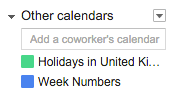
    It also appears on your list of other calendars, so you can change the color and enable or disable it:

    Using Week Numbers in Google Calendar - Other calendars

    The most organized businesses I came in contact with, made extensive use of calendar numbers and I intend on doing the same and recommend it to other people. I think the first obstacle to overcome is making the number ubiquitous so that when you use it, saying “week 6” for example, people know intuitively what you are talking about.

    Let’s do it.

    Picture by Yandle.