• This page, my blog, pupeno.com, is now hosted on WordPress.com instead of my own server; and that’s is a little personal success. Let me explain.

    I tend to be a control freak. I have my own servers. I run my own nameservers. I used to run my own mailserver but some time ago I switched to Google Apps for Domain. I used to run my blog in my own server, keeping my own set of plug ins, even modifying themes when necessary.

    Last weekend I published Why I love Smalltalk and it got picked by Hacker News. That traffic killed my server. I spent the whole weekend restarting and tuning Apache. You see, I can run my own server, use Puppet, keep it clean and up to date but I’m not a sysadmin. I can pretend I am for short periods of time but I’m really just a coder. I was forced to have a crush course into server tuning and I eventually got it more or less stable. By the second wave of traffic it was not trashing anymore. I have better things to do with my time that tune a web server so I decided to move and I did it.

    It is a personal success because I’m giving you up control. I can’t install whatever plug in I want now. I can’t modify themes. I’m not using my own nameservers anymore. I’m giving up control and simplifying my life when I have a natural tendency to make it more complex than it is.

    At the moment, my beloved pupeno.com is not ny any of my servers. Nothing. Every service related to pupeno.com is running on third party hosted solutions. I’m letting go, sleeping better and being happier.

    Only a couple of hours after I migrated my blog and went it sleep it was picked by Reddit. More than double the traffic of Hacker News (that is, Hacker News minus my server downtime) and I didn’t woke to a burning and smoking server, just an impressive traffic chart and even more comments. I’m happy.

  • These are instructions to get started with Clojure using IntelliJ IDEA, La Clojure and Leiningen for people that don’t know any of those tools. They are for Mac OS X but they may be adaptable to other operating systems as well.

    It doesn’t expect you to know Clojure or IntelliJ IDEA. I think this might be a good way for beginners to get started (instead of Emacs for example). I been using RubyMine for quite a while and I’m happy with it. The only requirement in installing Homebrew on your mac, which you should anyway if you want to code.

    Install Clojure and Leiningen using Homebrew:

    [sourcecode lang=”bash”]
    brew install clojure
    brew install leiningen
    [/sourcecode]

    Download IntelliJ IDEA and install it:

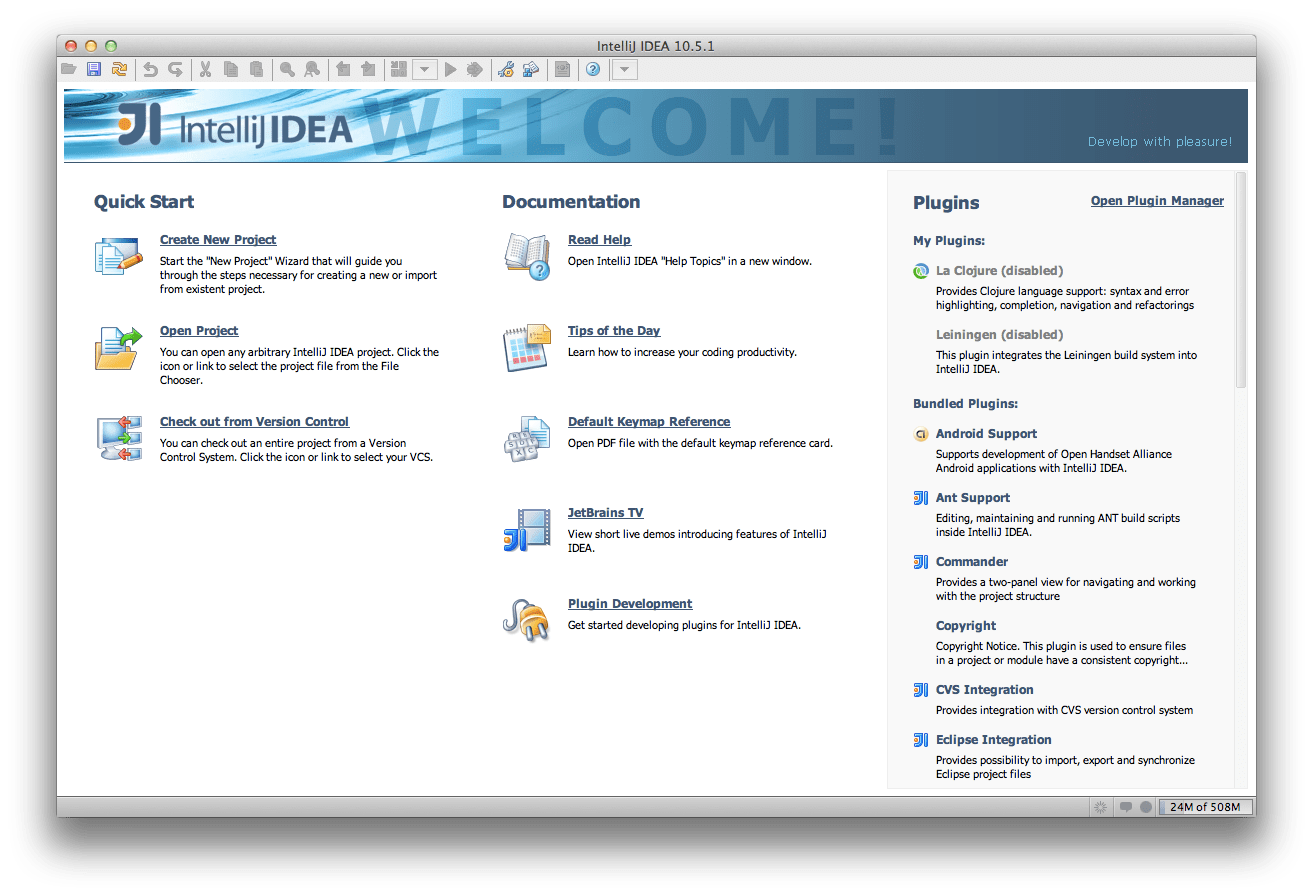
    Run it:

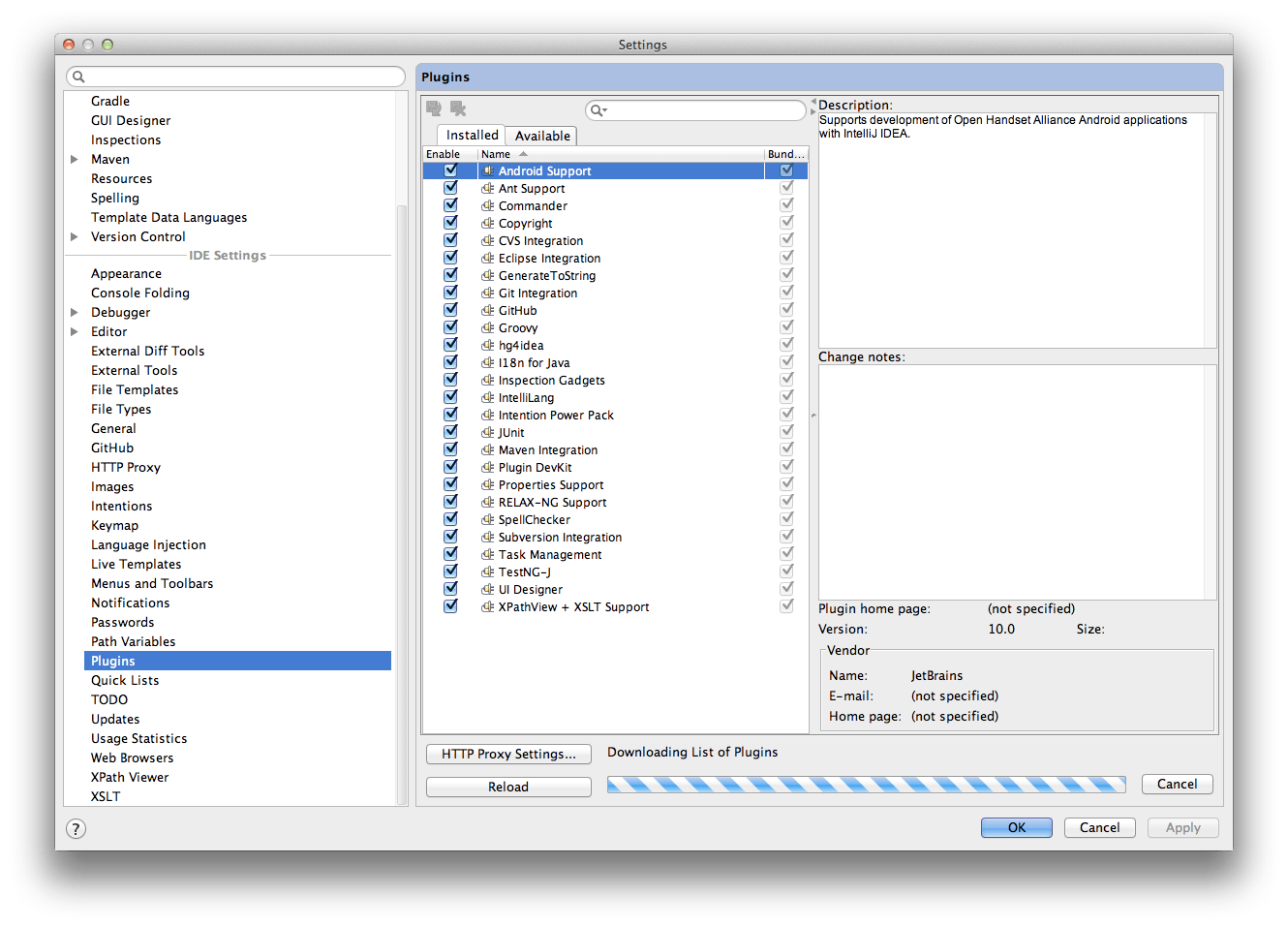
    Open the preferences (⌘,) and go to the plugins section:

    Download and install La Clojure plugin:

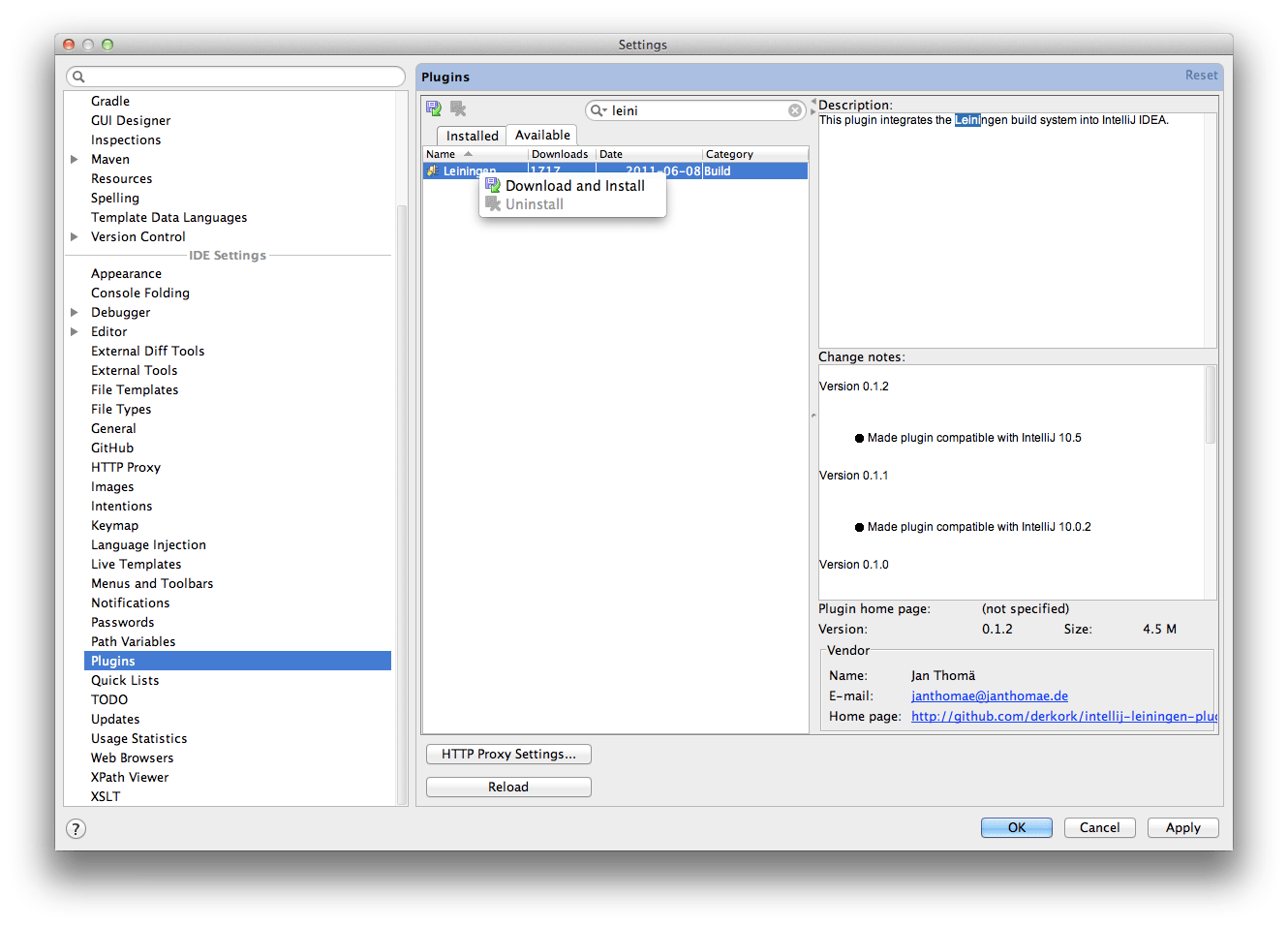
    Download and install the Leiningen plugin.


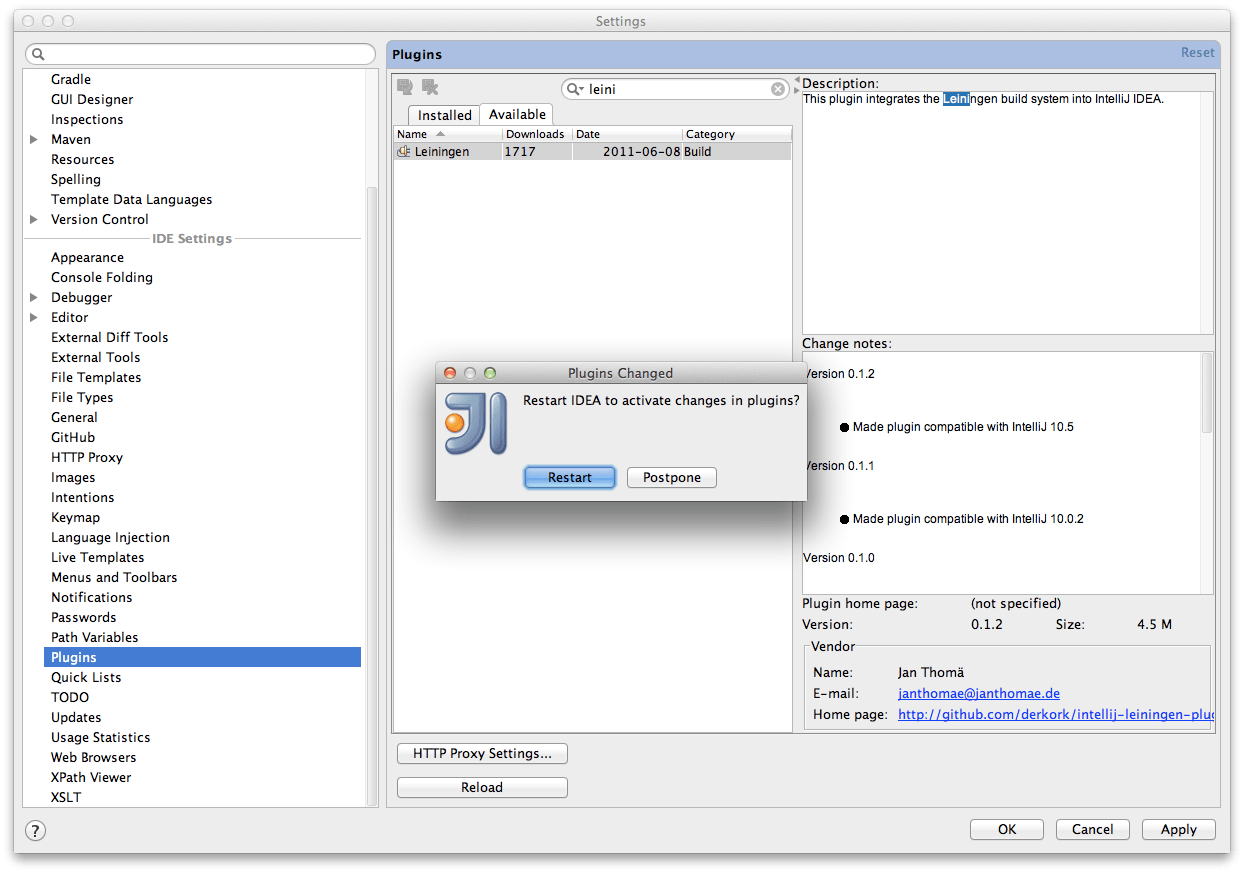
    Restart IntelliJ IDEA:


    Create a Leiningen project:

    lein new foobar
     Created new project in: /Users/pupeno/Temporary/foobar

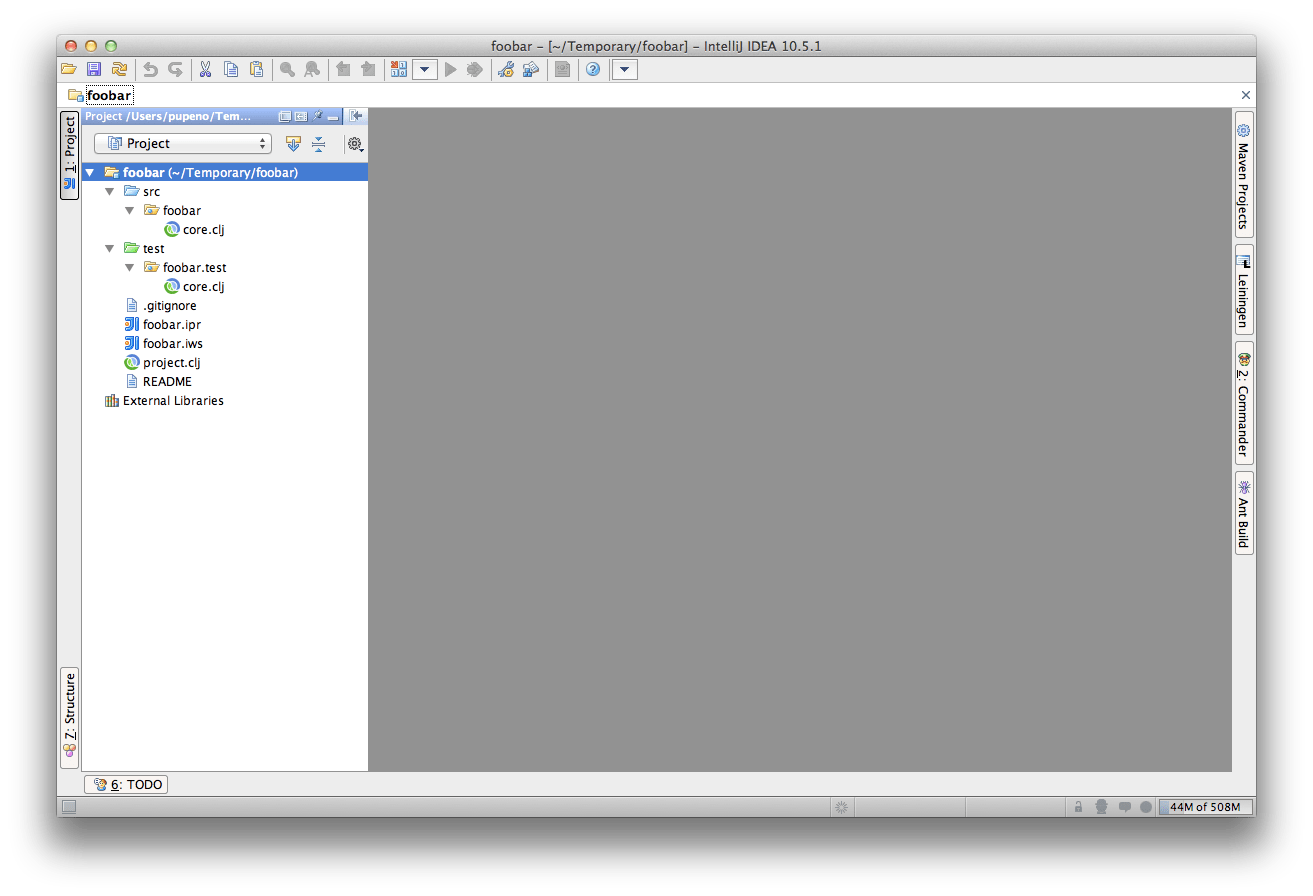
    Open the project in IntelliJ IDEA:


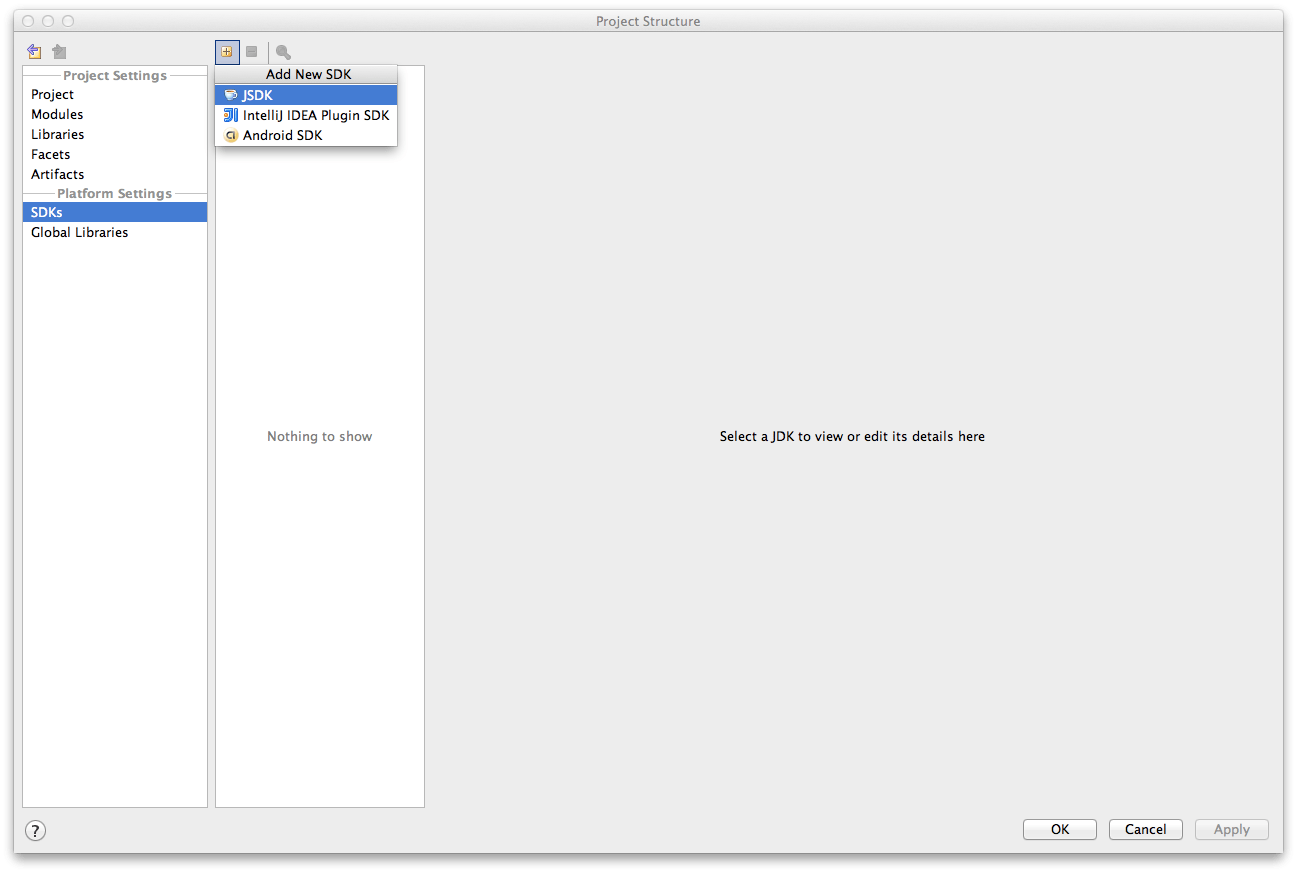
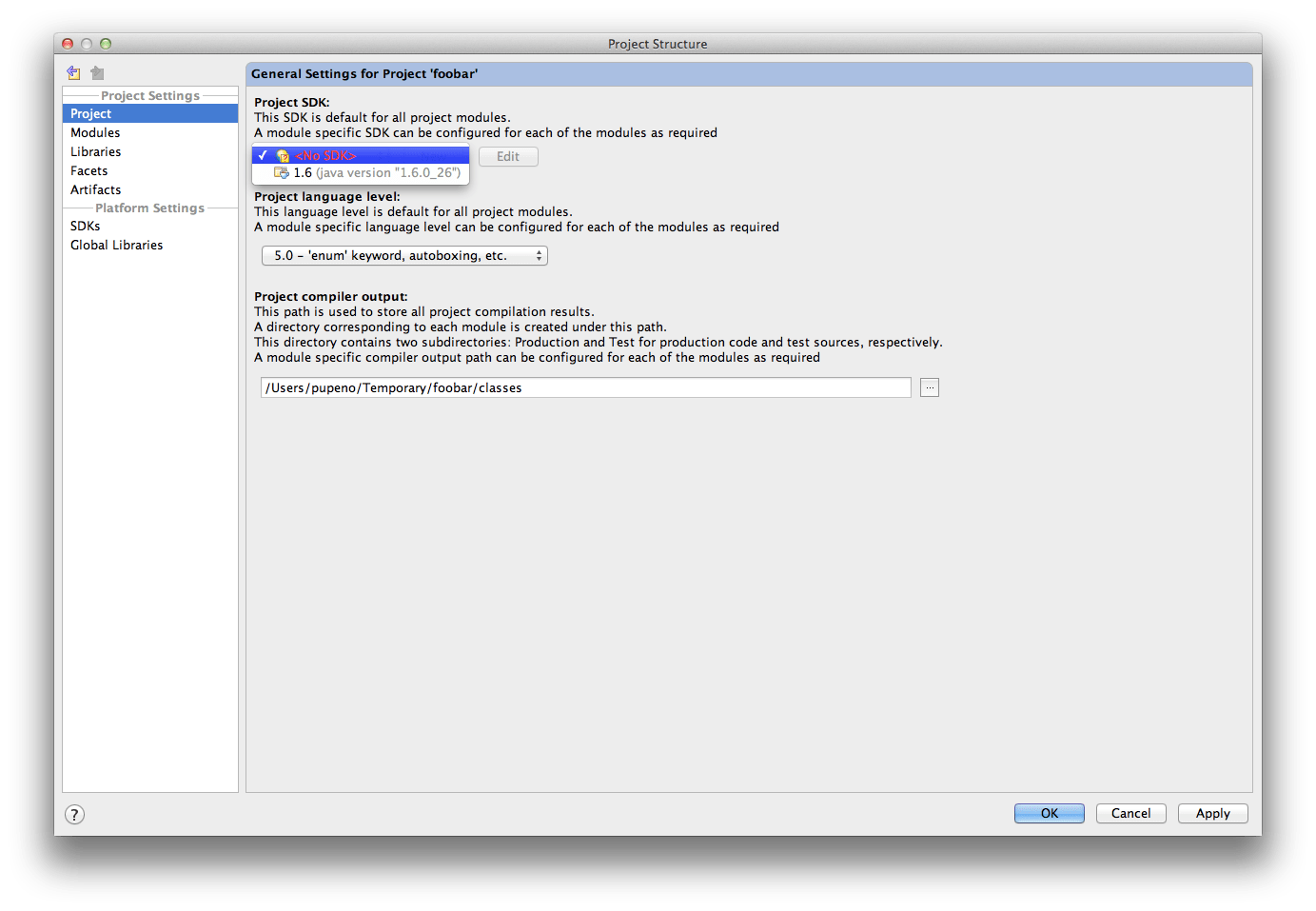
    Now open Project Structure (⌘;) and go to SDK. If you tried to run the Clojure REPL and got the error “No jdk for module ‘foobar’”, this is what you need to do to fix it:

    Click on the plus sign and add a JSDK:

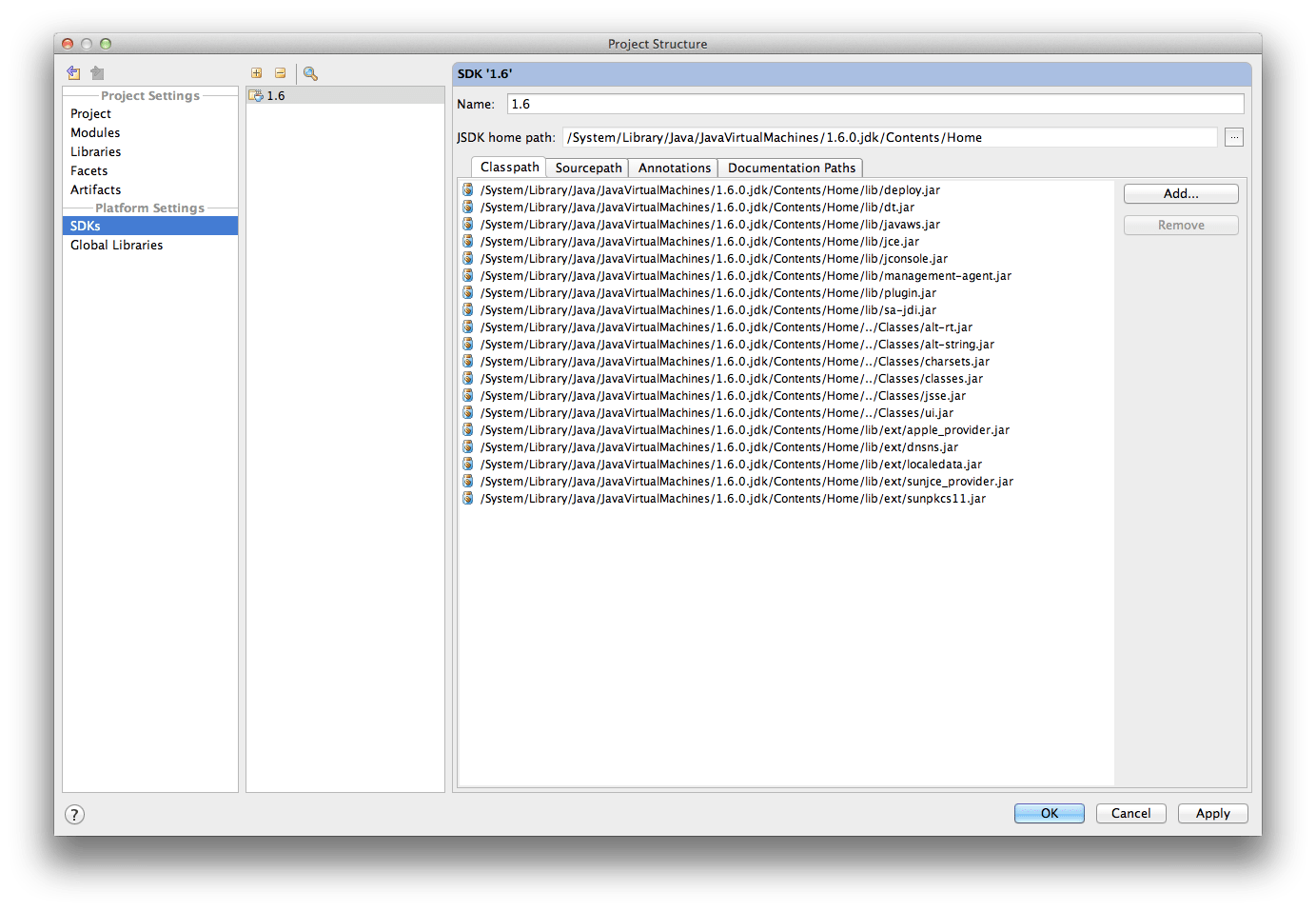
    The default is just fine:

    And you should see something like:

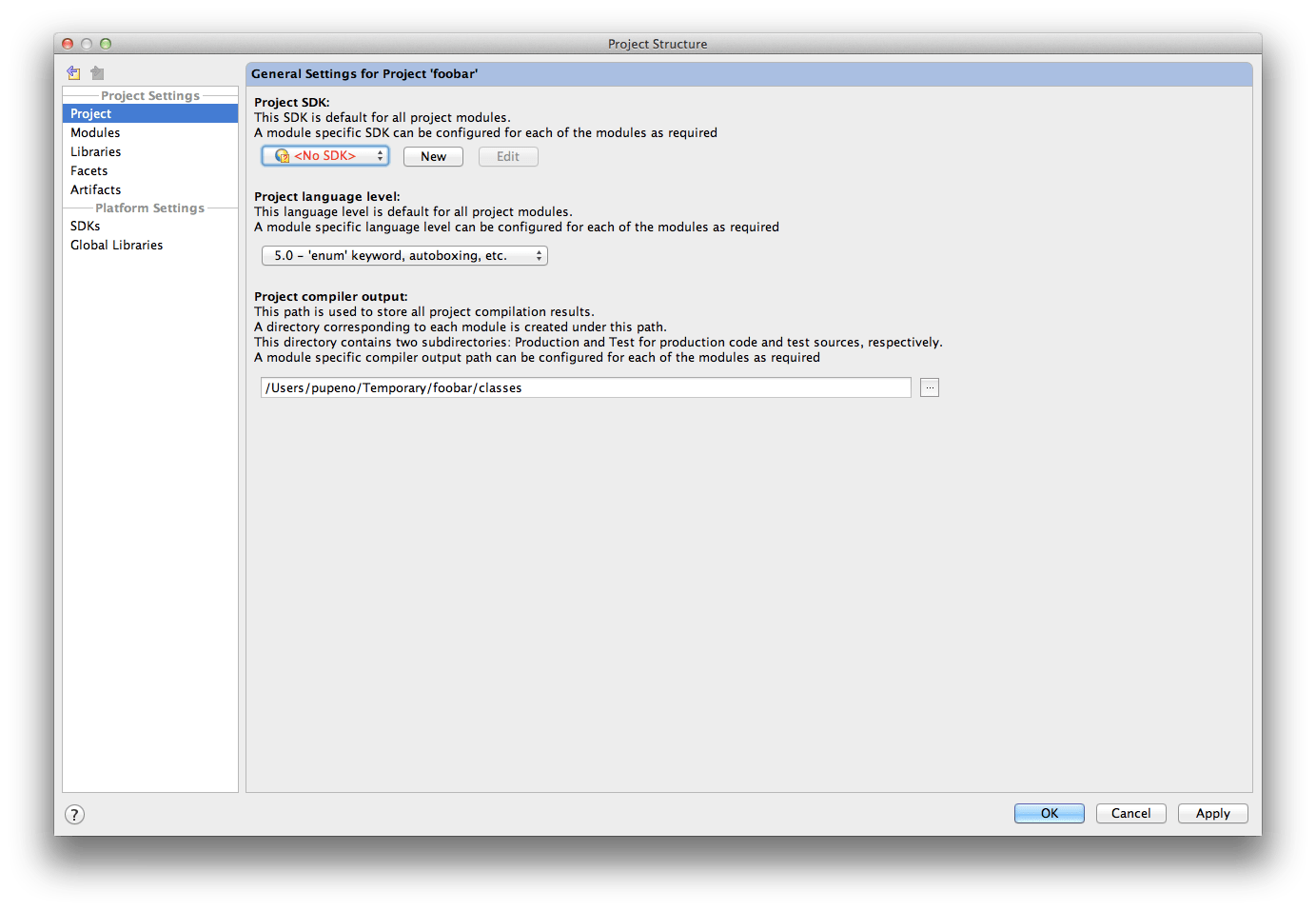
    Go to the project

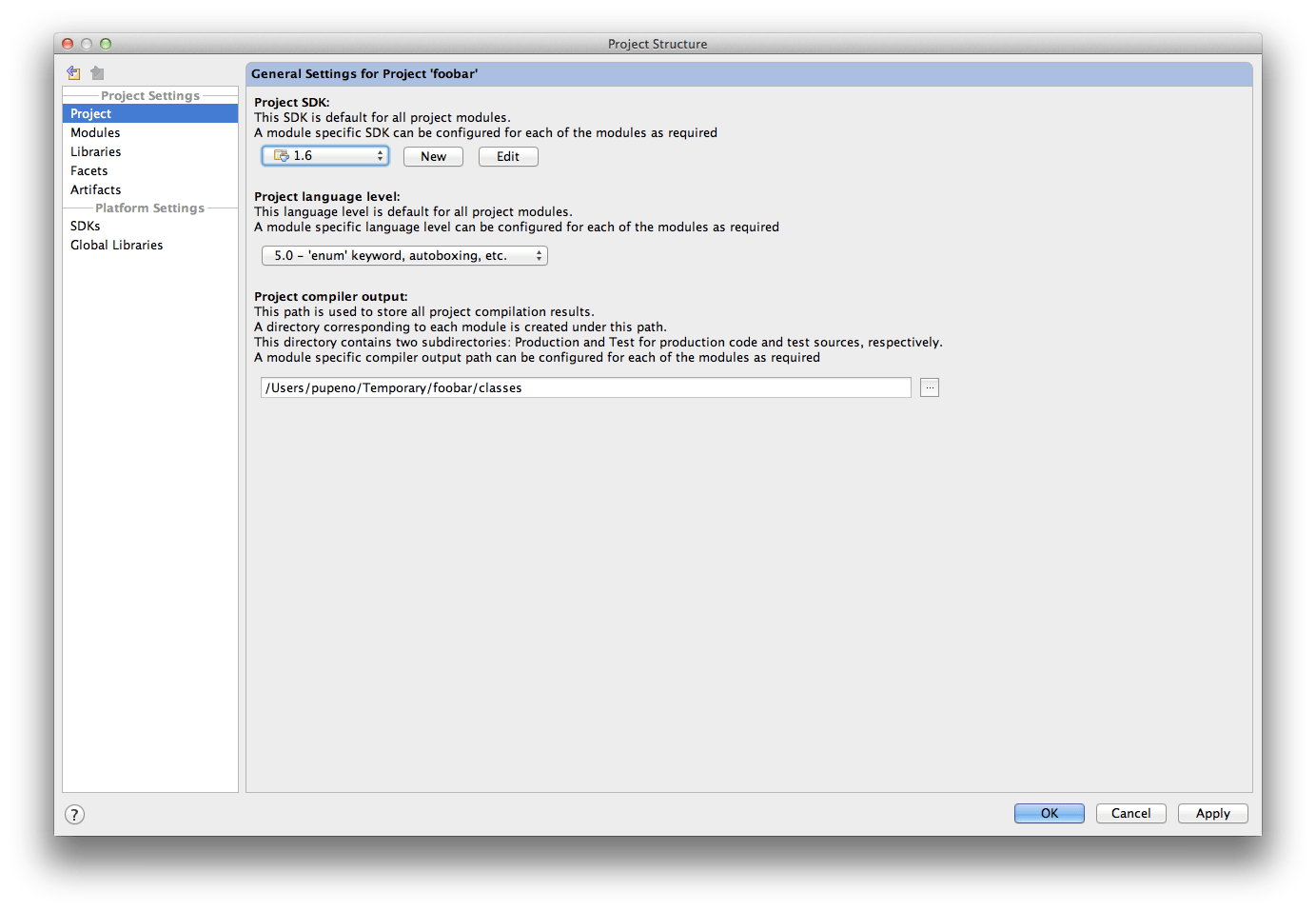
    and select the newly created 1.6 SDK:

    Go to modules

    open dependencies:

    and add a single entry:

    Use the installed Clojure from /usr/local/Cellar/clojure/1.2.1/clojure.jar:

    I’m not totally sure about that step. It might be that the IntelliJ project you are creating works only on a machine where Clojure is located on the same path.

    As they say… works for me! Restart IntelliJ… not sure if you’ll need to, but I needed it.

    Open the project if it wasn’t open and start the Clojure REPL (⇧⌘F10), it’s in the Tools menu:

    It works:

    Open a file:

    Type a little program, like:

    [sourcecode lang=”clojure”]
    (defn hello-world []
    (println "Hello world"))
    [/sourcecode]

    Load the file on the REPL (⇧⌘L), which is in Tools → Clojure REPL:

    Enjoy magnificent code completion:

    and run the code:

    And that’s it. Whether IntelliJ IDEA and La Clojure is a viable developing environment only time will tell.

  • Smalltalk logo

    This post was extracted from a small talk I gave at Simplificator, where I work, titled “Why I love Smalltalk and Lisp”. There should be another post, “Why I love Lisp” following this one.

    After I learned my basic coding skill in more or less traditional languages, like C, C++, Python, there were four languages that really taught me something new. Those languages changed my way of thinking and even if I never use them, they were worth learning. They are:

    • Smalltalk
    • Lisp
    • Erlang
    • Haskell

    You can probably add Prolog to that list, but I never learned Prolog. This post is about Smalltalk.

    My goal is not to teach Smalltalk but to show things that you can do with Smalltalk that you can’t do with any other language (disclaimer: surely other languages can do it, and we’ll call them Smalltalk dialects). Nevertheless I need to show you some basics of the language to be able to show you the good stuff, so here we go, a first program:

    1 + 1

    That of course, evaluates to 2. If we want to store it in a variable:

    m := 1 + 1

    Statements are finished by a period, like this:

    m := 1.
    m := m + 1

    In Squeak, a Smalltalk implementation, there’s an object called Transcript and you can send messages to it to be displayed on the screen. It’s more or less like a log window. It works like this:

    Transcript show: 'Hello world'

    and it looks like this:

    Squeak transcript showing the result of Transcript show: 'Hello World'

    The syntax is quite unique to Smalltalk. The message, otherwise known as “method call” in other languages, is called show: (including the colon) and it takes an argument. We can run it 10 times in a row with the following snippet:

    10 timesRepeat: [
      Transcript show: 'Hello world'
    ]

    There you can start to see how Smalltalk is special. I’m sending the message timesRepeat: to the object 10, an Integer. Doing something N times repeatedly is handled by the Integer class, which if you think about it, makes sense.

    The second interesting part, is the block. The part inside squared brackets. You might thing that’s the equivalent of other language’s block syntax, like in this Java example:

    for(int i=1; i<11; i++) {
      System.out.println("Hello world");
    }

    but Smalltalk version’s is a bit more powerful. It’s a real closure. Look at this:

    t := [
      Transcript show: 'Hello world'
    ]

    Now I have a variable named t, of type BlockClosure, and I can do anything I want with that variable. If I send it the class message it’ll return its class:

    t class

    and if I sed it the value message, it’ll execute and leave a “Hello World” in the transcript:

    t value

    Let’s see some more code. A message without any arguments:

    10 printString

    a message with one argument:

    10 printStringBase: 2

    and a message with two arguments:

    10 printStringBase: 2 nDigits: 10

    Isn’t it cute? That method is called printStringBase:nDigits:. I never seen that syntax anywhere else; well, except in Objective-C, which copied it from Smalltalk.

    Enough toying around, let’s start building serious stuff. Let’s create a class:

    Object subclass: #MyClass
           instanceVariableNames: ''
           classVariableNames: ''
           poolDictionaries: ''
           category: 'Pupeno'

    Notice that a class is created by sending a message to another class telling it to subclass itself with the name and a few other arguments. It’s a message, a method call like any other. Object is a class, classes are objects. The object model of Smalltalk is a beauty but that’s a subject for another post.

    Now that we have a class, let’s create a method called greet: in that class.

    greet: name
      "Greets the user named name"
    
      | message |
    
      message := 'Hello ', name.
      Transcript show: message.

    In that method definition first we have a comment for the method, then the list of local variables within pipes (“|”), and then the implementation, which sets the variable message to contain “Hello ” and the comma concatenates name to it. Then we just send it to the transcript.

    It looks like this:

    MyClass greet method

    Ok, let’s use it:

    m := MyClass new.
    m greet: 'Pupeno'

    To create an object of class MyClass, we send the new message to that class. There’s no new keyword like in Java. new is just a method. You can read its code, override it, etc. Don’t mess with it unless you really know what you are doing.

    Actually, if you think about it, we haven’t seen a single keyword. Look all the code we wrote without having to memorize any keywords! What’s even more important is that by now you essentially know Smalltalk. That’s all there is, but like LEGO bricks, this simple and small building blocks allow you to build whatever you want.

    Yes, that’s it, that’s all there is to it. We already saw that Smalltalk doesn’t need loops, it has integers and that class implements the timesRepeat: message which allows you to do something N times. There are many other looping methods here and there.

    What about the if keyword you ask? Surely Smalltalk has an if? Well, no, it doesn’t. What you can recognize as an if is actually implemented in Smalltalk using the same mechanism of classes and message passing you saw already. Just for fun let’s re-implement it.

    We starte by creating the class PBoolean and then two classes inheriting from it, PTrue and PFalse.

    Object subclass: #PBoolean
           instanceVariableNames: ''
           classVariableNames: ''
           poolDictionaries: ''
           category: 'Pupeno'
    
    PBoolean subclass: #PTrue
           instanceVariableNames: ''
           classVariableNames: ''
           poolDictionaries: ''
           category: 'Pupeno'
    
    PBoolean subclass: #PFalse
           instanceVariableNames: ''
           classVariableNames: ''
           poolDictionaries: ''
           category: 'Pupeno'

    For the class we created before, MyClass, we define a equals: method that will return either true or false, or rather, PTrue or PFalse.

    equals: other
      ^ PTrue new

    The little hat, ^, means return. For now, just a hardcoded true. Now we can do this in the workspace:

    m1 := MyClass new.
    m2 := MyClass new.
    m1 equals: m2

    and get true, that is PTrue, as a result. We are getting close but no if yet. How should if look like? It’ll look like something like this:

    m1 := MyClass new.
    m2 := MyClass new.
    (m1 equals: m2) ifTrue: [
      Transcript show: 'They are equal'; cr
    ] else: [
      Transcript show: 'They are false'; cr
    ]

    and you can start to imagine how to implement it. In PTrue we add the method:

    ifTrue: do else: notdo
      ^ do value

    That method basically takes two parameters, evaluates the first one and ignores the second one. For PFalse we create the oposite:

    ifTrue: notdo else: do
      ^ do value

    and that’s it. A working if! If you ask me, I think this is truly amazing. And if you check Squeak itself, you’ll find the if is actually implemented this way:

    True's ifTrue:ifFalse:

    If your programming language allows you to create something as basic as the if conditional, then it allows you to create anything you want.

  • A recent update to RubyGems is causing a lot of deprecation warnings like these:

    [sourcecode]
    NOTE: Gem::Specification#default_executable= is deprecated with no replacement. It will be removed on or after 2011-10-01.
    Gem::Specification#default_executable= called from /usr/lib/ruby/gems/1.8/specifications/rubygems-update-1.4.1.gemspec:11.
    NOTE: Gem::Specification#default_executable= is deprecated with no replacement. It will be removed on or after 2011-10-01.
    Gem::Specification#default_executable= called from /usr/lib/ruby/gems/1.8/specifications/bundler-1.0.7.gemspec:10.
    NOTE: Gem::Specification#default_executable= is deprecated with no replacement. It will be removed on or after 2011-10-01.
    Gem::Specification#default_executable= called from /usr/lib/ruby/gems/1.8/specifications/file-tail-1.0.5.gemspec:10.
    [/sourcecode]

    I generally like software to move forward and the way to do that is deprecate and then after a while, make backwards incompatible changes. It’s painful but there’s no other way.

    I do have a problem with all the cron jobs of my web apps like Keep on Posting or DNSk9 flooding my inbox with those warnings. Thankfully, that’s not hard to fix. Where I was doing:

    [sourcecode lang=”bash”]
    rake pre_calculate_thingies > /dev/null
    [/sourcecode]

    now I’ll be doing:

    [sourcecode lang=”bash”]
    rake pre_calculate_thingies 2>&1 >/dev/null | grep -v default_executable
    [/sourcecode]

  • I was running out of storage space on my machine, so I started to search for things to remove using Grand Perspective. Some of the big files were inside Git repositories, or rather, inside the .git directory of those repositories. I decided it was time to run the Git garbage collector on them, all of them.

    I wrote this little script:

    #!/usr/bin/env bash
    
    echo "Gitgcing $1"
    cd "$1"
    

    and with this line:

    find . -name ".git" -type d -exec gitgc "{}" ";"
    

    run in my home directory, I got all my repos gc’ed.

  • When you are building systems like my Keep on Posting or my DNSk9 that send emails there’s always the danger that you’ll accidentally fire emails from your development machine to real users. You really don’t want to do that because it’s annoying and extremely unprofessional.

    It happened to me a couple of times. Thankfully, nothing serious. But I learned the lesson. That’s why in my user models now I have a safe_email method which I use instead of accessing email whenever I’m about to actually deliver a message.

    The method safe_email ensures that nobody will receive a message unless I’m in production and at the same time it’s good for testing. Obviously most of the time in development and testing mode I don’t deliver emails at all, but sometimes, I make an exception:

    def safe_email
      if Rails.env.production? || email.blank? # If the email is blank (or nil), let it be.
        email
      else
        "pupeno+#{email.gsub("@", "_AT_")}@pupeno.com"
      end
    end
    
  • I’m not sure if anybody uses the terminology “data driven test” but if you explain what it is, experienced people will tel you that they are bad. Data driven tests are tests with the same code repeating over many different pieces of data.

    Let’s show an example. For my startup project Keep on Posting, I have a method that turns a blog url into a feed url. That method is critical for my application and there are many things that can go wrong, so I test it by querying a sample of real blogs. The test would be something like this (this is in Ruby):

    [sourcecode lang=”ruby”]
    class BlogToolsTest
    BLOGS_AND_FEES =>
    "http://blog.sandrafernandez.eu&quot; => "http://blog.sandrafernandez.eu/feed/&quot;,
    "http://www.lejanooriente.com&quot; => "http://www.lejanooriente.com/feed/&quot;,
    "http://pupeno.com&quot; => "http://pupeno.com/feed/&quot;,
    "http://www.avc.com/a_vc&quot; => "http://feeds.feedburner.com/avc&quot;,
    }

    def test_blog_to_feed_url
    BLOGS_AND_FEEDS.each_pair do |blog_url, feed_url|
    assert_true feed_url == BlogTools.blog_to_feed(blog_url)
    end
    end
    end
    [/sourcecode]

    Note: I’m using assert_true instead of assert_equal to make a point; these kind of tests tend to user assert_true.

    The problem with that is that eventually it’ll fail and it’ll say something like:

    [sourcecode]
    false is not true
    [/sourcecode]

    Oh! so useful. Let’s see at least where the error is happening… and obviously it’ll point to this line:

    [sourcecode lang=”ruby”]
    assert_true feed_url == BlogTools.blog_to_feed(blog_url)
    [/sourcecode]

    which is almost as useless as the failure message. That’s the problem with data drive tests. You might be tempted to do this an re-run the tests:

    [sourcecode lang=”ruby”]
    def test_blog_to_feed_url
    BLOGS_AND_FEEDS.each_pair do |blog_url, feed_url|
    puts blog_url
    puts feed_url
    assert_true feed_url == BlogTools.blog_to_feed(blog_url)
    end
    end
    [/sourcecode]

    but if your tests take hours to run, like the ones I often found while working at Google, then you are wasting time. Writing good error messages ahead of time help:

    [sourcecode lang=”ruby”]
    def test_blog_to_feed_url
    BLOGS_AND_FEEDS.each_pair do |blog_url, feed_url|
    assert_true feed_url == BlogTools.blog_to_feed(blog_url), "#{blog_url} should have returned the feed #{feed_url}"
    end
    end
    [/sourcecode]

    and if half your cases fail and the whole suit takes an hour to run and you have 1000 data sets you’ll spend hours staring at your monitor fixing one test every now and then, because as soon as one case fails, the execution of the tests is halted. If you are coding in a language like Java, that’s as far as you can take it.

    With Ruby you can push the boundaries and write it this way (thanks to executable class bodies):

    [sourcecode lang=”ruby”]
    class BlogToolsTest
    BLOGS_AND_FEES =>
    "http://blog.sandrafernandez.eu&quot; => "http://blog.sandrafernandez.eu/feed/&quot;,
    "http://www.lejanooriente.com&quot; => "http://www.lejanooriente.com/feed/&quot;,
    "http://pupeno.com&quot; => "http://pupeno.com/feed/&quot;,
    "http://www.avc.com/a_vc&quot; => "http://feeds.feedburner.com/avc&quot;,
    }

    BLOGS_AND_FEEDS.each_pair do |blog_url, feed_url|
    define_method "test_#{blog_url}_#{feed_url}" do
    assert_true feed_url == BlogTools.blog_to_feed(blog_url), "#{blog_url} should have returned the feed #{feed_url}"
    end
    end
    end
    [/sourcecode]

    That will generate one method per item of data, even if one fails, the rest will be executed as they are separate isolated tests. They will also be executed in a potential random order so you don’t have tests depending on tests and even if you don’t get a nice error message, you’ll know which piece of data is the problematic through the method name.

    Note: that actually doesn’t work because blog_url and feed_url have characters that are not valid method names, they should be replaced, but I wanted to keep the example concise.

    Since I’m using shoulda, my resulting code looks like this:

    [sourcecode lang=”ruby”]
    class BlogToolsTest
    BLOGS_AND_FEES =>
    "http://blog.sandrafernandez.eu&quot; => "http://blog.sandrafernandez.eu/feed/&quot;,
    "http://www.lejanooriente.com&quot; => "http://www.lejanooriente.com/feed/&quot;,
    "http://pupeno.com&quot; => "http://pupeno.com/feed/&quot;,
    "http://www.avc.com/a_vc&quot; => "http://feeds.feedburner.com/avc&quot;,
    }

    BLOGS_AND_FEEDS.each_pair do |blog_url, feed_url|
    should "turn blog #{blog_url} into feed #{feed_url}" do
    assert_equal feed_url, BlogTools.blog_to_feed(blog_url), "#{blog_url} did not resolve to the feed #{feed_url}"
    end
    end
    end
    [/sourcecode]

    and running them in RubyMine looks like this:

  • Picture of the Eneo team
    The Eneo team

    This past weekend I participated in the Startup Weekend Lausanne 2011, my first startup weekend ever. It was amazingly interesting. I worked on an application called Eneo. Eneo allows you to talk with people around you using your mobile phone, people that you don’t know, so the next time you are stuck at the airport waiting in a 3 hours delayed flight, you don’t have to eat alone. Find someone else in the same situation and go for lunch.

    I think the application has great potential and I was told that the jury didn’t understand it. I don’t know, they spoke in french. Supposedly the event was going to be in french and english but was all in french… I was bored when I wasn’t coding.

    I’m thankful I didn’t present an idea, I would have done a poor job of doing it. I now wrote a list of things to do when presenting an idea. I was going to publish it, but it’s gold so I’ll keep it to myself, at least, until I use the techniques. Muahahaha.

    I chose a company to work with, but the guy with the idea decided not to work on it because he didn’t get enough people. It was him, one designer and me, a programmer. I was surprised. Then I saw most groups were more than 5 people, some may have been even 8. For me that’s absolutely crazy. The startup sizes that make sense for me are 2, 3 and 4. Any less and it gets lonely (tell me about it!), any more and it gets crowded.

    When the group I was in disolved, I turned into a free developer and the four or five groups that didn’t get a developer already started to pitch to me (now they did speak in English ;), at the same time. It was crazy. I think I got a glimpse of how investors feel. At any rate, immediate ego boost for a developer. If you are a developer I recommend to attend this events, is great for you and great for the event.

    While working on our project I did make some mistakes. One was working on a mobile application. I haven’t done mobile in a while, I’m not fast at it; not weekend-fast at least. Give me a week and I’ll be rocking your phone, but in a weekend, no. I decided I wasn’t going to code, but I’m a coder and in less than two hours after joining Eneo I was writing code. I paid a step price when I tried to make the application look mobile by using jqtouch. I never used jqtouch before so there were a lot of things not working and I wasted precious hours on it. Big mistake.

    My second mistake was trying to make a product. I wanted to woo the jury by showing an active product with users already. I failed to do that. I should have gone straight to coding a demo, not a finished product. What we ended up with was half product half demo, not good at either.

    Here’s the app running in a desktop browser (imagine it’s a phone):


    Next time I’ll do better.

  • When I need to run something periodically on production, I always implement it as a rake tasks and install it as a cron job. Nevertheless there’s some setup to do in the task to have proper logging and error reporting.

    This is the template I use for creating those tasks:

    namespace :projectx do
      desc "Do something"
      task :something => :environment do
        if Rails.env.development?
          # Log to stdout.
          logger = Logger.new(STDOUT)
          logger.level = Logger::INFO # DEBUG to see queries
          ActiveRecord::Base.logger = logger
          ActionMailer::Base.logger = logger
          ActionController::Base.logger = logger
        else
          logger = ActiveRecord::Base.logger
        end
    
        begin
          logger.info "Doing something"
        rescue Exception => e
          HoptoadNotifier.notify(e)
          raise e
        end
      end
    end

    While in development mode, it outputs to the console for convenience.

  • If you are going to fail, fail funnily, like Tumblr…