Tag: Business

  • I doubt any cinemas are going to implement this, because like airlines and banks, they seem to be very bad at making software. Nothing surprising there.

    A few months ago I was searching for a room in London. There are about 4 big sites to do that, so I posted ads on all of them, and searched on all of them. Only one provided a web application that allowed me to see whether I contacted someone already or whether I marked a flat as not-suitable. It made searching so much easier that soon I was using that and only that site. The ads weren’t better per se, but the software was.

    I like going to the movies with friends but I dread having to organize it. It’s such a pain because you have to balance the available time of each people, the timetable of the cinema, the shows in which there are still good seats, the fact that the seats might be going unavailable, and handling the money (I tend to pick the cool but expensive theaters).
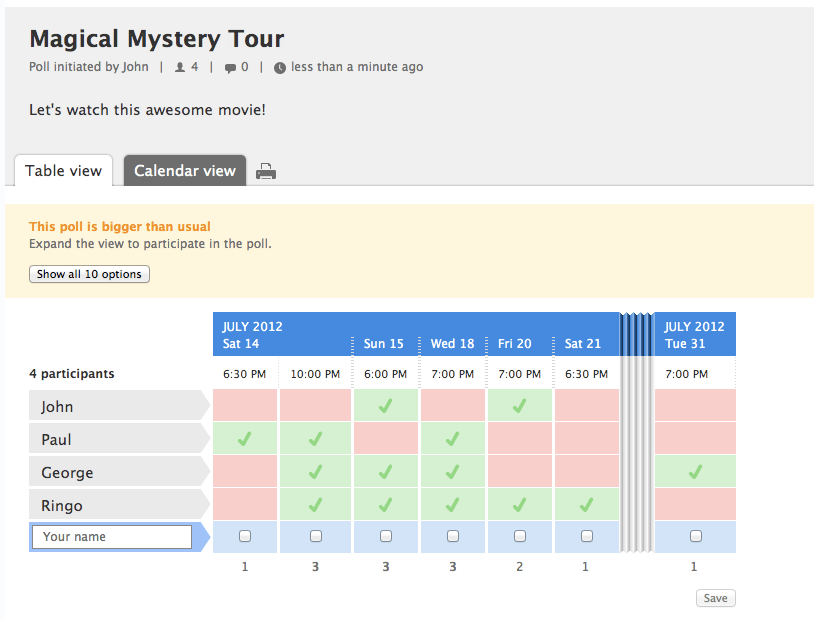
    If I was in charge of a cinema, I would make a built-in Doodle. Doodle is an awesome application that helps you organize an event. You select all the desirable dates and times, invite the people, and they respond yes or no to each slot. At the end you pick one and go for it. I thought of setting up a Doodle to organize going to see The Dark Knight, but I ended just picking a date and time that was convenient for me and inviting people. It didn’t work.

    The built-in Doodle could work like this:

    1. I go to the cinemas website.
    2. I buy my ticket.
    3. I pick all the shows I can go to.
    4. Set a deadline (maybe, optional).
    5. I send the invite to all the people that might want to join me.

    Notice that I paid for my ticket before picking the date and time. I’m not sure whether that’s a good idea, I would be okay with that but maybe not everybody. What do you think?

    Then each person that I invited goes to the web site and:

    1. Look at all the dates and times I and others picked.
    2. Buy their ticket or tickets.
    3. Pick the dates and times they can.

    Once everybody is in or I’m done waiting, I pick a day and time and I get all the seats assigned together in one action (even though the action of committing to the movie was individual and asynchronous). For those that didn’t get a ticket or those that changed their mind, they get their money back and/or the option to arrange the same movie, another day, with some of the same group and/or adding other people to it.

    For the cinema it’s a revenue booster. It makes it easier for people to commit to going to the cinema. And even people than don’t manage to go one day are compeled to go another because they already paid.

    Build it with nice Facebook and Twitter integration and that’s it, you’ll be the most popular cinema in town.
  • Some time ago I had an idea for a web application. That idea was essentially Gist. I couldn’t convince people to go after it, thankfully because I wouldn’t like to compete with a Brad Feld backed company. It’s nice to see that the idea was good, as Gist got bought by RIM. Congratulations Gist!

  • I think this partnership with Microsoft was a mistake for Nokia. It was great for Microsoft though.

    Every time you show an old Nokia phone you get the same comment: “Oh, those phones were built to last, I went through 3 iPhones and the Nokia still works…” or “That is the only phone that will not blend”.

    But Nokia’s obsolete software is killing it. They need to provide truly smartphones. They had three options:

    • build their own
    • use Android
    • use Windows

    I think they already tried to build their own and failed. That’s very hard. A giant like Microsoft tried to build their own and failed. It’s very hard to build a software platform.

    Apple did it by being the first ones and providing the coolest product ever. Google did it by doing it for free. They are both a success because they have thousands and thousands of applications on their platform by now.

    Microsoft haven’t done it. As powerful as Microsoft is, they still haven’t cracked the smartphone market, and it’s very likely they’ll never do. They are up against Apple and Google and both of them have years of advantage now (previous efforts by Microsoft are useless today).

    Now Microsoft has a chance to do it because of the deal with Nokia. Nokia is likely going to put Windows 7 Phone whatever on the hands of many people. Those people will get use to Windows, but not to Nokia and may switch to HTC or another provider in a blink of an eye. Microsoft wins, Nokia loses.

    I think Nokia should have done with Android. I know it’s hard to differentiate yourself with Android (what’s the different between a Samsung and a Sony/Ericson phone these days? They both run Angry Birds), but Nokia could have done it by making a tough phone. There’s a lot of people today not using smartphones because they won’t last in their pockets. Nokia could build a smartphone for them.

    Maybe Nokia decided against Android because of their past mistakes with Open Source projects and companies. At any rate, I think they are making a mistake right now.

  • I consider the iPad a very negative force. Apple is taking the close system of iPhone and moving it up to tablets. What’s the next move? Desktops? That’s very scary! Imagine a world where Steve Jobs is the final word on which programs people can and can’t run. If that happens, the dark ages of computers will have started, and who knows how long they’ll last.

    Now there’s a very good side effect to the iPad. People is starting to spend a lot of time on non-Windows computers. No, this is not a rant against Microsoft.

    There was a time when we had many operating systems and people use to choose. Different machines came with different operating systems. Then Microsoft dominated the market and there was one and only one operating system. For a time there was even only one browser. That hinders innovation.

    Microsoft Windows obviously failed on phones and tablets. Apple, first with the iPhone and now with the iPad, opened those markets. Now people is talking about how great WebOS (Palm’s operating system) would be on a tablet (made by HP). Nobody would have though of a non-Windows tablet if Apple haven’t done it before. Also Android tablets are coming. Microsoft is rebooting its phone efforts, without Windows this time; and maybe they’ll reboot their tablet efforts too. At any rate Microsoft won’t dominate that market and certainly not Windows.

    The only company capable of dominating phones and tablets is Apple; and they are not set to dominate it. Apple makes one and only one product, with no variations. If you want something different (a USB port, a memory card reader, a camera, porn, a cheaper product, whatever) you go to a competitor. Apple makes a lot of money by making the luxury products, not by selling it to everybody.

    I think it’s going to be a lot of fun to watch a very competitive market where four players are so will be constantly innovating trying to win users over.

  • For showing what music I like, keeping track of what music I listen to, discovering new music and finding people with the same tastes I use last.fm. For doing that but with books I use aNobii. Is there anything like that for movies? If not, there’s a market.
  • cakeSeth Godin wrote an interesting blog post titled “Two ways to build trust” in which he says that, to gain someone’s trust, you have to either be very professional, or very human. You are either like Apple: everything just works because they are super professional, or you are Joe the Baker who would make a custom cake for you.

    The problem is when you try to be like Apple and stuff doesn’t work or you try to be like Joe and your cake says “Made in China”. I’ve never thought about it consciously, but I’ve felt it, and it makes perfect sense.

    I was using an application in my Android phone called BeyondPod. It’s basically a podcast grabber. I liked the application and I wanted to buy it. I was using a limited version. They offer you two ways to buy: through the Android Market, the usual way; or if you live in a country where the paid applications are not available, like me, you could buy a license on the web site. That’s very professional.

    Also the application is quite good. So that was another hint that the maker was a very professional team.

    When I was ready to buy I went to the web site and it looked so 1998ish. Oh-oh. Not good. I’ve looked for a way to buy outside the Market and I’ve found two. Buying it on-line and paying with Paypal or using an alternate Market. The Paypal link didn’t work. Double oh-oh. That alternate market was hard to use, so I’m not totally sure if this is correct, but it seemed the application was not there. Strike three?

    By this point, I’ve already tried to buy the app through several days, failing each time and just going back to whatever I was doing before. The only thing that kept me coming back was that I was using the app, liking it and wanting the unlimited version.

    There was no contact address for support. One day, fed up, I signed up in their forum and said “I want to pay! How?” I wasn’t expecting any answer really, but about 42 seconds latter came a reply “Oh, the link was broken, try again.” That looked like the developer of the app, although he never mentioned that. That’s good. It may not be an Apple, but a Joe the Developer.

    I went to the site, clicked on the Paypal link and was redirected to another web site, a Paypal-clone. That’s it, too much. I’ve dropped a bomb on the forum: “I’ve clicked the paypal link and it sent me to another web site, looks very scammy, I’m not putting my credit card number there”. And I proceeded to search for another podcast reader.

    4.2 seconds latter came “My apologies, that’s my fallback merchant account, the Paypal one is working again”. Having a fallback account? That’s very professional. I know many companies working with Paypal, moving thousands of dollars, and not having a fallback transaction system. In a sense, this guy showed a lot of professionalism in some respect, and being a human being willing to solve the problems for the parts not very well done. I paid right away.

    I almost lost my faith in the product and company, but the owner wasn’t afraid of acting like a little company and that bought me over. I don’t expect a podcatcher for a niche platform to be developed by a corporation full of things with “Enterprise” in their names. I expect it to be developed by a guy on a basement and that doesn’t mean I won’t pay for it.

    Reviewed by Daniel Magliola. Thank you!

  • twitter-woodHere’s an idea for those Twitter clients, web and desktops out there: deferred posting.

    One tweet per hour during eight hours is much more effective than 8 tweets in a row. But sometimes you want to write eight tweets in a row and I find two reasons to do that.

    You are using Twitter professionally, for your work, as a marketing and social tool. You want to minimize the hit it takes on your productivity so you limit yourself to 15 minutes of tweeting per day. In those 15 minutes you generate tweets for the whole day, you want them to be automatically distributed through the day.

    When you open twitter after some hours of not using it, like after sleeping, you’ll find yourself replying to lot’s of stuff as you go through it. That’s specially true if you are 8 timezones away or so from most people you follow.

    I think a Twitter client should do the distribution automatically. It could distribute them evenly through the day, depending on how many you have on your queue. Whenever you want to tweet you just add it to the queue.

    Why limit itself to one day? why not leave tweets for tomorrow? And if not one day, how long? A way to solve the problem is to try to maintain your speed constant, minimize acceleration and deceleration.

    For example. If you normally tweet 5 times a day, and you have 10 tweets in your queue, do 7 today and leave 3 to tomorrow so that you don’t double the speed, you just increase it a little bit. If tomorrow you add another 10, you’ll have 13 and you are at a speed of 5.2 (previously you were at 5, but yesterday with 7 you sped up a little). So today you get 9 published and 4 left for tomorrow and so on.

    You’ll have different speeds on weekends and business hours. There’s a curve of speed and the Twitter client should try to match it with what you have on the queue.

    If you want to direct tweet, you can do that, just fine.

    Another interesting way is to match the curves of you readers instead of your own. The tweeter client would measure when your readers are posting more, and presumably, also reading more. It’ll make an average and it’ll have the curve of speed of your network. Instead of posting following your previous curve, it’ll post following your network’s curve maximizing the amount of people that is likely to read your Tweet.

    I would call that, Professional Tweeting.

    Another interesting feature would be to set importance to your tweets. More important tweets are sent when the chances of getting it read are highest, when the curve reaches its peak.

    Reviewed by Daniel Magliola. Thank you! Twitter carved-wood icon by gesamtbild.

  • SkypeThis is what I would do if I were in charge of Skype, a product that could be doing much better. The big problem is, of course, adoption. Currently there are a lot of show stoppers:

    • You have to go to the site.
    • You have to download the software.
    • You have to install it.
    • You have to create an account.
    • You have to find and add your friend.
    • You have to remember to re-run it after you restart the computer.

    If every obstacle halves the amount of users you are getting, Skype’s market could be 64 times bigger. That’s a lot.

    I would start by writing a Flash implementation of Skype: Skype-on-the-web. Then going to skype.com/call/bob would call the Skype user bob without having to install anything or even create an account. With this feature Bob could tell his friend Sally, in an email or chatting with a competing product: “Go to skype.com/call/bob, let’s talk”. Personally, I would prefer Silverlight, but someone at Microsoft decided to halve its market by not supporting the microphone.

    That’s open to abuse because anyone can call Bob at any time, anonymously. What a nightmare! That can be solved by requiring some random password, or hash. Bob would have a button on his Skype client that says “Generate call-me address” that would generate a use-once URL like skype.com/call/bob/dckx that would even work only for a short amount of time.

    That last solution got a little bit too complicated. I would offer it, but I would also offer something much more intelligent. When Bob wants to talk with Sally he would go and add her to his buddy list by email address. That would automatically create an Skype account for Sally with a randomly generated password. Sally would get an email saying “Hey! You now have a Skype account! You can download Skype or just go to skype.com/on-the-web and start using it”. The most likely outcome is that Sally won’t do any of those things and will just throw that email away. That’s all right because now comes the best part.

    The next time Bob calls Sally, since Sally is a non-convert yet, she’ll get an email saying: “Bob wants to talk with you! Answer him on skype.com/call/bob/dckx”. When Sally goes there, she doesn’t get a call-only-bob Skype, she gets a full featured Skype-on-the-web, automatically calling Bob. She’ll be able to call other users but what’s most important, she’ll have Bob in her buddy list. And when John does the same as Bob to call her, Sally will have Bob and John in her buddy list. Skype’s value for Sally is growing! She now has two good reasons to start using Skype

    To increase the network effect hugely, I’d make it so that Bob won’t be able to see that Sally is not a Skype user. He won’t search for Sally and give up because she doesn’t have an account. He’ll just add her and it’ll seem to him that Sally is a Skype user. Because eventually she will. This model is nothing new, it’s how Paypal became the number one (only?) player in its field.

    With the upcoming feature of screen sharing over Skype, tech support could also improve

    Another thing I would do is target the support market. I would allow companies, like Dell, Microsoft, Apple, etc, to open corporate accounts and get the ability to have a lot of users under the same name (like “Dell Support”, “Microsoft Office Support”, “Apple iPod Support”, etc). Skype would handle all the routing and distribution of calls to each user using the typical call-center algorithms. Currently you call a local number and Dell routes you over the internet to where the call center is: India. That routing over the Internet is most likely paid by Dell. If their customers used Skype they’d be calling India directly lowering the bandwidth bill for Dell.

    For the users it’s a huge win because sometimes it’s a hassle to find the right local number to call. And if you don’t speak the language of the country you’re in, or are traveling, it’s always a problem. Serving a global market globally is the way to go. After all, Skype knows which language you want to speak most of the time.

    But the real jewel of this idea is this. Skype could try to discover the type of machine it is installed on and what products are installed alongside. You download Skype for MacOSX? Here’s Apple Support on your buddy list automatically. Microsoft Office installed? Either Mac or PC, here’s Microsoft Office Support on your buddy list. Running Skype on a Dell laptop? Here’s Dell support on your buddy list. The next step is letting any developer and company register a support line with Skype and enable it at install time of the application. For example: when you install Picasa, Google is added to your buddy list and, through a Skype API, Picasa has a “Call support” button that triggers Skype if locally installed or Skype-on-the-web otherwise.

    Suddenly, Skype is becoming the dial tone of the internet (instead of that Twitter thingy).

    Reviewed by Daniel Magliola. Thank you!