Month: December 2009

  • First and foremost I’m a coder, a coder who strongly believes in revision control. Second I am also a sysadmin; but only by accident. I have some servers and someone has to take care of them. I’m not a good sysadmin because I don’t have any interest on it so I learn as little as possible and also because I don’t want to be good at it and get stuck doing that all the time. What I love is to code.

    I’m always scare of touching a file in /etc. What if I break something? I decided to treat /etc the same way I treat my software (where I am generally not afraid of touching anything). I decided to use revision control. So far I’ve never had to roll back a change in /etc, but it gives me a big peace of mind knowing that I can.

    In the days of CVS and Subversion I thought about it, but I’ve never done it. It was just too cumbersome. But DVCS changed that, it made it trivial. That’s why I believe DVCS is a breakthru. Essentially what you need to revision-control your /etc with Git is to go to /etc and turn it into a repository:

    cd /etc
    git init

    Done. It’s now a repo. Then, submit everything in there.

    git add .
    git commit -am "Initial commit. Before today it's prehistory, after today it's fun!"

    From now on every time you modify a file you can do

    git add <filename>
    git commit -m "Description of the change to <filename>"

    where <filename> is one or many files. Or if you are lazy you can also do:

    git commit -am "Description to all the changes."

    which will commit all pending changes. To see your pending changes do:

    git status

    and

    git diff

    When there are new files, you add them all with

    git add .

    and if some files were remove, you have to run

    git add -u .

    to be sure that they are remove in the repo as well (otherwise they’ll stay as pending changes forever).

    That’s essentially all the commands I use when using git and doing sysadmin. If you ever have to do a rollback, merge, branch, etc, you’ll need to learn git for real.

    One last thing. I often forget to commit my changes in /etc, so I created this script:

    #!/usr/bin/env sh
    
    cd /etc
    git status | grep -v "On branch master" | grep -v "nothing to commit"
    true # Don't return 1, which is what git status does when there's nothing to do.

    on /etc/cron.daily/git-status which reminds me, daily, of my pending changes.

    Hope it helps!

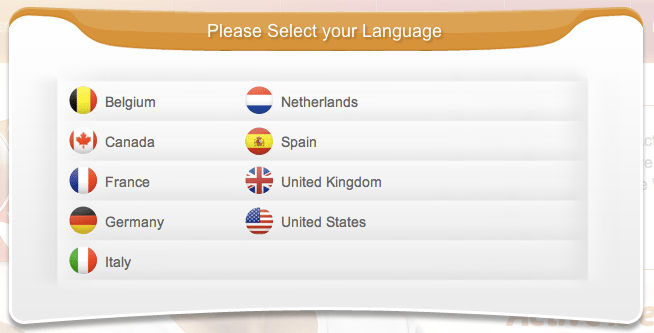
  • I apparently speak Spain, United States, United Kingdom and Canada.

    I would also like to speak Germany because it might be useful in Switzerland, you see, in Switzerland they speak a version of Germany, something like Swiss Germany.

    As seen on http://easportsactive.com. And by the way, the reason why I was at their site is to try to figure out whether EA Sports Active, here in Switzerland at least, comes multilingual or not. From the box it seems to be only in German (or should I say Germany?), searching on-line I’ve found conflicting results. It seems EA Sports doesn’t dig multilingualism, they should support Esperanto to not have to deal with that problem (of course I’ve had to drop some Esperanto propaganda!).

  • 150 years ago a great man was born. His name was Ludovic Lazarus Zamenhof and he was born to a world divided by language, a world of constant violence between polish, jews, russians, etc. All speaking different languages. He thought the problem of the world was that people could not understand each other and set himself the task of fixing it.

    He invented what latter on became know as Esperanto. You can go to the Wikipedia and check the article on Esperanto and on Zamenhof to get a lot of encyclopedic information. If you want to actually taste or learn the language, my recommendation is to go to Lernu. And with that you can learn your first Esperanto word (if you don’t know any yet): lernu means learn, as in “you learn”. Lerni means to learn.

    In this post I will tell you some things I find interesting about Esperanto.

    Let’s go on with lerni. School is lernejo. See the relationship? lern – ej – o is school. Ej means a “a place for”, so lernejo is literarily a place to learn. There are other places like laborejo, which is the place to work. Laboro means work (think of ‘labor unions’).

    Zamenhof thought about the task of creating the Esperanto dictionary and the task was so big he thought it was the end. Until he came up with the idea of allowing people to build words. My English-Esperanto, Esperanto-English dictionary is 75% for English, 25% for Esperanto. There are less words to learn in Esperanto.


    Did you know the Wikipedia is available in Esperanto? If you go to wikipedia.org, you’ll see it among the languages with more than 100000 articles.
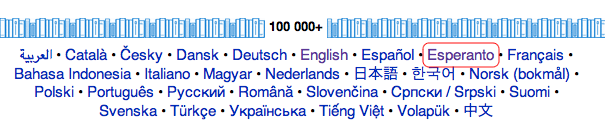
    Esperanto Wikipedia

    And if you go to the English wikipedia homepage, Esperanto is the only constructed language listed on the left column. Do you want to know something amazing? Vikipedio, the Esperanto Wikipedia is actually bigger than the Encyclopedia Britannica.

    The legend goes that Zamenhof released his book about Esperanto, called La Unua Libro (the first book) and six months latter someone nocked at his door speaking Esperanto and asking to practice the language. Esperanto spread like wildfire, unlike any other constructed language.


    Pasporta-servoToday it is estimated that there are 2 million Esperantists in the world. If you consider that 122 years ago there was only one Esperanto speaker, it’s growing quite fast. I would expect its growth is accelerating but it’s very hard to know. No census asks about Esperanto. I know someone that made a informal survey asking for people that spoke Esperanto on the streets of Zürich and then actually asking questions in Esperanto and he got 3% positive response.

    Those 2 million speakers are not concentrated in one location, they are spread through the world so you are very likely to find Esperanto-speakers everywhere if you know where to look.

    There are even an estimate of 1000 native Esperanto speakers. Basically that happens when a family is formed by a man and a woman who only share Esperanto as a common language. Even if they don’t actively teach their children Esperanto, they learn to be able to understand their parents. I know a couple of people that speak it natively.


    When talking about how many people speaks the language, it’s important to mention that Esperanto speakers were hunted by many totalitarian goverments. The Nazi government specially targeted them because Zamenhof was jewish and according to Hitler as expressed in his My Fight, Esperanto was the language to be used by the International Jewish Conspiracy to set a new world order.

    In the Soviet Union Esperanto was embraced at first. Most socialists parties saw the potential for international communication and understanding. Joseph Stalin saw it as a way to spread the ideals of communism until they realized that it was a two way street, new ideas would come from outside, including capitalism, and denounced Esperanto as the language of spies. Imperial Japan didn’t like the language either.

    In all those cases of totalitarism, Esperanto was forbidden and Esperantists hunted, exiled or even executed.


    The first Esperanto congress was held in 1905, bringing 600 people together from across the world. since then it was held every year except during the world wars with an average of 2000 participants. When it was done in China it was the biggest gathering of foreign people ever to happen in China.


    There’s a very practical reason to adopt Esperanto. Currently we waste a lot of resources pretending English is an adequate medium of international communication and in translation. Let me give you one example. In 1975 the World Health Organization denied the following requests:

    • $ 148,200 to improve the health service in Bangladesh
    • $ 83,000 to fight leprosy in Burma
    • 50 cents per patient to cure trachoma, which causes blindness.
    • $ 26,000 to improve hygiene in the Dominican Republic

    All those requests denied. It seems the World Health Organization didn’t have much money. But that same year they approved Arabic and Chinese as working languages requiring lots of translations and increasing the expenses of the WHO by $ 5,000,000 per year. That’s right, 5 million dollars per year spent on translation when they couldn’t give 50 cents to cure trachoma.


    Esperanto is probably the easiest to learn usable language out there. The Institute of Cybernetic Pedagogy at Paderborn compared how long it would take French speaking people to learn different languages to reach the same level:

    • 2000 hours studying German
    • 1500 hours studying English
    • 1000 hours studying Italian
    • 150 hours studying Esperanto

    Yes, a tenth of the time it takes to learn English and less than that when compared to German. And something very interesting happens here. The third language you learn takes less effort than the second one.

    If you want to learn another language, let’s say, German, it’ll take you less time to learn Esperanto and then learn German than to just learn German. Yes, you’ve read right. Less time to learn two languages than one.

    That experiment was done by teaching one year of Esperanto and four of French to some students while five of French to others. The amount of time studying was the same but those that spoke Esperanto first reached a better French level. So even if you never utter a single Esperanto word out there, it makes economical sense to learn it first, before you learn another language.


    Many said that Esperanto will never take off and they proceed to never learn it and accept a divided broken world. If you are among those, I’m sorry about your defeat. I’d rather hope and do my part and learn Esperanto. It’s not that hard.

  • mikPmjuI still haven’t found a good music player, for my computer that is. The one that got the closest to it was Amarok, but still it was very far away. My problem is that I don’t know what to listen to, really! I’m only just finding out what music to use  for coding. There’s one thing I really want from a music player: for it learn what to play for me. It’s not the same as learning what I like. It’s much more complex. Amarok learns what I like, but not really what to play for me.

    In Amarok, when you jump to the next song it checks how much of the song you listened and assigns a score based on that. For songs that you listen completely you get a high score and for songs you listen only for a couple of seconds a low score. Over time, as you listen, those you like most and listen most will get high scores while those you despise and jump immediately will get a lower score.

    Amarok has a special playing list, or used to have in the 1.4 version, which is called “dynamic” and plays those songs with the highest score. That sounds excellent, but it’s not enough. This music player I’d like to have would not compute how much I like a song, like Amarok, but how probable it is that  I’ll like it when it plays that song.

    Let’s call this player Pamup, Pablo’s Music Player, and let’s see how it could provide such a magic feat as playing songs that you want to listen (even if you don’t know you want to listen to them).

    Pamup would have a scoring for the songs but instead of being a linear score it’ll be multidimensional. Let’s start with two simple dimensions and the rest will be clear: percent of playing time and time of the day. Song A you play 100% and song B 50%. That means that you like song A better than B. That is what Amarok does. Pamup would instead record:

    • Song A in the morning: 100%
    • Song B in the morning: 50%
    • Song A in the evening: 50%
    • Song B in the evening: 100%

    You like A as much as B, but you are more likely to want to listen to A in the morning, and B in the evening. Of course adding the time of the day will probably not improve the equation by much. The idea would be to add as many dimensions as possible. Some dimensions may be irrelevant and they should cancel themselves out, like in this case:

    • Song A in the morning: 100%
    • Song B in the morning: 50%
    • Song A in the evening: 100%
    • Song B in the evening: 50%
    In that case, you like A better than B, in the evening and in the morning. The time of the day is irrelevant. Maybe it’s only irrelevant for some songs but not for other:
    • Let it be, I like it at all times.
    • O Fortuna of Carmina Burana, please, don’t wake me up with that (or maybe yes, please do, not sure).

    Maybe it’s irrelevant for some people, but not for others. I don’t know and we don’t need to know.

    I can think of many other dimensions to add to the system and I’m sure many other people will think of more and as technology improves we’ll be able to have even more:

    • What program are you using? I want music that helps me concentrate when I’m using my text editor to write code while I don’t care much about what I’m listen to while web browsing.
    • What are you browsing? Maybe I do care about the music while I’m web browsing. Redditing and Facebooking can be done pretty much with any music, but if I’m at Lambda the Ultimate, I need something to concentrate. Even some analysis of the web site could give some important hints: lot’s of dense text, no pictures, play Mozzart; a photo blog, play whatever.
    • How are you controlling the player? Are you using the keyboard with global shortcuts? you are probably doing something else. Are you using the remote control? you are probably away from the computer. Are you using the mouse directly into the players window with the lyrics window open? Ok, let’s play something with lyrics because you probably feel like reading, maybe even signing.
    • Are you singing? When can find that out using the computer’s microphone. Let’s play things that are in your vocal range, and mostly by the same gender as you are. Let’s also play things you liked singing before.
    • Are you using only one app or switching between various apps?
    • Which apps are you switching with?
    • Is there any other sound coming out from the computer? If so, maybe soothing background music with not much volume is what the player should play.
    • Are you dancing? Let’s disco! You think that’s a tough one? Most smart phones have accelerometers in them, if you have the smart phone on your pocket I’m sure I can find out if you are in the couch or dancing, or maybe moving but not dancing. Even the raw input of the accelerometer could be used as a signal, because it’ll be different depending how tired you are and how you are dancing.
    • Are you alone? You think that’s a hard one as well? Many people are using wifi, so, what’s the strength signal received on other devices on the same network?. If another computer has a similar signal level as yours and it is being used, you probably are not alone. It could also be done using smart phones, although with a smart phone you don’t require to be in use, you require it not to be on the table. If it’s plugged into the computer, you can ignore it, if it’s flat and not moving (accelerometer again), you can ignore it.
    • Who are you with? I hope by now you realize how much we can find out. Let’s make it social, let’s have the app in every device. Why would people install it? Well, when you visit me, if you have it on your device, you’ll device will tell my computer what you like, and my computer knows what I like, so it’ll try to find a common ground for us (and it won’t trust me that much when I skip a song, because maybe it’s you skipping it). We could make you use your own smart phone to skip it, and then Pumap knows who is skipping it.
    • Who are you talking with? If you are talking with other people, using voice recognition you may identify that people, or at least how many there are. If there’s cutlery clater in the background, people are eating, let’s just play background music for a nice evening. If it’s only you speaking, maybe you are in an old land-line phone (if you were using your smart phone, Pumap would know), let’s cut the music altogether, probably it’s distracting.

    I believe this program should not work with special cases but have some very sofisticated machine learning system where we input all these signals and does the right thing. And as more signals become available, they are added and analyzed as well. I would like to have that music program! Because honestly, really, I’m not sure what music I want to listen to. I want my computer to figure it out for me.