Category: Technical

Posts related to programming or other highly technical stuff that can only be of interest to computer geeks.

  • I like my text properly formatted and with pretty much every CMS editor out there I always have some confusion when it comes to titles. The post or page has a title and then sections inside it also have titles and they are second level titles. On most CMS you have the option of titles or headers starting at level 1 through 6 (that maps to h1, h2, through h6 in HTML).

    For example, this is Confluence, a tool that I really like:

    The confusion that I get here is whether a subsection to this page should have Heading 1 or Heading 2. Sometimes Heading 1 will be displayed with the same font, size, etc as the title of the page, so, by using Heading 1 you are almost creating two pages in one. But in other CMS, Heading 1 is the top level section heading and the title of the page is a special title that will always sit above it.

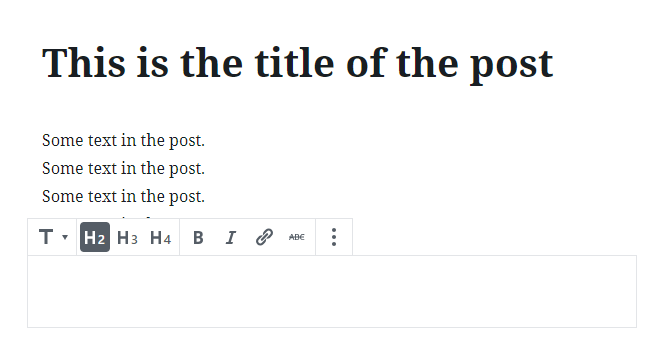
    The new WordPress.com editor does this correctly by being very clear that your first option for section headers, after setting the title of the page or post, is h2:

    I think that was a very neat solution to the problem. Bravo WordPress.

  • I recently found myself having to prepare a report of some mortgage calculations so that non-technical domain experts could read it, evaluate it, and tell me whether my math and the way I was using certain APIs was correct.

    Since I’m using Python, I decided to go as native as possible and make my little script generate a ReStructured Text file that I would then convert into HTML, PDFs, whatever. The result of certain calculations ended up looking like a data table expressed as list of dicts all with the same keys. I wrote a function that would turn that list of dicts into the appropriately formatted ReStructured Text.

    For example, given this data:

    creators = [{"name": "Guido van Rossum", "language": "Python"}, 
                {"name": "Alan Kay", "language": "Smalltalk"},
                {"name": "John McCarthy", "language": "Lisp"}]

    when you call it with:

    dict_to_rst_table(creators)

    it produces:

    +------------------+-----------+
    | name             | language  |
    +==================+===========+
    | Guido van Rossum | Python    |
    +------------------+-----------+
    | Alan Kay         | Smalltalk |
    +------------------+-----------+
    | John McCarthy    | Lisp      |
    +------------------+-----------+

    The full code for this is:

    from collections import defaultdict
    
    from io import StringIO
    
    
    def dict_to_rst_table(data):
        field_names, column_widths = _get_fields(data)
        with StringIO() as output:
            output.write(_generate_header(field_names, column_widths))
            for row in data:
                output.write(_generate_row(row, field_names, column_widths))
            return output.getvalue()
    
    
    def _generate_header(field_names, column_widths):
        with StringIO() as output:
            for field_name in field_names:
                output.write(f"+-{'-' * column_widths[field_name]}-")
            output.write("+\n")
            for field_name in field_names:
                output.write(f"| {field_name} {' ' * (column_widths[field_name] - len(field_name))}")
            output.write("|\n")
            for field_name in field_names:
                output.write(f"+={'=' * column_widths[field_name]}=")
            output.write("+\n")
            return output.getvalue()
    
    
    def _generate_row(row, field_names, column_widths):
        with StringIO() as output:
            for field_name in field_names:
                output.write(f"| {row[field_name]}{' ' * (column_widths[field_name] - len(str(row[field_name])))} ")
            output.write("|\n")
            for field_name in field_names:
                output.write(f"+-{'-' * column_widths[field_name]}-")
            output.write("+\n")
            return output.getvalue()
    
    
    def _get_fields(data):
        field_names = []
        column_widths = defaultdict(lambda: 0)
        for row in data:
            for field_name in row:
                if field_name not in field_names:
                    field_names.append(field_name)
                column_widths[field_name] = max(column_widths[field_name], len(field_name), len(str(row[field_name])))
        return field_names, column_widths

    Feel free to use it as you see fit, and if you’d like this to be a nicely tested reusable pip package, let me know and I’ll turn it to one. One thing that I would need to add is making it more robust to malformed data and handle more cases of data that looks differently.

    If I turn it into a pip package, it would be released from Eligible, as I wrote this code while working there and we are happy to contribute to open source.

  • Disclaimer: I don’t know what I’m talking about, I’ve done little Win API (Win32) development and I only have a few years of Java development of which maybe 2 or 3 are developing desktop applications with JavaFX (Dashman being my first fully fledged out JavaFX app).

    Disclaimer 2: I have only tested this on my own computer, running Microsoft Windows 10. I hope to soon test it in many others and over time we’ll see whether my solution was correct or not. I’ll update this blog post accordingly (or link to a newer version if necessary).

    I started taking the quality of Dashman very seriously and one of the problems I found was that the running instances wouldn’t exit properly during uninstall or upgrades. And as I expected, this turned out into a head-bashing-into-brick-wall task. My solution was for a JavaFX app, but this should work for a Swing or any other kind of apps.

    It all started with learning about Windows Restart Manager, something I didn’t know it even existed until a week ago. This is what allows Windows to close applications on uninstall, on reboots, etc. In the Guidelines for Applications, the crucial bit is this:

    The Restart Manager queries GUI applications for shutdown by sending a WM_QUERYENDSESSION notification that has the lParam parameter set to ENDSESSION_CLOSEAPP (0x1). Applications should not shut down when they receive a WM_QUERYENDSESSION message because another application may not be ready to shut down. GUI applications should listen for the WM_QUERYENDSESSION message and return a value of TRUE if the application is prepared to shut down and restart. If no application returns a value of FALSE, the Restart Manager sends a WM_ENDSESSION message with the lParam parameter set to ENDSESSION_CLOSEAPP (0x1) and the wparam parameter set to TRUE. Applications should shut down only when they receive the WM_ENDSESSION message. The Restart Manager also sends a WM_CLOSE message for GUI applications that do not shut down on receiving WM_ENDSESSION. If any GUI application responds to a WM_QUERYENDSESSION message by returning a value of FALSE, the shutdown is canceled. However, if the shutdown is forced, the application is terminated regardless.

    Simplifying it: when Windows needs your app to close, it will send a message asking if you are ready to close. Your application might respond negatively and then no application will be closed. This could happen for example if there’s some unsaved work and the app needs the consent from the user to either save or discard. This is what happens when you try to shut down your computer and Microsoft Word stops it asking whether you want to save the file or not.

    After that your application can receive a message asking it to please close or telling it to close now. I’m not sure what the nuances are between these two. For Dashman I decided to just save the config and close in either of these instances.

    Receiving these messages requires interfacing with Windows DLLs, for which I’m using JNA. I don’t know how JNA works, I read the code, sort-of understood it, copied and pasted it. What I think is going on is that you open the user32.dll like this:

    User32 user32 = Native.loadLibrary("user32", User32.class, Collections.unmodifiableMap(options))

    User32 is an interface that contains all the methods with the proper signatures to be able to call them from Java. options just makes sure we are using the Unicode version of the Win32 API calls. You can see that and all the other missing pieces on the full example at the end of the blog post.

    I need a Win32 API callback that will receive the messages and actually implement the guidelines previously quoted:

    StdCallLibrary.StdCallCallback proc = new StdCallLibrary.StdCallCallback() {
        public WinDef.LRESULT callback(WinDef.HWND hwnd, int uMsg, WinDef.WPARAM wParam, WinDef.LPARAM lParam) {
            if (uMsg == WM_QUERYENDSESSION && lParam.intValue() == ENDSESSION_CLOSEAPP) {
                return new WinDef.LRESULT(WIN_TRUE);
            } else if ((uMsg == WM_ENDSESSION && lParam.intValue() == ENDSESSION_CLOSEAPP && wParam.intValue() == WIN_TRUE) || uMsg == WM_CLOSE) {
                Application.exit();
                return new WinDef.LRESULT(WIN_FALSE); 
            }
            return user32.DefWindowProc(hwnd, uMsg, wParam, lParam);
     
        }
    };

    Oh! Lot’s of constants! What are they? I define them in the full example at the bottom of this post. They should be mostly self-evident what they stand for, their actual values are not that important.

    Now things get tricky. Apparently Microsoft Windows send these messages to windows, not processes. Dashman can run in the tray bar, with no active window. And even if it had an active window, getting the HWND pointer for that window in JavaFX doesn’t seem trivial (I couldn’t get it to work). So, I create a size 0 invisible window to receive the message:

    WinDef.HWND window = user32.CreateWindowEx(0, "STATIC", "Dashman Win32 Restart Manager Window.", WS_MINIMIZE, 0, 0, 0, 0, null, null, null, null);

    Then I need to connect that window to the callback:

    try {
        user32.SetWindowLongPtr(window, GWL_WNDPROC, proc);
    } catch (UnsatisfiedLinkError e) {
        user32.SetWindowLong(window, GWL_WNDPROC, proc);
    }

    The callback is not magic though, and requires an event loop that will constantly check if there’s a message and trigger the processing when that happens:

    WinUser.MSG msg = new WinUser.MSG();
    while (user32.GetMessage(msg, null, 0, 0) > 0) {
        user32.TranslateMessage(msg);
        user32.DispatchMessage(msg);
    }

    Of course, that means you want this to run as its own daemon thread. The reason to make it a daemon thread is so that it won’t hang around preventing the JVM from exiting. 

    One of my most useful sources of understanding and inspiration was the source code for Briar. I want to give credit where credit is due. I do think I spotted an issue with their source code in which they are not following the guidelines though. Also, they have a much more complex situation to handle.

    And now, the full example with all my comments including links to more information explaining where all the values for constants and logic is coming from:

    import com.sun.jna.Native;
    import com.sun.jna.Pointer;
    import com.sun.jna.platform.win32.WinDef;
    import com.sun.jna.platform.win32.WinUser;
    import com.sun.jna.win32.StdCallLibrary;
    import com.sun.jna.win32.W32APIFunctionMapper;
    import com.sun.jna.win32.W32APITypeMapper;
    
    import java.util.Collections;
    import java.util.HashMap;
    import java.util.Map;
    
    import static com.sun.jna.Library.OPTION_FUNCTION_MAPPER;
    import static com.sun.jna.Library.OPTION_TYPE_MAPPER;
    
    // Inspiration can be found at https://code.briarproject.org/akwizgran/briar
    public class RestartManager {
        // https://autohotkey.com/docs/misc/SendMessageList.htm
        private static final int WM_CLOSE = 0x10; // https://msdn.microsoft.com/en-us/library/windows/desktop/ms632617
        private static final int WM_QUERYENDSESSION = 0x11; // https://msdn.microsoft.com/en-us/library/windows/desktop/aa376890
        private static final int WM_ENDSESSION = 0x16; // https://msdn.microsoft.com/en-us/library/windows/desktop/aa376889
    
        // https://msdn.microsoft.com/en-us/library/windows/desktop/aa376890
        // https://msdn.microsoft.com/en-us/library/windows/desktop/aa376889
        private static final int ENDSESSION_CLOSEAPP = 0x00000001;
        private static final int ENDSESSION_CRITICAL = 0x40000000;
        private static final int ENDSESSION_LOGOFF = 0x80000000;
    
        // https://stackoverflow.com/questions/50409858/how-do-i-return-a-boolean-as-a-windef-lresult
        private static final int WIN_FALSE = 0;
        private static final int WIN_TRUE = 1;
    
        // https://msdn.microsoft.com/en-us/library/windows/desktop/ms633591(v=vs.85).aspx
        private static final int GWL_WNDPROC = -4;
    
        // https://msdn.microsoft.com/en-us/library/windows/desktop/ms632600(v=vs.85).aspx
        private static final int WS_MINIMIZE = 0x20000000;
    
        public static void enable() {
            Runnable evenLoopProc = () -> {
                // Load user32.dll usi the Unicode versions of Win32 API calls
                Map<String, Object> options = new HashMap<>();
                options.put(OPTION_TYPE_MAPPER, W32APITypeMapper.UNICODE);
                options.put(OPTION_FUNCTION_MAPPER, W32APIFunctionMapper.UNICODE);
                User32 user32 = Native.loadLibrary("user32", User32.class, Collections.unmodifiableMap(options));
    
                // Function that handles the messages according to the Restart Manager Guidelines for Applications.
                // https://msdn.microsoft.com/en-us/library/windows/desktop/aa373651
                StdCallLibrary.StdCallCallback proc = new StdCallLibrary.StdCallCallback() {
                    public WinDef.LRESULT callback(WinDef.HWND hwnd, int uMsg, WinDef.WPARAM wParam, WinDef.LPARAM lParam) {
                        if (uMsg == WM_QUERYENDSESSION && lParam.intValue() == ENDSESSION_CLOSEAPP) {
                            return new WinDef.LRESULT(WIN_TRUE); // Yes, we can exit whenever you want.
                        } else if ((uMsg == WM_ENDSESSION && lParam.intValue() == ENDSESSION_CLOSEAPP
                                && wParam.intValue() == WIN_TRUE) || uMsg == WM_CLOSE) {
                            Application.exit();
                            return new WinDef.LRESULT(WIN_FALSE); // Done... don't call user32.DefWindowProc.
                        }
                        return user32.DefWindowProc(hwnd, uMsg, wParam, lParam); // Pass the message to the default window procedure
    
                    }
                };
    
                // Create a native window that will receive the messages.
                WinDef.HWND window = user32.CreateWindowEx(0, "STATIC",
                        "Dashman Win32 Restart Manager Window.", WS_MINIMIZE, 0, 0, 0,
                        0, null, null, null, null);
    
                // Register the callback
                try {
                    user32.SetWindowLongPtr(window, GWL_WNDPROC, proc); // Use SetWindowLongPtr if available (64-bit safe)
                } catch (UnsatisfiedLinkError e) {
                    user32.SetWindowLong(window, GWL_WNDPROC, proc); // Use SetWindowLong if SetWindowLongPtr isn't available
                }
    
                // The actual event loop.
                WinUser.MSG msg = new WinUser.MSG();
                while (user32.GetMessage(msg, null, 0, 0) > 0) {
                    user32.TranslateMessage(msg);
                    user32.DispatchMessage(msg);
                }
            };
    
            Thread eventLoopThread = new Thread(evenLoopProc, "Win32 Event Loop");
            eventLoopThread.setDaemon(true); // Make the thread a daemon so it doesn't prevent Dashman from exiting.
            eventLoopThread.start();
        }
    
        private interface User32 extends StdCallLibrary {
            // https://msdn.microsoft.com/en-us/library/windows/desktop/ms632680(v=vs.85).aspx
            WinDef.HWND CreateWindowEx(int dwExStyle, String lpClassName, String lpWindowName, int dwStyle, int x, int y, int nWidth, int nHeight, WinDef.HWND hWndParent, WinDef.HMENU hMenu, WinDef.HINSTANCE hInstance, Pointer lpParam);
    
            // https://msdn.microsoft.com/en-us/library/windows/desktop/ms633572(v=vs.85).aspx
            WinDef.LRESULT DefWindowProc(WinDef.HWND hWnd, int Msg, WinDef.WPARAM wParam, WinDef.LPARAM lParam);
    
            // https://msdn.microsoft.com/en-us/library/windows/desktop/ms633591(v=vs.85).aspx
            WinDef.LRESULT SetWindowLong(WinDef.HWND hWnd, int nIndex, StdCallLibrary.StdCallCallback dwNewLong);
    
            // https://msdn.microsoft.com/en-us/library/windows/desktop/ms644898(v=vs.85).aspx
            WinDef.LRESULT SetWindowLongPtr(WinDef.HWND hWnd, int nIndex, StdCallLibrary.StdCallCallback dwNewLong);
    
            // https://msdn.microsoft.com/en-us/library/windows/desktop/ms644936(v=vs.85).aspx
            int GetMessage(WinUser.MSG lpMsg, WinDef.HWND hWnd, int wMsgFilterMin, int wMsgFilterMax);
    
            // https://msdn.microsoft.com/en-us/library/windows/desktop/ms644955(v=vs.85).aspx
            boolean TranslateMessage(WinUser.MSG lpMsg);
    
            // https://msdn.microsoft.com/en-us/library/windows/desktop/ms644934(v=vs.85).aspx
            WinDef.LRESULT DispatchMessage(WinUser.MSG lpmsg);
        }
    }

    And now, my usual question: do you think this should be a reusable open source library? would you use it?
  • A friend of my dad introduced me to ham radio when I was 7 years old. When I was 15 or so I passed my beginner’s exam and then I did nothing with it. I got my call sign when I was 24 years old and moving out of Argentina: LU5ARC. I never used it because Argentina is not part of CEPT (and I haven’t gone back except for short holidays).

    To get that Argentinean license, I had to take three months of two evenings a week of lessons on theory, Morse code and operating a radio (just making QSOs on 80 meters). I actually collected about 10 QSLs from that time (I wish I knew where they are).

    When I moved to the UK almost 7 years ago, I looked into transferring my license but I was told it was impossible. I wish they also told me how easy it was to get a license in the UK and I wouldn’t have waited so long to get started. Last year something else got me interested in radio and I decided to take the plunge and get licensed. I was delighted to see how easy it is.

    The hardest part of getting licensed was waiting for the two day course to happen (at that point, I didn’t know about ML&S running them). Because of my previous experience with radio and the fact that I studied electronics and electromechanics in school, there was little to nothing that I didn’t know for the foundation level. Without too much effort I got my first British call sign: M6UON.

    Then, I had to wait again and I was thrilled to find that ML&S run foundation and intermediate courses, as well as advanced exams so often. I took the course, pass the exam, and I got my intermediate license: 2E0GGE. A month after that, I took the advanced exam and I now have my full license M0ONP.

    Oh… even before there was a foundation course available, I went to the RSGB convention and I took the three exams in a row for the FCC (American) license, so, even before managing to get M6UON, I got an extra (full) one for the US as AC1DM. So ironic!

    2018-04-02-15-56-49.jpg

    And now the fun begins. I lifted all possible restrictions. I can use the full 100W of my Icom IC-7300 as well as take my Icom ID-51E PLUS2 abroad and use it. I can also supervise unlicensed people so I’ve been introducing all my friends to ham radio. I either have friends that are genuinely interested in this technical hobby that’s going without them knowing about or very good friends that humor me when I spend hours explaining frequency, modulation, SWR, antennas, bandwidth, etc.

  • Update 2018-05-23: Updated the code to my current version, which fixes a few bugs.

    When doing usability testing of an alpha version of Dashman, one thing that I was strongly asked was to have the windows remember their sizes when you re-open the application. The need was clear as it was annoying to have the window be a different size when re-started.

    The new version of Dashman is built using Java and JavaFX and thus I searched for how to do this, how to restore size. I found many posts, forums, questions, etc all with the same simplistic solution: restoring width and height, and maybe position.

    What those were missing was restoring whether the window was maximized (maximized is not the same as occupying all the available space, at least in Windows). But most important than that, none of the solutions took into consideration the fact that the resolutions and quantity of screens could be different than the last time the application run, thus, you could end up with a window completely out of bounds, invisible, immobile.

    I came up with this solution, a class that’s designed to be serializable to your config to store the values but also restore them and make sure the window is visible and if not, move it to a visible place:

    package tech.dashman.dashman;
    import com.fasterxml.jackson.annotation.JsonIgnore;
    import javafx.application.Platform;
    import javafx.geometry.Rectangle2D;
    import javafx.stage.Screen;
    import javafx.stage.Stage;
    import lombok.Data;
    import tech.dashman.common.Jsonable;
    @Data
    public class StageSizer implements Jsonable {
    private static double MINIMUM_VISIBLE_WIDTH = 100;
    private static double MINIMUM_VISIBLE_HEIGHT = 50;
    private static double MARGIN = 50;
    private static double DEFAULT_WIDTH = 800;
    private static double DEFAULT_HEIGHT = 600;
    private Boolean maximized = false;
    private Boolean hidden = false;
    private Double x = MARGIN;
    private Double y = MARGIN;
    private Double width = DEFAULT_WIDTH;
    private Double height = DEFAULT_HEIGHT;
    @JsonIgnore
    private Boolean hideable = true;
    @JsonIgnore
    public void setStage(Stage stage) {
    // First, restore the size and position of the stage.
    resizeAndPosition(stage, () -> {
    // If the stage is not visible in any of the current screens, relocate it to the primary screen.
    if (isWindowIsOutOfBounds(stage)) {
    moveToPrimaryScreen(stage);
    }
    // And now watch the stage to keep the properties updated.
    watchStage(stage);
    });
    }
    private void resizeAndPosition(Stage stage, Runnable callback) {
    Platform.runLater(() -> {
    if (getHidden() != null && getHidden() && getHideable()) {
    stage.hide();
    }
    if (getX() != null) {
    stage.setX(getX());
    }
    if (getY() != null) {
    stage.setY(getY());
    }
    if (getWidth() != null) {
    stage.setWidth(getWidth());
    } else {
    stage.setWidth(DEFAULT_WIDTH);
    }
    if (getHeight() != null) {
    stage.setHeight(getHeight());
    } else {
    stage.setHeight(DEFAULT_HEIGHT);
    }
    if (getMaximized() != null) {
    stage.setMaximized(getMaximized());
    }
    if (getHidden() == null || !getHidden() || !getHideable()) {
    stage.show();
    }
    new Thread(callback).start();
    });
    }
    public void setHidden(boolean value) {
    this.hidden = value;
    }
    private boolean isWindowIsOutOfBounds(Stage stage) {
    for (Screen screen : Screen.getScreens()) {
    Rectangle2D bounds = screen.getVisualBounds();
    if (stage.getX() + stage.getWidth() - MINIMUM_VISIBLE_WIDTH >= bounds.getMinX() &&
    stage.getX() + MINIMUM_VISIBLE_WIDTH <= bounds.getMaxX() &&
    bounds.getMinY() <= stage.getY() && // We want the title bar to always be visible.
    stage.getY() + MINIMUM_VISIBLE_HEIGHT <= bounds.getMaxY()) {
    return false;
    }
    }
    return true;
    }
    private void moveToPrimaryScreen(Stage stage) {
    Rectangle2D bounds = Screen.getPrimary().getVisualBounds();
    stage.setX(bounds.getMinX() + MARGIN);
    stage.setY(bounds.getMinY() + MARGIN);
    stage.setWidth(DEFAULT_WIDTH);
    stage.setHeight(DEFAULT_HEIGHT);
    }
    private void watchStage(Stage stage) {
    // Get the current values.
    setX(stage.getX());
    setY(stage.getY());
    setWidth(stage.getWidth());
    setHeight(stage.getHeight());
    setMaximized(stage.isMaximized());
    setHidden(!stage.isShowing());
    // Watch for future changes.
    stage.xProperty().addListener((observable, old, x) -> setX((Double) x));
    stage.yProperty().addListener((observable, old, y) -> setY((Double) y));
    stage.widthProperty().addListener((observable, old, width) -> setWidth((Double) width));
    stage.heightProperty().addListener((observable, old, height) -> setHeight((Double) height));
    stage.maximizedProperty().addListener((observable, old, maximized) -> setMaximized(maximized));
    stage.showingProperty().addListener(observable -> setHidden(!stage.isShowing())); // Using an invalidation instead of a change listener due to this weird behaviour: https://stackoverflow.com/questions/50280052/property-not-calling-change-listener-unless-theres-an-invalidation-listener-as
    }
    }

    and the way you use it is quite simple. On your start method, you create or restore an instance of StageSizer and then do this:

    public void start(Stage stage) {
    StageSizer stageSizer = createOrRestoreStageSizerFromConfig();
    stageSizer.setStage(stage);
    }

    I haven’t put a lot of testing on this code yet but it seems to work. Well, at least on Windows. The problem is that this snippet is interacting with the reality of screen sizes, resolutions, adding and removing monitors, etc. If you find a bug, please, let me know and I might release this a library with the fix so we can keep on collectively improving this.f

  • Next month, I’m taking my test to get a ham radio licence here in the UK. This is not my first licence. I’ve got LU5ARC years ago, as I was leaving Argentina, so, I never really got to use it. Years before that I’ve got a Yaesu FT411E, but I never transmitted with it due to lack of licence.

    I don’t want that to happen again, so, as soon as I get my licence I want to hit the ground running and start using it. My plan right now is:

    1. Get a VHF/UHF hand held radio.
    2. Learn about antennas by reading:
    3. Get an antenna for VHF/UHF on my car (probably magnetic).
    4. Attempt to install a VHF/UHF vertical antenna in my house.
    5. Decide based on the information I have so far whether I can go for HF.
    6. Set up an HF base station.

    Right now, I’m concerned about step 1. These are the things I’m after, in this order of preference:

    1. VHF
    2. UHF
    3. Ability to use a stationary vertical antenna
    4. Weather proofing
    5. D-Star (with GPS)
    6. APRS (with GPS)

    I could try to get everything now, or maybe do it in stages. I’m not sure yet. I narrowed down my selection to these 5 radios:

    • Kenwood TH-D74
    • Icom ID-51 PLUS2
    • Icom IC-E91
    • Yaesu FT-60E
    • A Baofeng

    Kenwood TH-D74

    The ideal radio seems to exist and it’s the Kenwood TH-D74 (Buy: US). From what I’m seeing this piece of equipment is insane. It does everything and it does almost everything well (except maybe battery life). The price is also insane. If money was no object I would just get this radio and I’m done. I’d probably use it for many, many years.

    Kenwood TH-D74

    Icom ID-51 PLUS2

    The runner up is the Icom ID-51 PLUS2 (Buy: US, UK). It’s more than 35% cheaper than the TH-D74 and it does everything but APRS. From this list it probably has the most bang for the buck since there are two ways of doing APRS: through D-Star repeaters that have it enabled or with an extra piece of kit that you plug to it. The audio quality seems not to be as good as the TH-D74 but it still is great. Like the TH-D74, this is a radio to buy, keep and don’t think about equipment for many years (at least not hand-helds).

    Icom ID-51A PLUS2

    After these two, we get into the get a radio now with the intention of upgrading later.

    Icom IC-E91

    Icom IC-E91The Icom IC-E91 cost less than half of the TH-D74 but I’m a bit puzzled by it. I cannot find a lot of reviews or information about it. It doesn’t seem to be a popular unit. It can do D-Star but to transmit GPS it requires an external GPS module that would put it close to the cost of an ID-51 PLUS2. When it comes to APRS, it’s the same story as for the other Icom on this list.

    Yaesu FT-60

    Yaesu FT-60The Yaesu FT-60 is a good solid radio. It cost about a sixth of the TH-D74 and it only ticks the VHF/UHF boxes on my requirements so this is definitely one to get started and upgrade later.

    A Yaesu FT-411E was my first radio and I always had a soft spot for Yaesu, so it saddens me that they decided to make their own proprietary protocol for digital radio. This is why you don’t see any higher end Yaesu models, I don’t want to use nor support System Fusion. I really hope one day Yaesu will start producing equipment with D-Star, then I will consider again buying their higher end models.

    A Baofeng

    baofeng's messy product line in the uk

    This would cost me the same as a pizza. It’s definitely in the buy something to get started and upgrade later. From a cost point of view, this is a no-brainier. I could just go ahead and buy one or two just for the lolz. I do have two issues with it:

    The first is quality. Obviously I don’t expect high end quality, but I read some reports of horrible things. I don’t want to buy a paperweight.

    The second issue is that I don’t know which one to get. Their line of products is a mess. In the UK they have a gazillion different models. They changed names three times (Pofang, Misuta). Their website is confusing and once I drill down on all the models, they seem to be all the same. If you look at their American presence, there they offer two radios with clear pros and cons, none of which are available in the UK.

    Conclusion

    Well, I don’t have one. I haven’t made a decision yet. I’d like to just buy a Baofeng now and upgrade later, but it sounds like I’m buying a problem. Getting the Yaesu seems a bit expensive for an upgrade-later path (but not too bad). Getting any of the high ends feel like throwing money for a toy instead of taking on a new hobby in a sensible manner.

    Any word of advice?

  • Searching online for how to set up the credentials to access the database (or any other service) while in development leads to a lot of articles that propose something that works, but it’s wrong: putting your credentials in the application.properties file that you then commit to the repository.

    The source code repository should not have any credentials, ever:

    • You should be able to make your project open source without your security being compromised.
    • You should be able to add another developer to your team without them knowing any credentials to your own development machine.
    • You should be able to hire a company that does a security analysis of your application, give them access to your source code and they shouldn’t gain access to your database.
    • You should be able to use a continuous integration service offered by a third party without that third party learning your database credentials.

    If you want to see what happens when you commit your credentials to your repo, check out these news articles:

    That’s probably enough. I hope I convinced you.

    In an effort to find a solution for this, I asked in Stack Overflow and I got pointed in the right direction.

    Leave application.properties where it is, in your resources of code folder, commit it to the repository. Instead, create a new file in ${PROJECT_ROOT}/config/application.properties and also add it to your version control ignore file (.gitignore, .hgignore, etc). That file will contain the credentials and other sensitive data:

    # This should be used only for credentials and other local-only config.
    spring.datasource.url = jdbc:postgresql://localhost/database
    spring.datasource.username = username
    spring.datasource.password = password

    Then, to help onboard new developers on your project (or yourself in a new computer), add a template for that file, next to it. Something like ${PROJECT_ROOT}/config/application.template.properties that will contain:

    # TODO: copy this to application.properties and set the credentials for your database.
    # This should be used only for credentials and other local-only config.
    spring.datasource.url = jdbc:postgresql://localhost/database
    spring.datasource.username =
    spring.datasource.password =

    And voila! No credentials on the repo  but enough information to set them up quickly.

    Disclaimer: I’m new to Spring Boot, I only started working with it a few days ago, so, I may be missing something big here. If I learn something new that invalidates this post, I’ll update it accordingly. One thing I’m not entirely sure about is how customary it would be to have ${PROJECT_ROOT}/config/application.properties on the ignore list. Please, leave a comment with any opinions or commentary.

  • There’s already an AJAX re-frame effect handler provided by Day8, the same guy who made re-frame and there’s nothing wrong with it. From the documentation, this is how you use it:

    [code lang=”clojure”]
    (re-frame/reg-event-fx ::http-post
    (fn [_world [_ val]]
    {:http-xhrio {:method :post
    :uri "https://httpbin.org/post&quot;
    :params data
    :format (ajax/json-request-format)
    :response-format (ajax/json-response-format {:keywords? true})
    :on-success [::good-post-result]
    :on-failure [::bad-post-result]}}))
    [/code]

    That felt a little to verbose for my taste, so I made my own that you use like this:

    [code lang=”clojure”]

    (re-frame/reg-event-fx ::http-post
    (fn [_world [_ val]]
    {:ajax {:post "https://httpbin.org/post&quot;
    :params data
    :on-success [::good-post-result]
    :on-failure [::bad-post-result]}}))
    [/code]

    If you are familiar with cljs-ajax, you’ll notice the pattern. Day8’s solution uses the raw cljs-ajax API, while I use the higher level one. Day8’s is more versatile, mine is more compact.

    This is my solution:

    [code lang=”clojure”]
    (ns ajax-fx-handler
    (:require [ajax.core :as ajax]
    [re-frame.core :as re-frame]
    [clojure.set :as set]))

    (re-frame/reg-fx :ajax
    (fn http-effect [request]
    (let [request-verb (set/intersection #{:get :post :put :patch :delete :head :options :trace :purge}
    (set (keys request)))]
    (if (not= 1 (count request-verb))
    (throw (js/Error (str "When specifying an AJAX request, one and only one verb should be specified. Found: " request-verb)))
    (let [request-verb (first request-verb)
    url (get request request-verb)
    request (if (contains? request :on-success)
    (assoc request :handler #(re-frame/dispatch (conj (:on-success request) %)))
    request)
    request (if (contains? request :on-failure)
    (assoc request :error-handler #(re-frame/dispatch (conj (:on-failure request) %)))
    request)
    request (-> request
    (dissoc request-verb)
    (dissoc :on-success)
    (dissoc :on-failure))
    ajax-fn (cond
    (= request-verb :get) ajax/GET
    (= request-verb :post) ajax/POST
    (= request-verb :put) ajax/PUT
    (= request-verb :patch) ajax/PATCH
    (= request-verb :delete) ajax/DELETE
    (= request-verb :head) ajax/HEAD
    (= request-verb :options) ajax/OPTIONS
    (= request-verb :trace) ajax/TRACE
    (= request-verb :purge) ajax/PURGE)]
    (ajax-fn url request))))))
    [/code]

    Feel free to use it, but, is it worth releasing it as a library? does anybody want that?

  • For those cases in which there can be one and only one record on the database with certain fields and I don’t just want to get the first one and silently get the wrong one. I want to make sure there’s one and only one, so, I wrote this little extension to ActiveRecord that does exactly that:

    [code lang=”ruby”]
    module ActiveRecordExtension
    extend ActiveSupport::Concern

    class_methods do
    def one_and_only
    records = limit(2).all.to_a
    if records.count &gt; 1
    raise "#{self} generated more than one record when expecting only one."
    else
    records.first
    end
    end

    def one_and_only!
    one_and_only.tap do |record|
    if record.nil?
    raise "#{self} didn’t generate any records."
    end
    end
    end
    end
    end

    ActiveRecord::Base.send(:include, ActiveRecordExtension)
    [/code]
    The first method, one_and_only, will raise an exception if there’s more than one item but it’ll return null if there aren’t any. one_and_only! will fail if there isn’t exactly one and only one record in the database.

    If you don’t know why I’m calling this The Highlander query, you should go and watch Christopher Lambert’s masterpiece.

  • Emacs is a very powerful text editor and its popularity amongst Clojurians is easily understood. Emacs has a long tradition in the Lisp communities as it’s written, in a big part, in a flavor of Lisp called Emacs Lisp.

    Because of its history, it handles Lisp code wonderfully, with automatic correct indentation, paraedit, integration with REPLs, etc. But Emacs is really hard to use.

    Yeah, most Clojurians know how to use it by now and they suffer from bias: “it’s not that hard” they say. Learning Emacs or Clojure is hard enough. Combining them is insane.

    Many Clojurians also say it’s worth it. And again, I think they are biased. Human brains are very good at forgetting pain. Other editors these days are also very powerful and although not as much as Emacs, their usage is intuitive so you can achieve a higher level of proficiency just by using it, without spending time and effort in becoming better at it.

    The way Emacs is hurting Clojure is by Clojurians maintaining this myth that you need to use Emacs for Clojure. This is not done by simple statements but by a general culture of jokes saying things such as “you are wrong if you don’t use emacs”.

    Me, personally, I don’t care what editor you use. If you want to learn Emacs, go for it. Intellij and Cursive is much easier to use and almost as powerful. When I compare myself to another clojurian, productivity is generally decided by knowledge of the language and libraries, not the editor. If you want to use another editor, so be it. It’s better if they understand Lisp code but it’s not a deal breaker for learning Clojure.

    I do care about the success and popularity of Clojure. Coupling the growth of the language to the use of an editor that is hard to use and non intuitive makes no sense. It’s hurting us. Even if you are an Emacs power user, when you talk to a Clojure newbie, please, don’t push it down their throats.

    Thank you.