We just released a new version of to-jdbc-uri, 0.3.0, with MySQL support (courtesy of Joe Kutner). Grab it while it’s hot: https://clojars.org/to-jdbc-uri
We also improved the documentation: https://github.com/carouselapps/to-jdbc-uri
We just released a new version of to-jdbc-uri, 0.3.0, with MySQL support (courtesy of Joe Kutner). Grab it while it’s hot: https://clojars.org/to-jdbc-uri
We also improved the documentation: https://github.com/carouselapps/to-jdbc-uri

Update: there’s a version of this article that uses bidi instead of silk: No-hashes bidirectional routing in re-frame with bidi and pushy. The content is very similar, only the code changes.
I recently replaced secretary with silk and pushy in a re-frame project that was created fresh out of leiningen template and this is how I did it, but first, the reason.
What I like about silk is that it’s bidirectional. It not only parses URLs into data structures but also generates URLs from data structures. This is not unique to silk, bidi also does it and feature-wise they are almost equivalent. On bidi’s website you can find this table comparing various routing libraries:
| Library | clj | cljs | Syntax | Isomorphic? | Self-contained? | Extensible? |
|---|---|---|---|---|---|---|
| Compojure | ✔ | Macros | ✔ | |||
| Moustache | ✔ | Macros | ✔ | |||
| RouteOne | ✔ | Macros | ✔ | ✔ | ||
| Pedestal | ✔ | Data | ✔ | |||
| gudu | ✔ | Data | ✔ | ✔ | ||
| secretary | ✔ | Macros | ✔ | ✔ | ✔ | |
| silk | ✔ | ✔ | Data | ✔ | ✔ | ✔ |
| fnhouse | ✔ | Macros | ✔ | |||
| bidi | ✔ | ✔ | Data | ✔ | ✔ | ✔ |
I don’t have a strong reason to chose silk over bidi, both seem like excellent choices. I also added pushy to the mix so I could have nice URLs, such as /about instead of /#/about. The reason for this is that it looks better, follows the semantics of URLs better and allows for server side rendering, to be covered in a future article. It uses HTML5 pushState which by now it’s widely supported.
I’m going to use a fresh project for this article, but the information here is applicable to any similar situation. Let’s get started:
lein new re-frame projectx +routesThe first step is to get rid of secretary and include silk and pushy by replacing
[secretary "1.2.3"]with
[com.domkm/silk "0.1.1"]
[kibu/pushy "0.3.2"]
The routes.cljs file will be completely re-written. The namespace declaration will include silk and pushy:
(ns projectx.routes
  (:require [clojure.set :refer [rename-keys]]
            [domkm.silk :as silk]
            [pushy.core :as pushy]
            [re-frame.core :as re-frame]))
The first step is to define the routes we want. One of the designing features of silk is that routes are data structures, not function/macro calls:
(def routes (silk/routes [[:home [[]]]
                          [:about [["about"]]]]))
The app-routes function that used to define functions is replaced by one that sets up pushy:
(defn app-routes []
  (pushy/start! (pushy/pushy dispatch-route parse-url)))
parse-url is a very simple function that uses silk/arrive to turn a URL into a data structure representing it:
(defn- parse-url [url]
  (silk/arrive routes url))
Then dispatch-route is called with that structure:
(defn- dispatch-route [matched-route]
  (let [matched-route (sanitize-silk-keywords matched-route)
        panel-name (keyword (str (name (:name matched-route)) "-panel"))]
    (re-frame/dispatch [:set-active-panel panel-name])))
The :name of the matched-route will be :home or :about and panel-name is constructed to be :home-panel or :about-panel so that we can dispatch setting the active panel the same way secretary used to do it.
sanitize-silk-keywords just simplifies the namespaced keywords silk produces:
(defn- sanitize-silk-keywords [matched-route]
  (rename-keys matched-route {:domkm.silk/name    :name
                              :domkm.silk/pattern :pattern
                              :domkm.silk/routes  :routes
                              :domkm.silk/url     :url}))
And that’s the core of it. You now have to change URLs in the view to be /about and / instead of /#/about and /#/ respectively.
The whole point of using silk was to not hard-code the URLs, for that I added this function to routes.cljs:
(def url-for (partial silk/depart routes))which allowed me to replace the previous URLs with:
(routes/url-for :about)and
(routes/url-for :home)This works fine until you try to re-load the about page and you get a 404 Not Found error. This is because the server doesn’t know about the /about URL or any other URL the client-side might support. What you need to do is just send serve the application no matter what the URL and let the client do the dispatching (with any exceptions you might have for APIs and whatnot).
I’m actually not quite sure how you do it with a figwheel-only project, probably by setting a ring handler. With compojure I ended up creating a route like this:
(routes (ANY "*" [] (layout/render "app.html")))Something else you might consider is passing the whole matched-route structure to the handler, so that the handler has access to path and query attributes.
And that’s it! Now you have beautiful bi-directional no-hash client-side routing.
For your reference, the full routes.cljs :
(ns projectx.routes
  (:require
   [clojure.set :refer [rename-keys]]
   [domkm.silk :as silk]
   [pushy.core :as pushy]
   [re-frame.core :as re-frame]))

(def routes
  (silk/routes
   [[:home [[]]]
    [:about [["about"]]]]))

(defn- parse-url [url]
  (silk/arrive routes url))

(defn- sanitize-silk-keywords [matched-route]
  (rename-keys matched-route
               {:domkm.silk/name    :name
                :domkm.silk/pattern :pattern
                :domkm.silk/routes  :routes
                :domkm.silk/url     :url}))

(defn- dispatch-route [matched-route]
  (let [matched-route (sanitize-silk-keywords matched-route)
        panel-name    (keyword (str (name (:name matched-route)) "-panel"))]
    (re-frame/dispatch [:set-active-panel panel-name])))

(defn app-routes []
  (pushy/start! (pushy/pushy dispatch-route parse-url)))

(def url-for
  (partial silk/depart routes))
and the full views.cljs:
(ns projectx.views
    (:require [re-frame.core :as re-frame]
              [projectx.routes :as routes]))

;; --------------------
(defn home-panel []
  (let [name (re-frame/subscribe [:name])]
    (fn []
      [:div (str "Hello from " @name ". This is the Home Page.")
       [:div [:a {:href (routes/url-for :about)} "go to About Page"]]])))

(defn about-panel []
  (fn []
    [:div "This is the About Page."
     [:div [:a {:href (routes/url-for :home)} "go to Home Page"]]]))

;; --------------------
(defmulti panels identity)
(defmethod panels :home-panel [] [home-panel])
(defmethod panels :about-panel [] [about-panel])
(defmethod panels :default [] [:div])

(defn main-panel []
  (let [active-panel (re-frame/subscribe [:active-panel])]
    (fn []
(panels @active-panel))))Learning about macros in Lisps was one of my biggest whoa-moments in my programming career and since then I’ve given presentations about them to audiences ranging from 1 to 100 people. I have a little script that I follow in which I implement a custom form of the if-conditional. Unfortunately, I don’t think I’ve managed to generate many whoa-moments. I’m probably not doing macros justice. It’s not an easy task as they can be complex beasts to play with.
As we are experimenting with Clojure, I eventually needed a tool that I knew was going to be a macro, and I built a simple version of it. The tool is assert_difference. I don’t know where it first appeared, but Rails ships with one and not satisfied with that one I built one a few years ago. In the simplest case it allows you to do this:
assert_difference("User.count()", 1) do
  add_user_to_database()
end

assert_difference("User.count()", 0) do
  modify_user_on_the_database()
end

assert_difference("User.count()", -1) do
  remove_user_from_the_database()
end
Do you see what’s wrong there? Well, wrong is a strong word. What’s not as good as it could be? It’s the fact that User.count is expressed as a string and not code, when it is code. The reason for doing that is that we don’t want that code to run, we want to have it in a way that we can run it, run the body of the function (adding users, removing users, etc) and run it again comparing it with the output of the previous one.
There’s no (nice) way in Ruby or many languages to express code and not run it. Rephrasing that, there’s no (nice) way to have code as data in Ruby as in most languages. I’m not picking on Ruby, I love that language, I’m just using it because it’s the language I’m most familiar with; what I’m saying is probably true about any programming language you chose.
One of the things you’ll hear repeated over and over in the land of the Lisp, be it Common Lisp, Scheme or Clojure is that code is data. And that’s what we want here, we want to have a piece of code as data. We want this:
assert_difference(User.count(), 1) do
  add_user_to_database()
end

assert_difference(User.count(), 0) do
  modify_user_on_the_database()
end

assert_difference(User.count(), -1) do
  remove_user_from_the_database()
end
which in Lisp syntax it would look like this:
(assert-difference (user-count) 1
  (add-user-to-database))

(assert-difference (user-count) 0
  (modify-user-on-the-database))

(assert-difference (user-count) -1
  (remove-user-from-the-database))
and this, ladies and gentlemen, is not only easy, it’s good practice.
I achieved it with a simple 4-line macro and here it is:
(defmacro assert-difference [form delta & body]
  `(let [count# ~form]
     ~@body
     (assert-equal (+ count# ~delta) ~form)))
If you are not familiar with Clojure that will be very hard to read, so, let me help you:
The first line defines the macro with the name assert-difference and getting 3 or more parameters with the first one called form , the second delta and all other parameters, as a list, in body. So, in this example:
(assert-difference (user-count) 1
  (add-user-to-database))
we end up with:
Note that the parameters to the macro didn’t get the value of calling (user-count), it got the code itself, unexecuted, represented as data that we can inspect and play with, not an unparsed string.
The body of the macro is a bit cryptic because it’s a template. The backtick at the beginning just identifies it as a template and ~ means “replace this variable with the parameter”. ~@ is a special version of ~ that we have to use because body contains a list of statements instead of a single one. That means that:
`(let [count# ~form]
    ~@body
    (assert-equal (+ count# ~delta) ~form))
turns into:
(let [count# (user-count)]
   (add-user-to-database)
   (assert-equal (+ count# 1) (user-count)))
Is it starting to make sense? count# is a variable that is set to (user-count), then we execute the body, that is (add-user-to-database) and then we execute (user-count) again and compare it count# plus delta. This is the code that’s emitted by the macro, this is the code that actually gets compiled and executed.
If you are wondering about why the variable name has a hash at the end, imagine that variable was just named count instead and the macro was used like this:
(let [count 10]
  (assert-difference (user-count) 1
    (add-users-to-database (generate-users count)))
That snippet defines count, but then the macro defines count again, by the time you reach (generate-users count) that count was masked by the macro-generated one. That bug can be very hard to debug. The hash at the ends makes it into a uniquely named variable, something like count__28766__auto__ , that is consistent with the other mentions of count# within that macro.
Isn’t that beautiful?
The actual macro that I’m using for now is:
(defmacro is-different [[form delta] & body]
  `(let [count# ~form]
     ~@body
     (is (= (+ count# ~delta) ~form))))
which I’m not going to package and release yet like I did with assert_difference because it’s nowhere near finished and I’m not going to keep on improving it until I see the actual patterns that I like for my tests.
You might notice that it doesn’t use assert-equal. That’s a function I made up because I believe it was familiar for non-clojurians reading this post. When using clojure.test, you actually do this:
(is (= a b))
There’s one and only one thing to remember: is . Think of is as a generic assert and that’s actually all that you need. No long list of asserts like MiniTest has: assert, assert_block, assert_empty, assert_equal, assert_in_delta, assert_in_epsilon, assert_includes, assert_instance_of, assert_kind_of, assert_match, assert_nil, assert_operator, assert_output, assert_predicate, assert_raises, assert_respond_to, assert_same, assert_send, assert_silent and, assert_throws.
In a programming language like Ruby we need all those assertions because we want to be able to say things such as “1 was expected to be equal to 2, but it isn’t” which can only be done if you do:
assert_equal(1, 2)
but not if you do
assert(1 == 2)
because in the second case, assert doesn’t have any visibility into the fact that it was an equality comparison, it would just say something like “true was expected, but got false” which is not very useful.
Do you see where this is going? is is a macro, so it has visibility into the code, it can both run the code and use the code as data and thus generate errors such as:
FAIL in (test-users) (user.clj:12)
expected: 1
  actual: 2
    diff: - 1
          + 2
which if you ask me, is a lot of very beautiful detail to come out of just
(is (= 1 2))
When talking to people about this, I often get rebuttals that this or that language can do it too and yes, other languages can do some things like this.
For example, we could argue that this is possible in Ruby if you encase the code in an anonymous function when passing it around, such as:
assert_difference(->{User.count}, 1) do
  add_user()
end
but it’s not as nice and we don’t see it very often. What we see is 20 assert methods like in MiniTest. To have an impact in the language, these techniques need to be easy, nice, first class citizens, the accepted style. Otherwise they might as well not exist.
An even better syntax for blocks in Ruby might help with the issue and indeed what you are left with is a different approach to incredible flexibility and it already exists. It’s called Smalltalk and there’s some discussion about closures, what you have in Lisp, and objects, what you have in Smalltalk, being equivalent.
I’m also aware of a few languages having templating systems to achieve things such as this, like Template Haskell, but they are always quite hard to use and left for the true experts. You rarely see them covered in a book for beginners of the language, like macros tend to be covered for Lisp.
There are also languages that have a string based macro system, like C and I’ve been told that Tcl does as well. The problem with this is that it’s from hard to impossible to build something that’s of medium complexity, to the point that you are recommended to stay away from it.
All of the alternative solutions I mention so far have a problem: code is not (nice) data. When a macro in Lisp gets a piece of code such as:
(+ 1 2)
that code is received as a list of three elements, containing + , 1 and 2 . If the macro instead received:
(1 2 +)
the code would be a list containing 1, 2 and +. Note that it’s not valid Lisp code, it doesn’t have to be because it’s not being compiled and executed. The output of a macro has to be valid Lisp code, the input can be whatever and thus, making a macro that changes the language from prefix notation to suffix notation, like in the last snippet of code, is one of the few first exercises you do when learning to make macros.
What makes it so easy to get code as data and work with it and then execute the data as code is the fact that Lisp’s syntax is very close to the abstract syntax tree of the language. The abstract syntax tree of Lisp programs is something Lisp programmers are familiar with intuitively while most programmers of other languages have no idea what the AST looks like for their programs. Indeed, I don’t know what it looks like for any of the Ruby code I wrote.
Most programmers don’t know what an AST actually is, but even the Lisp programmers that don’t know what an AST is have an intuition for what the ASTs of their programs are.
This is why many claim Lisp to be the most powerful programming language out there. You could start thinking of another programming language that has macros that receive code as data and that their syntax is close to the AST and if you find one of those, congratulations, you found a programming language of the Lisp family because pretty much those properties make it a member of the Lisp family.
We tend to be very security conscious at Carousel Apps and one thing we often do is force all our applications to run over TLS (aka SSL), that is, when you go to http://example.com we redirect you to https://example.com. This little article will show you how to do it in a Luminus application.
First, add Ring SSL to your project by editing project.clj , finding the list of dependencies and adding:
[ring/ring-ssl "0.2.1"]
That library provides various Ring middleware functions to deal with SSL. The first one you care about is wrap-ssl-redirect that will cause an HTTP request to be redirected to the equivalent HTTPS one.
In your middleware.clj file, find the function wrap-base which will look something like:
(defn wrap-base [handler]
  (-> handler
      wrap-dev
      wrap-auth
      (wrap-idle-session-timeout
        {:timeout          (* 60 30)
         :timeout-response (redirect "/")})
      wrap-formats
      (wrap-defaults
        (-> site-defaults
            (assoc-in [:security :anti-forgery] false)
            (assoc-in [:session :store] (memory-store session/mem))))
      wrap-servlet-context
      wrap-internal-error))
Depending on which options you added, you might have fewer or more middleware functions in your project. You can start simple by adding wrap-ssl-redirect to it, like this:
(defn wrap-base [handler]
  (-> handler
      wrap-ssl-redirect
      wrap-dev
      ...))
Redirecting to SSL should happen as early as possible to avoid leaking any information over a non-secure channel. With that code you’ll immediately run into trouble when running your project locally, because neither your development environment nor your test one are likely to support TLS, so you’ll get redirected to HTTPS and it won’t work.
That’s easy to solve by creating a function, let’s call it enforce-ssl , that will skip the enforcement when developing or testing:
(defn enforce-ssl [handler]
  (if (or (env :dev) (env :test))
    handler
    (-> handler
        wrap-ssl-redirect)))
and then in your middleware configuration:
(defn wrap-base [handler]
  (-> handler
      enforce-ssl
      wrap-dev
      ...))
The function wrap-ssl-redirect obviously checks whether you are already accessing the site over SSL and if that’s the case, it doesn’t redirect you; otherwise you’d have a redirect loop.
If your application is sitting behind a proxy or a load balancer, like in the case of Heroku, Linode’s Load Balance, AWS Elastic Load Balancing, etc. the proxy will be terminating the HTTPS connection and then it’ll issue an HTTP (non-S) connection to your application because since now you are in an internal secure network, encryption is no longer required and HTTP is faster. Thus, your application after forwarding to HTTPS will still receive connections to HTTP and forward again and it’ll be stuck in an infinite forwarding loop.
The convention for this situation is that those proxies will add the header X-Forwarded-Proto with the original protocol, either http or https. There’s another middleware function called wrap-forwarded-scheme that will look at X-Forwarded-Proto (or another header entry of your choosing) and set that as the actual scheme in the request so a simple check for http or https would suffice:
(defn enforce-ssl [handler]
  (if (or (env :dev) (env :test))
    handler
    (-> handler
        wrap-ssl-redirect
        wrap-forwarded-scheme)))
Doing the scheme forwarding should be the first thing you do, so that wrap-ssl-redirect can use the correct scheme.
IMPORTANT: if your application is not behind a trusted proxy, or the proxy is using a different header, then blindly applying wrap-forwarded-scheme would be dangerous as your application could be easily deceived into believing a connection is secure which would enable a man‐in‐the‐middle attack.
One last thing that we do is add wrap-hsts which makes sure the browser from now on will only use HTTPS for this domain, even if the user types http (which would result in a redirect anyway). The final code looks like this:
(defn enforce-ssl [handler]
  (if (or (env :dev) (env :test))
    handler
    (-> handler
        wrap-hsts
        wrap-ssl-redirect
        wrap-forwarded-scheme)))
And that’s it, your application now uses TLS/SSL by default, something that you should always consider and definitely do if there’s any kind of auth at all.
You know when after a few months of dating someone, they do something that touches you and fall in love all over again. It just happened to me and Clojure. I was playing with Korma and I had the following namespace declaration:
(ns carouselapps.db.core
  (:require
    [korma.core :refer :all]
    [korma.db :as db]
    [environ.core :refer [env]]
    [to-jdbc-uri.core :refer [to-jdbc-uri]]))
which was generating this warning:
WARNING: update already refers to: #'clojure.core/update in namespace:
              carouselapps.db.core, being replaced by: #'korma.core/update
What now? I thought I was going to spend the next two hours figuring out a clean way to deal with this, but nope, it took 5 minutes to figure out I could just rename korma.core/update as I was requiring it:
(ns carouselapps.db.core
  (:require
    [korma.core :refer :all :rename {update sql-update}]
    [korma.db :as db]
    [environ.core :refer [env]]
    [to-jdbc-uri.core :refer [to-jdbc-uri]]))
This is the kind of real world pragmatism that you rarely see in programming languages, specially those rooted in academic practices, like being a Lisp, which Clojure is.
I fell in love all over again. Sometimes it’s the small things you know!
Lobos is a Clojure library to create and alter tables which also supports migrations similar to what Rails can do. I like where Lobos is going but it’s a work in progress, so the information here might be out of date soon, beware!
Let’s imagine a project called px (for Project X of course) with the usual Leiningen structure. In the src directory you you need to create a lobos directory and inside there let’s get started with config.clj which contains the credentials and other database information:
[sourcecode lang=”clojure”]
(ns lobos.config)
(def db
{:classname "org.postgresql.Driver"
:subprotocol "postgresql"
:subname "//localhost:5432/px"})
[/sourcecode]
then we create a simple migration in lobos/migrations.clj that creates the users table:
[sourcecode lang=”clojure”]
(ns lobos.migrations
(:refer-clojure :exclude [alter defonce drop bigint boolean char double float time])
(:use (lobos [migration :only [defmigration]] core schema) lobos.config))
(defmigration create-users
(up [] (create (table :users
(integer :id :primary-key)
(varchar :email 256 :unique))))
(down [] (drop (table :users))))
[/sourcecode]
You run a REPL, load the migrations and run them (using the joyful Clojure example code convention):
[sourcecode lang=”clojure”]
(require ‘lobos.migrations)
;=> nil
(lobos.core/run)
;=> java.lang.Exception: No such global connection currently open: :default-connection, only got [] (NO_SOURCE_FILE:0)
[/sourcecode]
and you get an error because you didn’t open the connection yet, so, let’s do that:
[sourcecode lang=”clojure”]
(require ‘lobos.connectivity)
;=> nil
(lobos.connectivity/open-global lobos.config/db)
;=> {:default-connection {:connection #<Jdbc4Connection org.postgresql.jdbc4.Jdbc4Connection@2ab600af>, :db-spec {:classname "org.postgresql.Driver", :subprotocol "postgresql", :subname "//localhost:5432/px"}}}
[/sourcecode]
and now it works:
[sourcecode lang=”clojure”]
(lobos.core/run)
; create-users
;=> nil
[/sourcecode]
and you can also rollback:
[sourcecode lang=”clojure”]
(lobos.core/rollback)
; create-users
;=> nil
[/sourcecode]
You might be tempted to open the global connection in your config.clj and that might be fine for some, but I found it problematic that the second time I load the file, I get an error: “java.lang.Exception: A global connection by that name already exists (:default-connection) (NO_SOURCE_FILE:0)”.
My solution was to write a function called open-global-when-necessary that will open a global connection only when there’s none or when the database specification changed, and will close the previous connection in that case, leaving a config.clj that looks like:
[sourcecode lang=”clojure”]
(ns lobos.config
(:require lobos.connectivity))
(defn open-global-when-necessary
"Open a global connection only when necessary, that is, when no previous
connection exist or when db-spec is different to the current global
connection."
[db-spec]
;; If the connection credentials has changed, close the connection.
(when (and (@lobos.connectivity/global-connections :default-connection)
(not= (:db-spec (@lobos.connectivity/global-connections :default-connection)) db-spec))
(lobos.connectivity/close-global))
;; Open a new connection or return the existing one.
(if (nil? (@lobos.connectivity/global-connections :default-connection))
((lobos.connectivity/open-global db-spec) :default-connection)
(@lobos.connectivity/global-connections :default-connection)))
(def db
{:classname "org.postgresql.Driver"
:subprotocol "postgresql"
:subname "//localhost:5432/px"})
(open-global-when-necessary db)
[/sourcecode]
That works fine locally, so let’s move to Heroku. To get started with Clojure on Heroku I recommend you read:
I took the code used to extract the database specification from DATABASE_URL but I modified it so I don’t depend on that environment variable existing on my local computer and I ended up with the following config.clj:
[sourcecode lang=”clojure”]
(ns lobos.config
(:require [clojure.string :as str] lobos.connectivity)
(:import (java.net URI)))
(defn heroku-db
"Generate the db map according to Heroku environment when available."
[]
(when (System/getenv "DATABASE_URL")
(let [url (URI. (System/getenv "DATABASE_URL"))
host (.getHost url)
port (if (pos? (.getPort url)) (.getPort url) 5432)
path (.getPath url)]
(merge
{:subname (str "//" host ":" port path)}
(when-let [user-info (.getUserInfo url)]
{:user (first (str/split user-info #":"))
:password (second (str/split user-info #":"))})))))
(defn open-global-when-necessary
"Open a global connection only when necessary, that is, when no previous
connection exist or when db-spec is different to the current global
connection."
[db-spec]
;; If the connection credentials has changed, close the connection.
(when (and (@lobos.connectivity/global-connections :default-connection)
(not= (:db-spec (@lobos.connectivity/global-connections :default-connection)) db-spec))
(lobos.connectivity/close-global))
;; Open a new connection or return the existing one.
(if (nil? (@lobos.connectivity/global-connections :default-connection))
((lobos.connectivity/open-global db-spec) :default-connection)
(@lobos.connectivity/global-connections :default-connection)))
(def db
(merge {:classname "org.postgresql.Driver"
:subprotocol "postgresql"
:subname "//localhost:5432/px"}
(heroku-db)))
(open-global-when-necessary db)
[/sourcecode]
After you push to Heroku, you can run heroku run lein repl, load lobos.config and run the migrations just as if they were local.
Thanks to Daniel Magliola and Nicolas Buduroi for reading drafts of this.
Lisp is an old language. Very old. Today there are many Lisps and no single language is called Lisp today. Actually, there are as many Lisps as Lisp programmers. That’s because you become a Lisp programmer when you go alone in the desert and write an interpreter for your flavor of lisp with a stick on the sand.
There are two main Lisps these days: Common Lisp and Scheme, both standards with many implementations. The various Common Lisps are more or less the same, the various Schemes are the same at the basic level but then they differ, sometimes quite significantly. They are both interesting but I personally failed to make a practical use of any of those. Both bother me in different ways, and of all the other Lisps, my favorite is Clojure. I’m not going to dig into that, it’s a personal matter and it’ll take me a long time.
Clojure, like any other Lisp, has a REPL (Read Eval Print Loop) where we can write code and get it to run immediately. For example:
5
;=> 5

"Hello world"
;=> "Hello world"
Normally you get a prompt, like user>, but here I’m using the joyful Clojure example code convention. You can give this REPL thing a try and run any code from this post in Try Clojure.
We can call a function like this:
(println "Hello World")
; Hello World
;=> nil
It printed “Hello World” and returned nil. I know the parenthesis look misplaced but there’s a reason for that and you’ll notice it’s not that different from Javaish snippet:
println("Hello World")except that Clojure uses the parenthesis in that way for all operations:
(+ 1 2)
;=> 3
In Clojure we also have vectors:
[1 2 3 4]
;=> [1 2 3 4]
symbols:
'symbol
;=> symbol
The reason for the quote is that symbols are treated as variables. Without the quote, Clojure would try to find its value. Same for lists:
'(li st)
;=> (li st)
and nested lists
'(l (i s) t)
;=> (l (i s) t)
Here’s how defining a variable and using it looks like
(def hello-world "Hello world")
;=> #'user/hello-world

hello-world
;=> "Hello world"
I’m going very fast, skipping lots of details and maybe some things are not totally correct. Bear with me, I want to get to the good stuff.
In Clojure you create functions like this:
(fn [n] (* n 2))
;=> #<user$eval1$fn__2 user$eval1$fn__2@175bc6c8>
That ugly long thing is how a compiled function is printed out. Don’t worry, it’s not something you see often. That’s a function, as created by the operator fn, of one argument, called n, that multiplies the argument by two and returns the result. In Clojure as in all Lisps, the value of the last expression of a function is returned.
If you look at how a function is called:
(println "Hello World")you’ll notice the pattern is, open parens, function, arguments, close parens. Or saying it in another way, a list where the first item is the operator and the rest are the arguments.
Let’s call that function:
((fn [n] (* n 2)) 10)
;=> 20
What I’m doing there is defining an anonymous function and applying it immediately. Let’s give that function a name:
(def twice (fn [n] (* n 2)))
;=> #'user/twice
and then we can apply it by name:
(twice 32)
;=> 64
As you can see, functions are stored in variables like any other piece of data. Since that’s something that’s done very often, there’s a shortcut:
(defn twice [n] (* 2 n))
;=> #'user/twice

(twice 32)
;=> 64
Let’s make the function have a maximum of 100 by using an if:
(defn twice [n] (if (> n 50) 100 (* n 2))))The if operator has three arguments, the predicate, the expression to evaluate when the predicate is true and the one when it’s false. Maybe like this it’s easier to read:
(defn twice [n]
(if (> n 50)
100
(* n 2)))Enough basic stuff, let’s move to the fun stuff.
Let’s say you want to write Lisp backwards. The operator at the last position, like this:
(4 5 +)Let’s call this language Psil (that’s Lisp backwards… I’m so smart). Obviously if you just try to run that it won’t work:
(4 5 +)
;=> java.lang.ClassCastException: java.lang.Integer cannot be cast to clojure.lang.IFn (NO_SOURCE_FILE:0)
That’s Clojure telling you that 4 is not a function (an object implementing the interface clojure.lang.IFn).
It’s easy enough to write a function that converts from Psil to Lisp:
(defn psil [exp]
  (reverse exp))
The problem is that when I try to use it, like this:
(psil (4 5 +))
;=> java.lang.ClassCastException: java.lang.Integer cannot be cast to clojure.lang.IFn (NO_SOURCE_FILE:0)
I obviously get an error, because before psil is called, Clojure tries to evaluate the argument, that is, (4 5 +) and that fails. We can call it explicitly turning the argument into a list, like this:
(psil '(4 5 +))
;=> (+ 5 4)
but that didn’t evaluate it, it just reversed it. Evaluating it is not that hard though:
(eval (psil '(4 5 +)))
;=> 9
You can start to see the power of Lisp. The fact that the code is just a bunch of nested lists allows you to easily generate running programs out of pieces of data.
If you don’t see it, just try doing it in your favorite language. Start with an array containing two numbers and a plus and end up with the result of adding them. You probably end up concatenating strings or doing other nasty stuff.
This way of programming is so common on Lisp that it was abstracted away in a reusable thing call macros. Macros are functions that receive the unevaluated arguments and the result is then evaluated as Lisp.
Let’s turn psil into a macro:
(defmacro psil [exp]
  (reverse exp))
The only difference is that I’m now calling defmacro instead of defn. This is quite remarkable:
(psil (4 5 +))
;=> 9
Note how the argument is not valid Clojure yet I didn’t get any error. That’s because it’s not evaluated until psil processes it. The psil macro is getting the argument as data. When you hear people say that in Lisp code is data, this is what they are talking about. It’s data you can manipulate to generate other programs. This is what allows you to invent your own programming language on top of Lisp and have any semantics you need.
There’s an operator on Clojure called macroexpand which makes a macro skip the evaluation part so you can see what’s the code that’s going to be evaluated:
(macroexpand '(psil (4 5 +)))
;=> (+ 5 4)
You can think of a macro as a function that runs at compile time. The truth is, in Lisp, compile time and run time are all mixed and you are constantly switching between the two. We can make our psil macro very verbose to see what’s going on, but before, I have to show you do.
do is a very simple operator, it takes a list of expressions and runs them one after the other but they are all grouped into one single expression that you can pass around, for example:
(do (println "Hello") (println "world"))
; Hello
; world
;=> nil
With do, we can make the macro return more than one expression and to make it verbose:
(defmacro psil [exp]
  (println "compile time")
  `(do (println "run time")
       ~(reverse exp)))
That new macro prints “compile time” and returns a do that prints
“run time” and runs exp backwards. The back-tick, ` is like the quote ' except that allows you to unquote inside it by using the tilde, ~. Don’t worry if you don’t understand that yet, let’s just run it:
(psil (4 5 +))
; compile time
; run time
;=>; 9
As expected, compile time happens before runtime. If we use macroexpand things will get more clear:
(macroexpand '(psil (4 5 +)))
; compile time
;=> (do (clojure.core/println "run time") (+ 5 4))
You can see that the compile phase already happened and we got an expression that will print “run time” and then evaluate (+ 5 4). It also expanded println into its full form, clojure.core/println, but you can ignore that. When that code is evaluated at run time.
The result of the macro is essentially:
(do (println "run time")
    (+ 5 4))
and in the macro it was written like this:
`(do (println "run time")
     ~(reverse exp))
The back-tick essentially created a kind of template where the tilde marked parts for evaluating ((reverse exp)) while the rest was left at is.
There are even more surprises behind macros, but for now, it’s enough hocus pocus.
The power of this technique may not be totally apparent yet. Following my Why I love Smalltalk post, let’s imagine that Clojure didn’t come with an if, only cond. It’s not the best example in this case, but it’s simple enough.
cond is like a switch or case in other languages:
(cond (= x 0) "It's zero"
      (= x 1) "It's one"
      :else "It's something else")
Around cond we can create a function my-if straightforward enough:
(defn my-if [predicate if-true if-false]
  (cond predicate if-true
        :else if-false))
and at first it seems to work:
(my-if (= 0 0) "equals" "not-equals")
;=> "equals"
(my-if (= 0 1) "equals" "not-equals")
;=> "not-equals"
but there’s a problem. Can you spot it? my-if is evaluating all its arguments, so if we do something like this, the result is not as expected:
(my-if (= 0 0) (println "equals") (println "not-equals"))
; equals
; not-equals
;=> nil
Converting my-if into a macro:
(defmacro my-if [predicate if-true if-false]
  `(cond ~predicate ~if-true
         :else ~if-false))
solves the problem:
(my-if (= 0 0) (println "equals") (println "not-equals"))
; equals
;=> nil
This is just a glimpse into the power of macros. One very interesting case was when object oriented programming was invented (Lisp is older than that) and Lisp programmers wanted to use it.
C programmers had to invent new languages, C++ and Objective C, with their compilers. Lisp programmers created a bunch of macros, like defclass, defmethod, etc. All thanks to macros. Revolutions, in Lisp, tend to just be evolutions.
Thanks to Gonzalo Fernández, Alessandro Di Maria, Vladimir Filipović for reading drafts of this.
 These are instructions to get started with Clojure using IntelliJ IDEA, La Clojure and Leiningen for people that don’t know any of those tools. They are for Mac OS X but they may be adaptable to other operating systems as well.
It doesn’t expect you to know Clojure or IntelliJ IDEA. I think this might be a good way for beginners to get started (instead of Emacs for example). I been using RubyMine for quite a while and I’m happy with it. The only requirement in installing Homebrew on your mac, which you should anyway if you want to code.
Install Clojure and Leiningen using Homebrew:
[sourcecode lang=”bash”]
brew install clojure
brew install leiningen
[/sourcecode]
Download IntelliJ IDEA and install it:

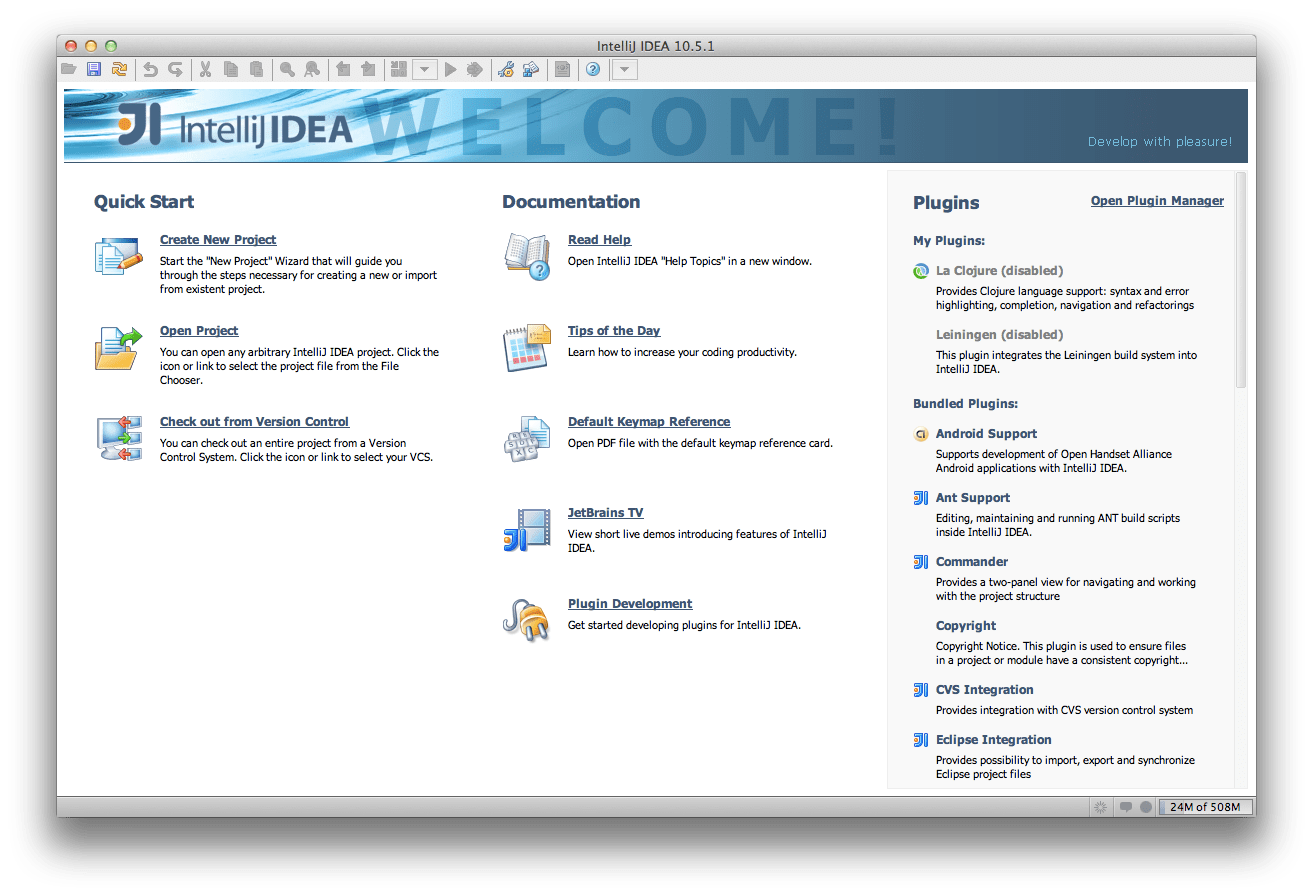
Run it:
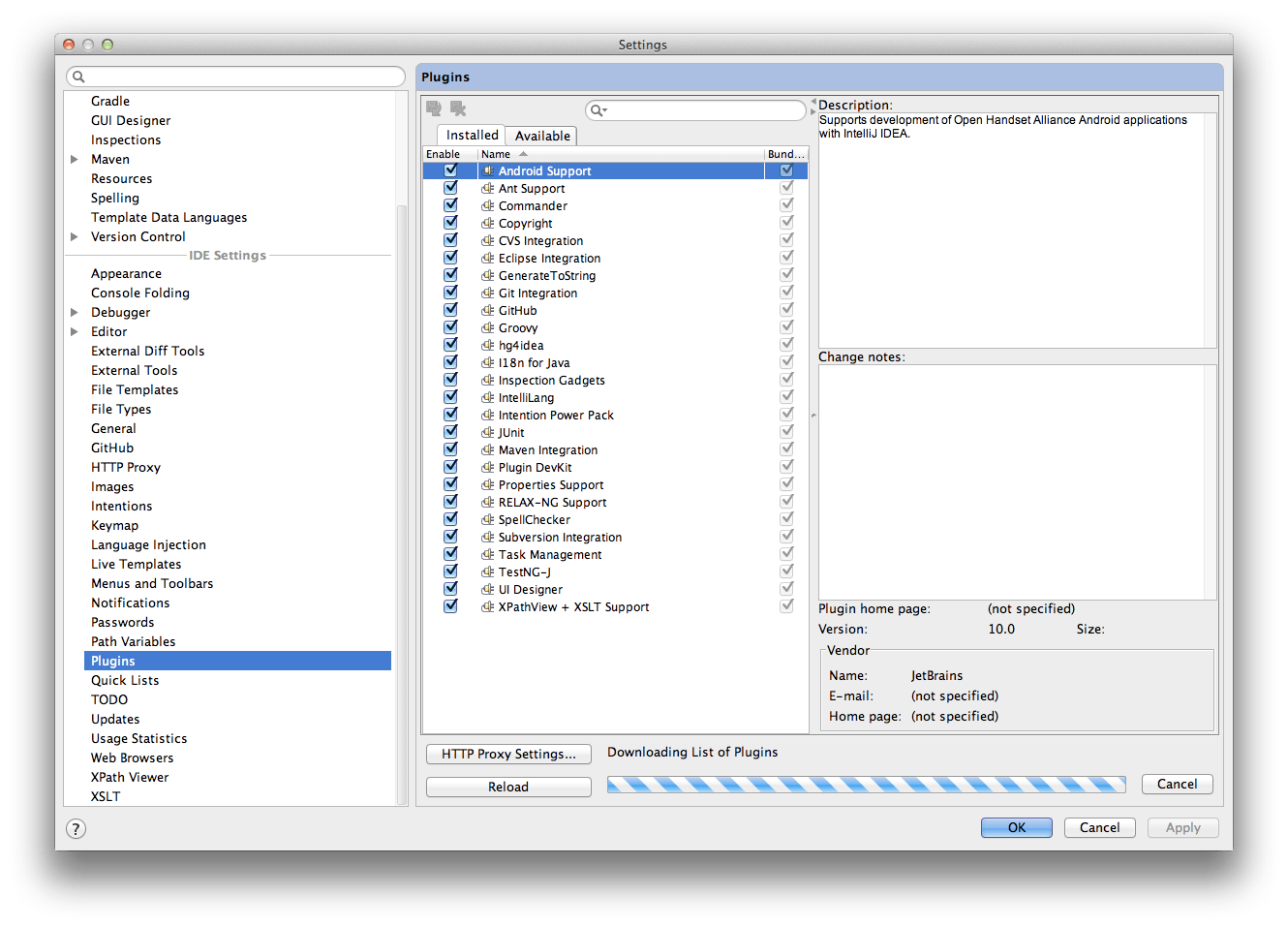
Open the preferences (⌘,) and go to the plugins section:
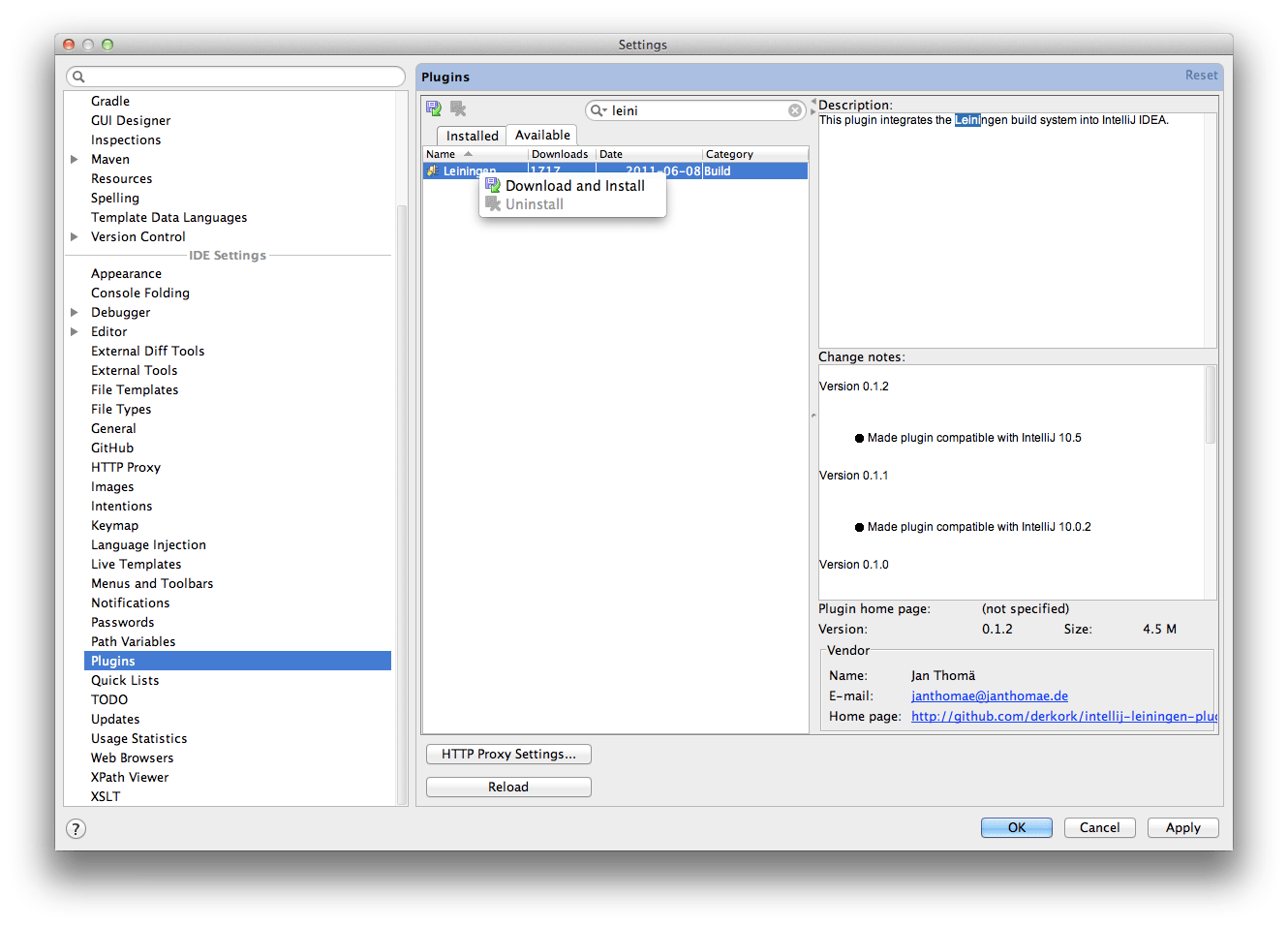
Download and install La Clojure plugin:

Download and install the Leiningen plugin.
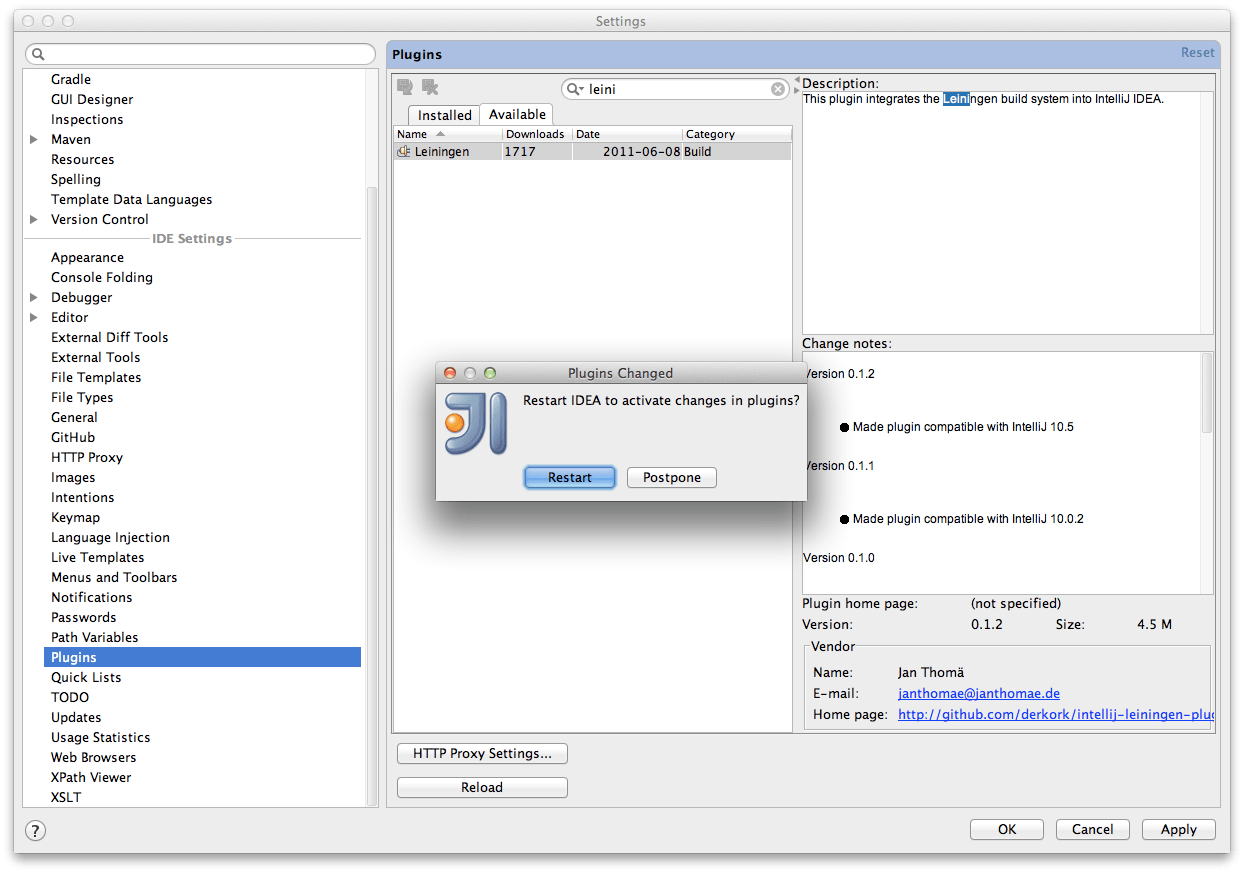
Restart IntelliJ IDEA:
Create a Leiningen project:
lein new foobar
 Created new project in: /Users/pupeno/Temporary/foobar
Open the project in IntelliJ IDEA:
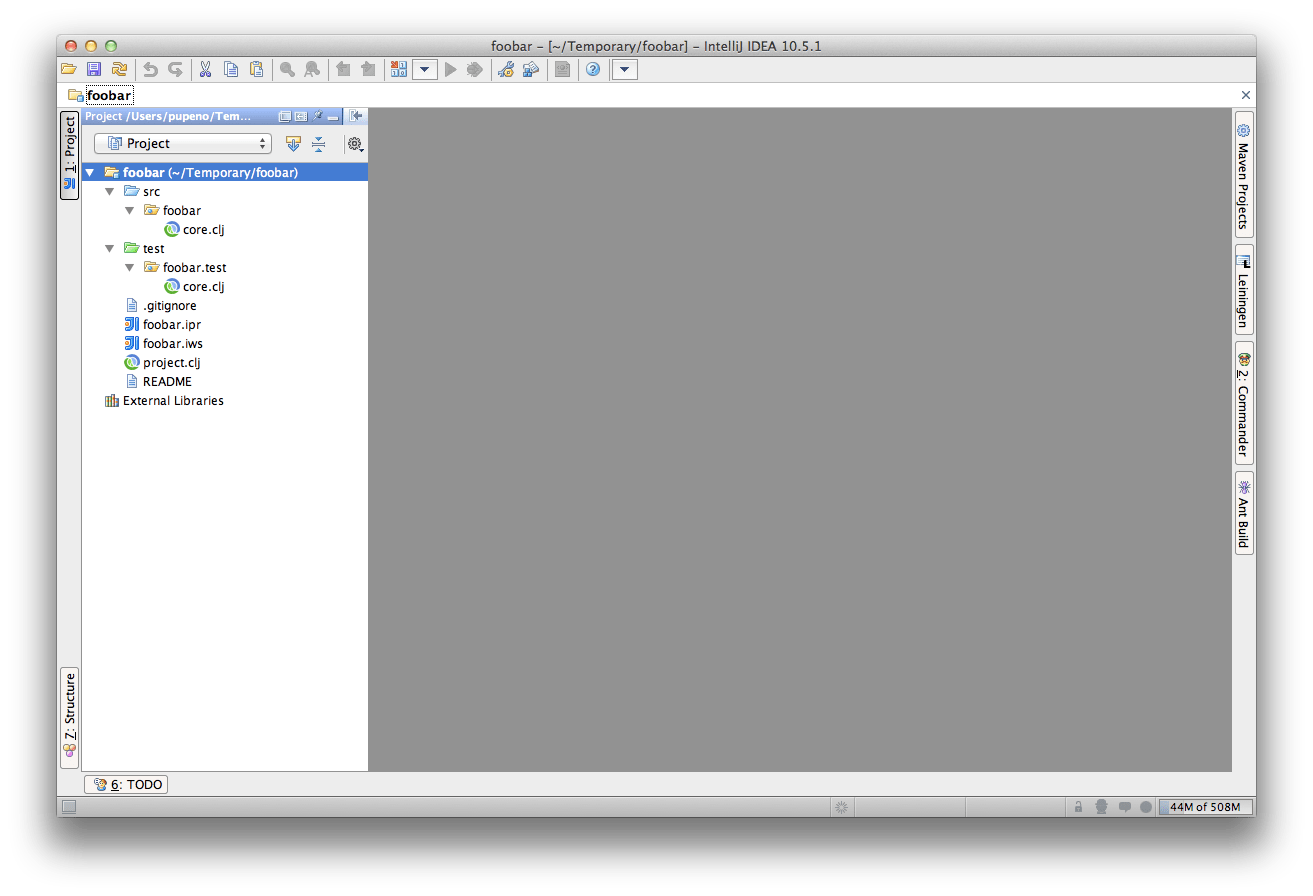
Now open Project Structure (⌘;) and go to SDK. If you tried to run the Clojure REPL and got the error “No jdk for module ‘foobar’”, this is what you need to do to fix it:

Click on the plus sign and add a JSDK:
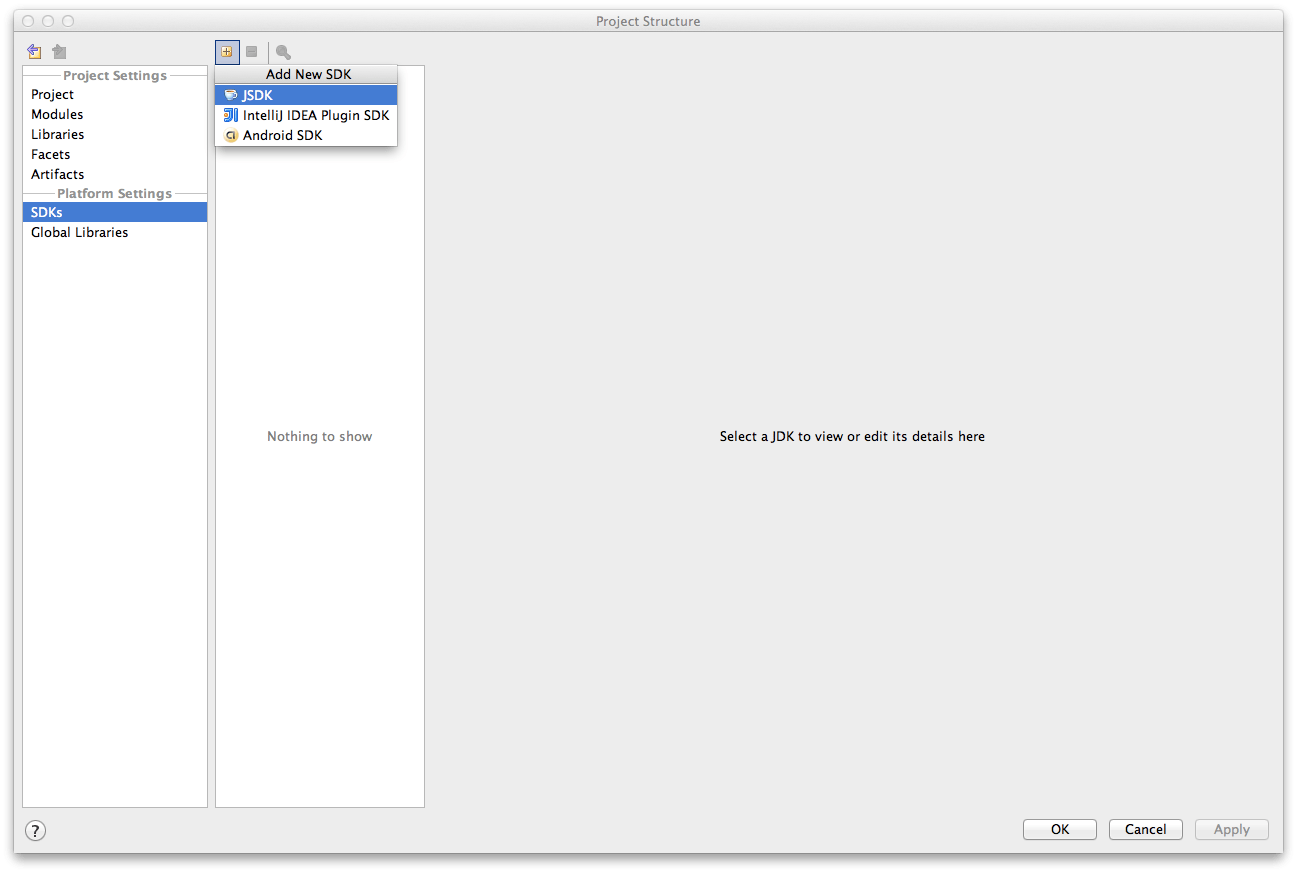
The default is just fine:
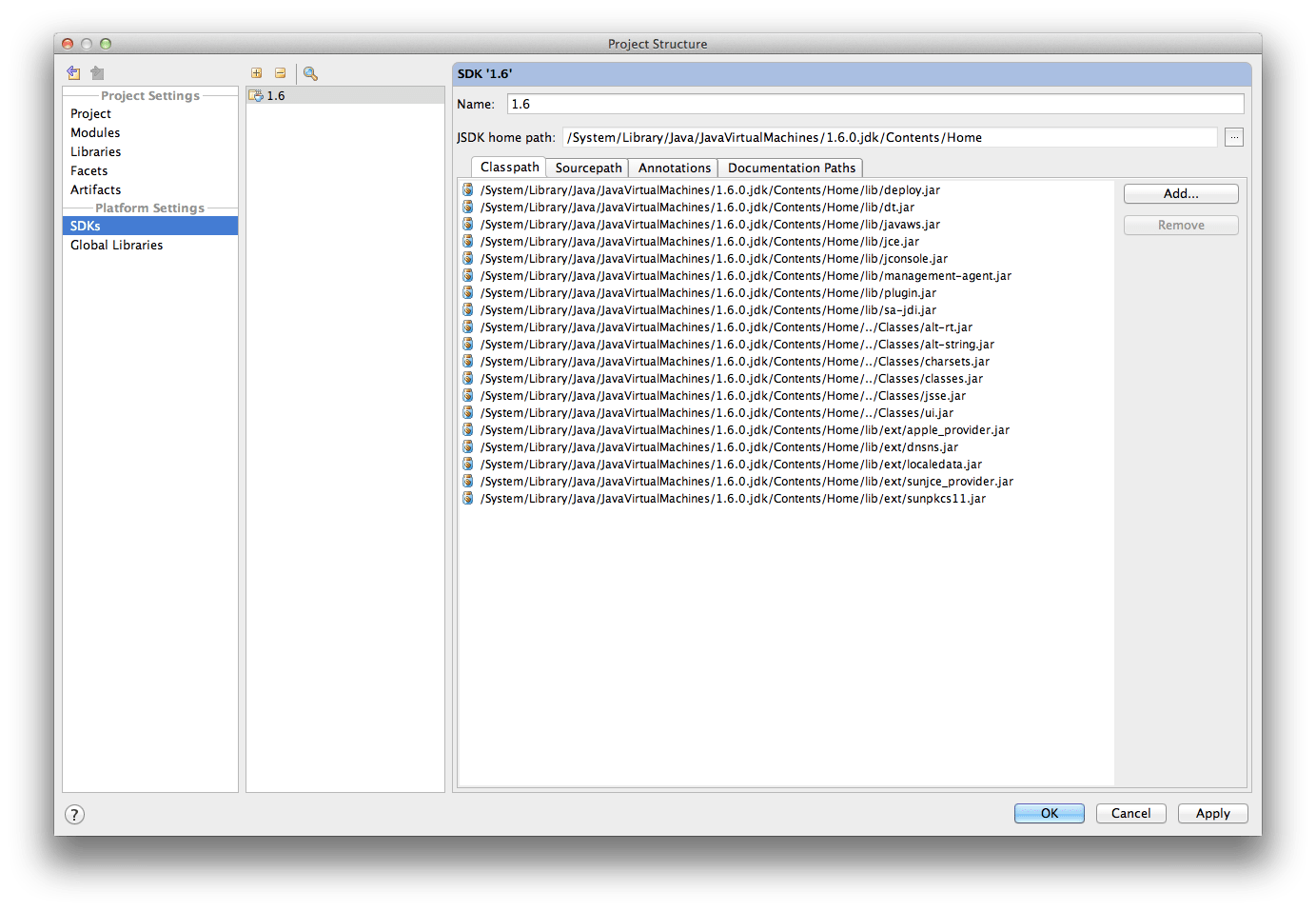
And you should see something like:

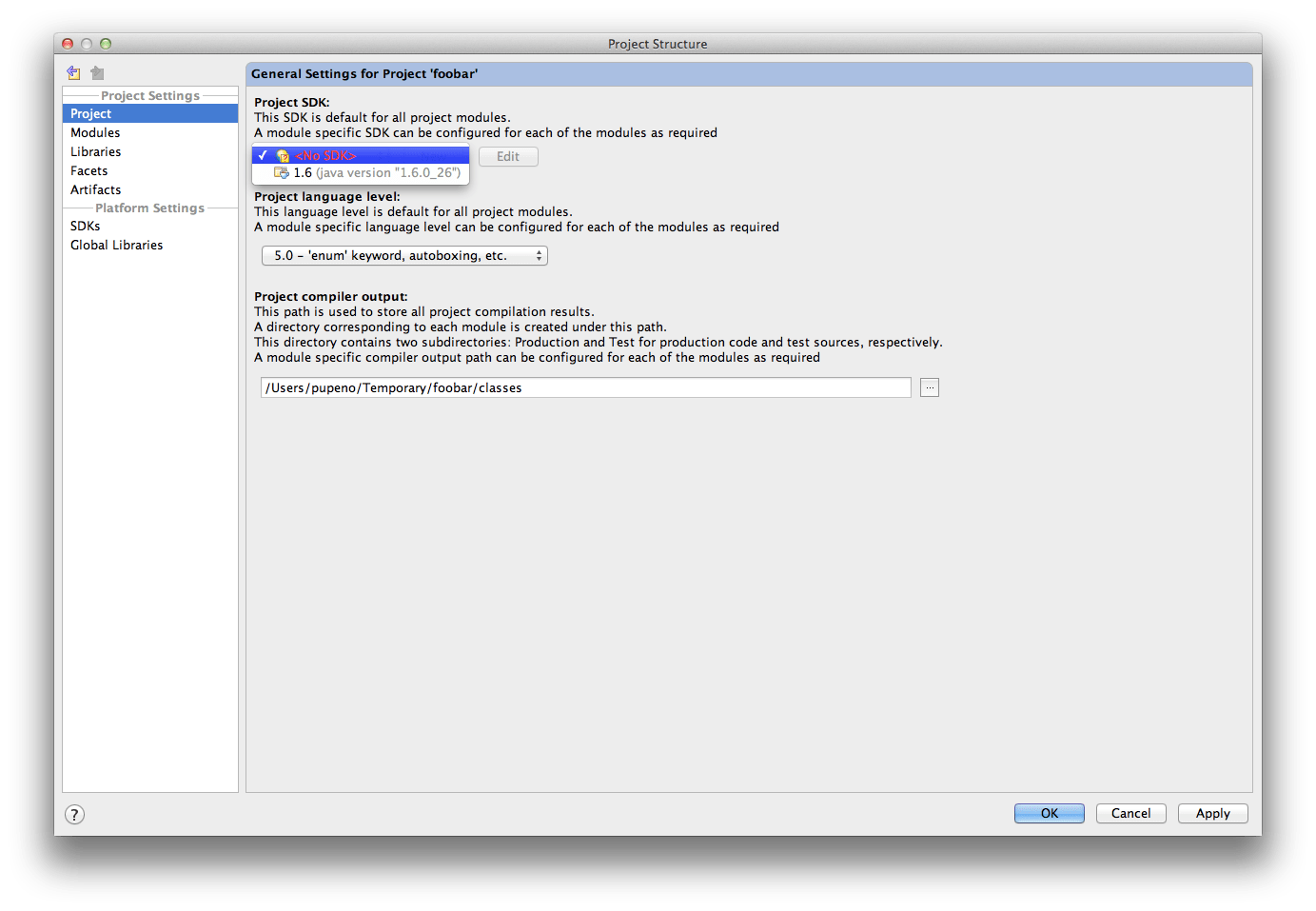
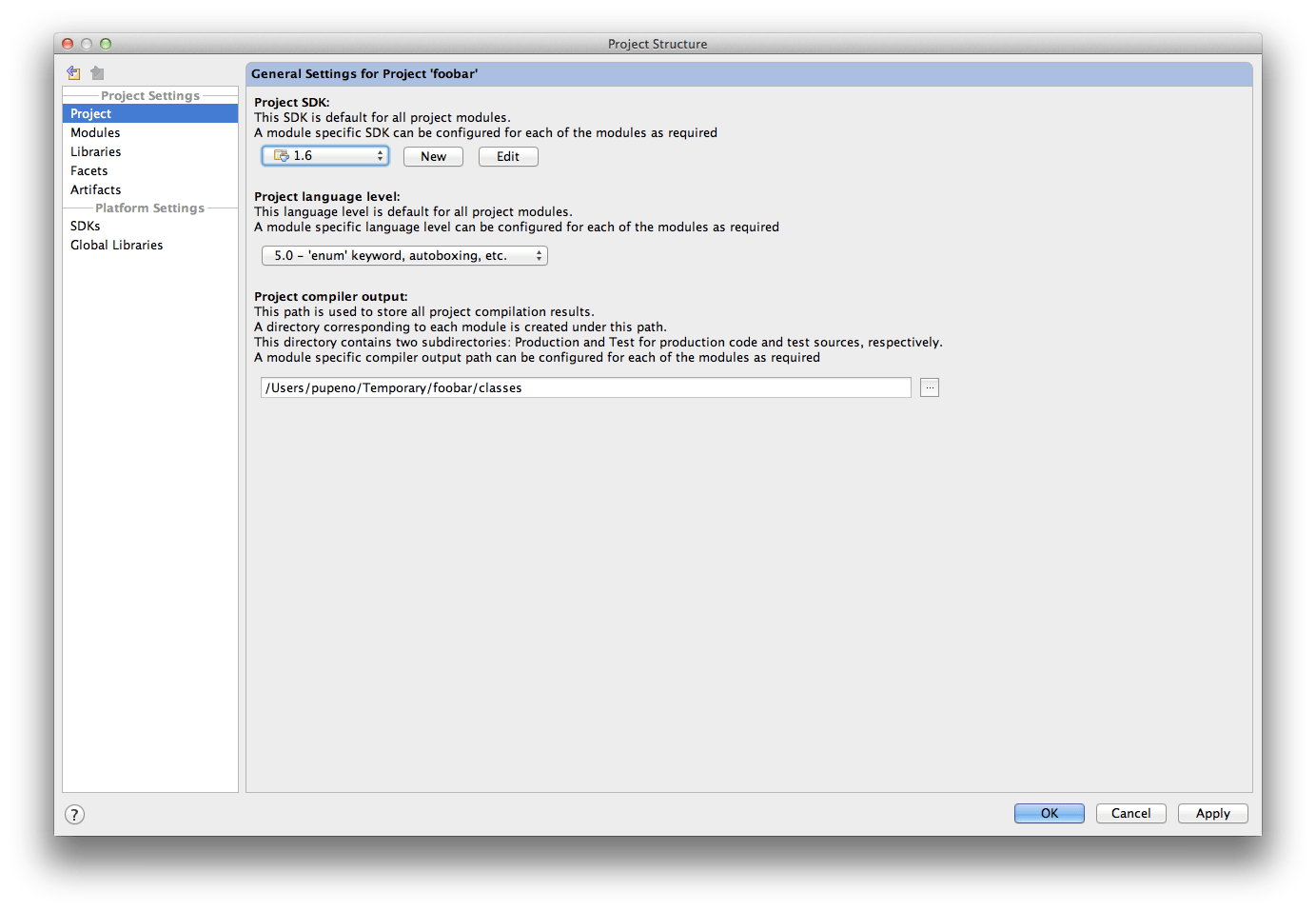
Go to the project
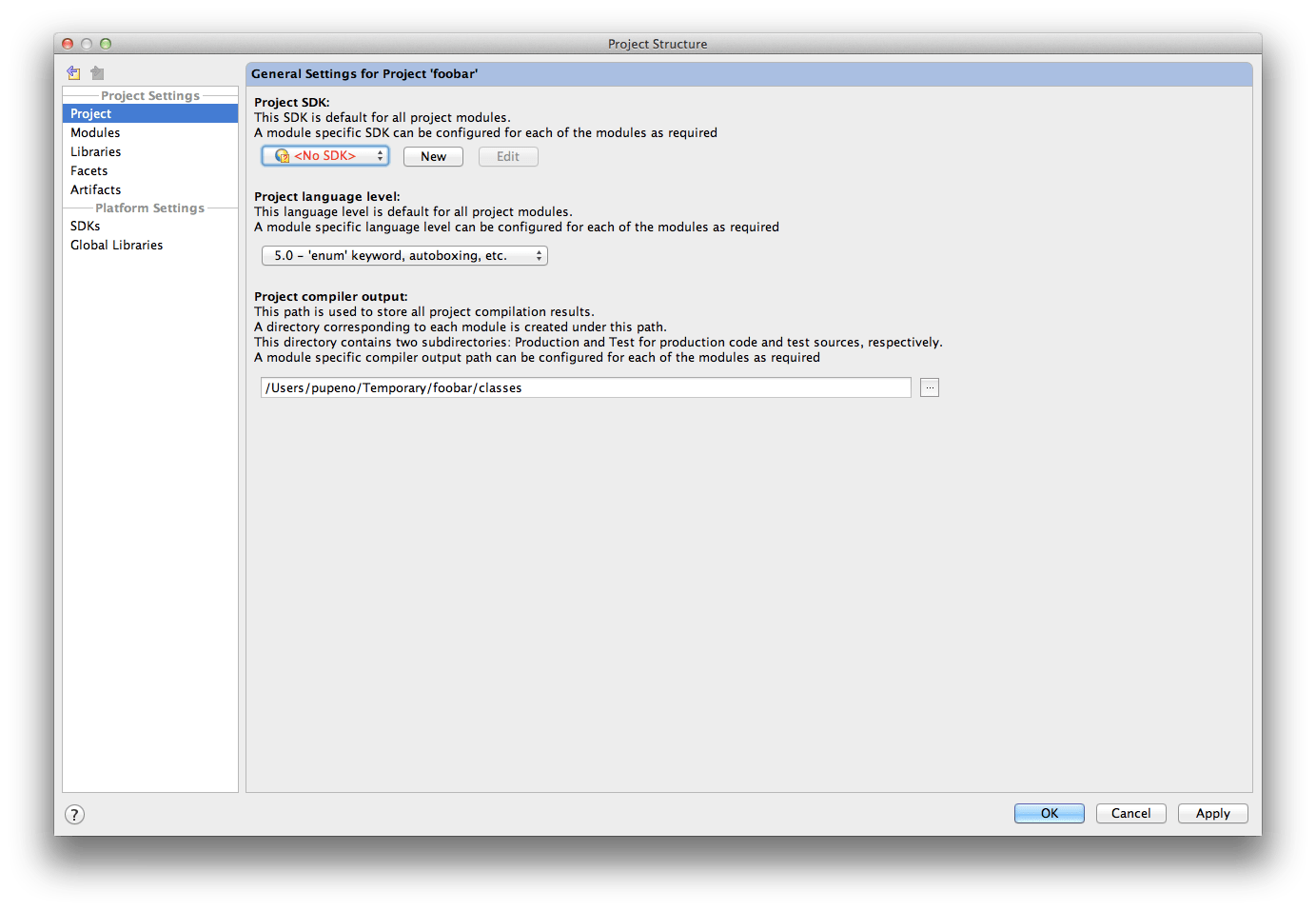
and select the newly created 1.6 SDK:
Go to modules

open dependencies:

and add a single entry:

Use the installed Clojure from /usr/local/Cellar/clojure/1.2.1/clojure.jar:

I’m not totally sure about that step. It might be that the IntelliJ project you are creating works only on a machine where Clojure is located on the same path.

As they say… works for me! Restart IntelliJ… not sure if you’ll need to, but I needed it.
Open the project if it wasn’t open and start the Clojure REPL (⇧⌘F10), it’s in the Tools menu:

It works:

Open a file:

Type a little program, like:
[sourcecode lang=”clojure”]
(defn hello-world []
(println "Hello world"))
[/sourcecode]

Load the file on the REPL (⇧⌘L), which is in Tools → Clojure REPL:

Enjoy magnificent code completion:


and run the code:

And that’s it. Whether IntelliJ IDEA and La Clojure is a viable developing environment only time will tell.
Let’s compare how we print the class-path in Clojure and how we do it on Java.
In Clojure:
[sourcecode lang=”clojure”]
(println (seq (.getURLs (java.lang.ClassLoader/getSystemClassLoader))))
[/sourcecode]
In Java:
[sourcecode lang=”clojure”]
import java.net.URL;
import java.net.URLClassLoader;
public class PrintClasspath {
public static void main(String[] args) {
//Get the System Classloader
ClassLoader sysClassLoader = ClassLoader.getSystemClassLoader();
//Get the URLs
URL[] urls = ((URLClassLoader)sysClassLoader).getURLs();
for(int i=0; i< urls.length; i++)
{
System.out.println(urls[i].getFile());
}
}
}
[/sourcecode]
To be fair, the output is not the same, but the effect is.
Being able to write, build and run a Clojure application, like I explained in a previous article, is not enough. You also want to hack on it, to iterative code on it, after all, you are using a Lisp.
What I mean by iterative coding is something not very few know or do, but it’s extremely common in Lisp. You have you REPL running all the time (that is, generally, the interpreter). You load the code into the REPL, run it, modify some part of the code and re-load it. You may not reload the whole file but only a function on it, and you may have background process running on the REPL, like a web server. It is very powerful. (more…)