When I was 16 years old or so, one day, my computer didn’t boot. I got a blue screen with some white text-mode error. Something was broken with the file system. This was after being utterly disappointed by Windows 95 and before I became a Linux person, so I was running Windows NT 4.0. I was the only person I knew running that operating system, and thus the only person I knew with an NTFS partition.
What to do now? That was my only computer, thus I couldn’t get online, smartphones wouldn’t be invented for another decade, I had nobody to ask for help and no tools to run checks on an NTFS partition. That filesystem was quite new back then. I could just blank the hard drive and reinstall Windows NT and all the software. But what about my data? my data!!!
At 16 years old I learned the lesson that the data is the most valuable and important thing inside my computer. Everything is replaceable. I’m sure if I could see that data now I would life, but for 16-year-old-me, that was my life. I started making backups and since that day I had a personal backup strategy that’s more robust than 90% of the companies I talk to. I have yet to lose a file and I hope to keep it that way. My ex-wife recently recovered from a complete computer failure because she’s following the backup strategy I set up for her.
One of the things I wonder is, should I have to do a total restore of my data, how do I verify it? I have more than 2 million files. Big chunks could be missing and it might take me years to notice. Because I have so much data to backup, keeping my 3 backups all up to date is hard, so it’s possible that I may have to reconstruct my information piecing things together from the 3 of them. Technically my backup software should be able to do it. But… I’m skeptical.
This is why every night I have an automatic script that generates a list of all of my files in a text file. That text file gets backed up and unless that files gets permanently and historically lost, I can use it to verify a backup restore. I think my friend Daniel Magliola gave me this idea.
Since I use Windows (shocker, I know, but try building a Mac workstation with 6 screens and play video games and report back to me), I wrote the script in PowerShell, but since I couldn’t find anything like Linux’s find, the script invokes wsl. Here it is, normally I put it in c:\Users\pupeno\.bin\filelist.ps1:
echo "Creating list of all files in C:"

wsl find /mnt/c/Users/pupeno -type b,c,p,f,l,s > C:\Users\pupeno\.all-files.new.txt

move -Force C:\Users\pupeno\.all-files.new.txt C:\Users\pupeno\.all-files.txt

echo "Creating lists of all files in D:"

wsl find /mnt/d -type b,c,p,f,l,s > D:\.all-files.new.txt

move -Force D:\.all-files.new.txt D:\.all-files.txt

echo "Creating lists of all files in E:"

wsl find /mnt/e -type b,c,p,f,l,s > E:\.all-files.new.txt

move -Force E:\.all-files.new.txt E:\.all-files.txt
And this is how it’s configured in the Task Scheduler to run every night. First run Task Scheduler:
To convince people to come work for you you offer them, aside from compensation, perks. And you try to have better perks than your competitors (other employers). Brainstorming with my friend Justin a few years ago I came up with what I believe is the ultimate perk and since then I’ve been desperatly trying to find a place to deploy it. I haven’t found a place where I feel even comfortable bringing it up, that’s how far I am from deploying it, so I’m sharing it with the world. If I was running my own company, I’d deploy it in an instance, not giving it a second thought.
This is the perk: every developer gets a confidentiality-bound personal assistant. There wouldn’t be one PA per developer, because they don’t need nor have enough work that can be delegated to keep one person fully occupied. Instead there would be one for all of the developers (or two, or three… or whatever you need depending on how many devs you have).
First, I don’t think this would be a very expensive perk, because actually delegating work to a PA is a skill that you have to learn and most developers will not have it. Most developers will not know where to start. But most developers will likely enjoy saying “I have a PA” or “I have a secretary”. Having said that, I would actually run courses for the developers to learn to delegate because…
It’s a perk that pays for itself. You might think you are paying for extra employees or contractors, but your developers are likely the most expensive salaries in your books. So if they can pass a task to someone else, you are saving money, not spending money. Let’s say a developer needs to arrange a call with a vendor to discuss a technical mater. They have to search for the right person, their contact details, go back and forth over emails. Imagine if the developer just tells their PA “Can you arrange that call?” over a Slack message and that’s the end of it. Back to coding!
Think about making reservations, making doctors appointments, running errands, making phone calls in general (this is why they should be confidential). Developers tend to hate phone calls. Imagine if they could delegate to someone complaining about a flight ticket that got canceled! I once had a coworker who spent half a day on hold while pretending to code.
It’s a perk that generates retention: you know why Google pays for food, haircuts, laundry, doctors on-site, etc? It’s because that generates a lot of retention. When you quit Google, you not only need a job, you also need to find a hairdresser, a place to clean your clothes and make doctor’s appointments. They treat you like children and you became as dependent as you were on your parents. I’m not exactly sure where the ethical boundary is here, but offering a free PA feels on the good side of things.
It’s unique: nobody is doing and I bet nobody will start, even after it’s been proven successful. It’s like private offices: we have the studies to prove that developers need silence to focus and yet we cram them in open office buildings. Private offices, and PAs, are for the three-piece suit executives, not for the lowly developer, so it’s not a perk likely to get devalued when everybody picks it up, because nobody will.
It’s loud. Imagine when the developer is hanging out with other developers and jokingly says
Have your people call my people to arrange it
Oh… you don’t have people? I do… this email address and phone number is my PA, just call them… and if you want a PA, come work for us.
You should not send rejection emails to job candidates when there was no interaction. For example, in the case of rejecting someone just from the application, without a screening call.
There’s a mantra that good recruiters and hiring managers take on the difficult task of sending rejection emails instead of just ghosting candidates. But I don’t think this should be a black and white decision. Do you agree? Disagree? Please leave a comment with your point of view, I’m intrigued.
When you had a screening call with the candidate, then the candidate will likely be wondering about the next step, so if the rejection happens at this or any other later stage, then yes, ghosting is extremely rude and you should always send a rejection email and possibly some feedback for the candidate to improve. More on that later.
If there hasn’t been any interaction, you shouldn’t have your only interaction with the candidate be a rejection. The reason for this is that most of us have, at some point, been desperate, and started applying to lots of jobs hoping that someone would pay us some attention, hoping we may accidentally open a door, and because being homeless is worse that shotgunning job ads. And actually, when the job ads are anonymous bland indistinguishable walls of text, there’s not a lot you can do other than hit apply and move on, so don’t hold it against the candidate.
The problem is that then this candidate might have hundreds of applications that result in tens of rejections emails. Rejections for roles the candidate forgot about 10 seconds after hitting apply (how long can you remember a non-descript job post about an anonymous company anyway?), so all you are doing by sending the rejection is reminding the candidate that they didn’t get something they forgot they tried to get. When you get tens of these, one after another, it’s emotionally debilitating. It’s no wonder that a candidate might snap at one too many rejections.
Oh, and about feedback: if you have nothing to say, don’t say anything. If you are going to give feedback, give actionable feedback. Giving someone impossible feedback is a slap in the face. For example, for a few years, I’ve been wanting to have an engineer manager position at a big scale-up or at a big company. When I get rejected and I ask for feedback, most of the time it boils down to “You haven’t been an engineer manager at a big company before”. What am I going to do with that? They might as well tell me “Have you tried being a different person? Have you tried having been born in a different country?” It’s useless and infuriating.
I just got an Icom IC-750 with the goal of going out in the open and the first thing I did is try to configure it with my computer because it’s what’s most convenient for me. I like keeping backups of various configurations and being able to go back to them. I’m also working on a project to help set up repeaters in this and others radios.
Unfortunately, I encountered the error:
Connected transceiver is not compatible model.
Check the following:
Appropriate programming software for the transceiver is being used.
The revision number of the transceiver
What was confusing is that the CS-705 was correctly seeing my connected IC-705:
I tried a few things, but long story short, my IC-705 had firmware version 1.31 and I was running CS-705 version 1.11 when only version 1.20 supports firmware 1.31. Now that I upgraded everything works:
And for the record, I’m running the USB driver version 1.12.
I find the Icom’s website to download the different versions of the software a bit confusing (especially the interactions between Icom UK and Icom Japan), but you can find it searching there
One of my projects, Unbreach, has a database of more than 600 breaches. These come from haveibeenpwned and they are composed of some metadata, a one-paragraph description, and an image. I wanted to improve these with more content, links to articles, tweets, videos, and some content of my own.
I decided that a good way to do it would be to move them from the app, which resides at app.unbrea.ch, to the marketing website, which is at unbrea.ch, essentially creating them as blog posts. That way after the blog post is automatically created (when haveibeenpwned ads the breach), I can go in and manually edit it in all the WordPress glory. I thought this was going to take me a few hours, not days.
Hopefully, with this blog post, it’ll only take you hours. I’ll be using Ruby but it should be trivial to translate it to Python, JavaScript, or any other programming language. Writing the code wasn’t the hard part, understanding the WordPress.com world was.
WordPress has two different APIs that should be able to accomplish this task, one is the XML-RPC API and the other is the REST API. The XML-RCP API depends on a file called xmlrpc.php and it’s strongly recommended you leave this deactivated because it had a lot of security issues. It’s also old, cumbersome, and possibly on the way out. I didn’t want to use it and I don’t think you should either.
From what I can gather the REST API is what the admin tool uses, so using it sounds like a safe bet. If you are going to be creating blog posts from an unattended background process, as I do, you’ll find your first obstacle when you read about authentication because it just assumes there’s a browser sending cookies.
Fear not! There are plug-ins that implement other authentication methods and one of those is the Application Passwords plug-in. Which is now discontinued because it’s been merged into WordPress itself in version 5.6. This sounds promising until you realize the feature seems to be missing in WordPress.com.
If you search how to create an Application Password on WordPress.com you’ll land in the wrong place. WordPress.com users have an Application Password that’s hidden behind the Two-Step Authentication in Security. This is what it looks like:
If you are here you are in the wrong place
What’s going on here? Well, WordPress.com has its own API, which is a REST API, and if you talk to support and WordPress.com they’ll point you to that. I wasn’t a fan of that solution because although I want to use WordPress.com, I don’t want to be tied to it. I want to be able to move to WP Engine or something like that whenever I want.
That API, similar to the REST API, assumes there’s a human interacting through a third-party application, so it’s not great for unattended processes. Authentication works using OAuth2 which for a background job that just needs an API key I find very annoying. It’s doable but annoying. Well… it’s doable until you enable 2FA and then it’s not doable anymore, and that’s why that specific Application Password exists.
WordPress.com support also told me that the WordPress REST API is enabled only if you are on a business plan or above.
So… where’s the Application Password for the REST API then? I don’t know if there’s a link to it anywhere, but you get to it by going to https://example.com/wp-admin/profile.php where example.com is the URL of your blog. That is, add /wp-admin/profile.php to it. On WordPress.com’s defense, it was their support that finally pointed me to it. When you go there you’ll see an old-style profile page:
The correct place to set up an application password to use the WordPress REST API
The previous Application Password was tied to the user, this one is tied to the user and the site, so if you have more than one site you’ll need to create one per site.
And that was the hard part. Once I got that application password things just worked. It’s a straightforward and mostly well-documented API. I’ll share my messy code here anyway (sorry, didn’t have time to clean it up).
In Ruby I’m using a library called Faraday to talk to APIs. The first thing is creating the Farady object that has the metadata that will be used in all the requests:
The first thing I need is the id of the category in which these posts will end up. This is very important because they appear on a separate page about breaches and not on the blog and that’s achieved with categories:
Now, if the category doesn’t exist, I want to create it:
if category.nil?
  response = conn.post("/wp-json/wp/v2/categories") do |req|
    req.body = {name: "Breach"}
  end
  if response.status != 201
    raise "Unexpected response #{response.status}: #{response.body}"
  end
  category = response.body
end
Then I needed to do the same with tags. In my case, the tags were in a field called data_classes and the code for getting the id of the tag and creating it if it doesn’t exist is very similar:
tags = data_classes.map do |data_class|
  response = conn.get("/wp-json/wp/v2/tags", {search: data_class, _fields: %w[id name]})
  if response.status != 200
    raise "Unexpected response #{response.status}: #{response.body}"
  end
  tag = response.body.find { |tag| tag["name"] == data_class }
  if tag.nil?
    response = conn.post("/wp-json/wp/v2/tags") do |req|
      req.body = {name: data_class}
    end
    if response.status != 201
      raise "Unexpected response #{response.status}: #{response.body}"
    end
    tag = response.body
  end
  tag
end
And finally, we can create the post. I create the content as an HTML snippet which causes WordPress to interpret it as classic content, not as blocks. But that’s fine because it renders well and the first time I edit one of those posts converting them to blocks is two clicks and works perfectly for this simple content.
At this point, I wasn’t done. I wanted these posts to have the image associated with the breach (the logo of the company breached). The first step was downloading it which was a trivial one-liner:
In that code, logo_path is actually a full URL of the file.
To create media items in WordPress, I needed to encode the post as multi-part, so I ended up creating a separate Faraday object for that:
multipart_conn = Faraday.new(url: ENV["WORDPRESS_URL"],
  headers: {"Authorization" => "Basic #{auth_token}"}) do |conn|
  conn.request :multipart
  conn.response :json
end
It should have been possible to use a single Faraday object for all requests, but when you specify multipart, you need to take care of encoding the JSON requests yourself and adding them as one of the parts. This is where I got lazy and just moved on with my work.
The code for creating the image in WordPress is this:
extension = File.extname(logo_path)
file_name = "#{name.underscore.tr("_", "-")}#{extension}"
content_type = if extension == ".png"
  "image/png"
else
  raise "Unexpected extension #{extension}"
end
media = multipart_conn.post("/wp-json/wp/v2/media", {
  date_gmt: (breach_date.to_time(:utc) + 12.hours).iso8601.to_s,
  status: "publish",
  title: title,
  comment_status: "closed",
  ping_status: "closed",
  alt_text: "Logo for #{title}",
  caption: "Logo for #{title}",
  description: "Logo for #{title}",
  post: post["id"],
  file: Faraday::Multipart::FilePart.new(StringIO.new(logo_request.body), content_type, file_name)
})
In reality, 100% of the images are PNG so I was ok with such a simplistic approach. When creating the FilePart I wrapped logo_request.body in a StringIO because it already contained the binary data of the image. If you have a local file you can just pass the path to FilePart.new and it just works.
And now that I had the image, I could set it as the featured image for the post I created earlier:
response = conn.post("/wp-json/wp/v2/posts/#{post["id"]}", {
  featured_media: media.body["id"]
})
if response.status != 200
  raise "Unexpected response #{response.status}: #{response.body}"
end
The reason why I didn’t create the image before creating the post was so that I could pass the post id to the image and thus the image would be connected to the post. I’m not sure how useful that is.
And that’s all.
I wonder if this code should be put in a gem and made reusable. WordPress points to the wp-api-client gem as the Ruby solution, which is read-only and abandoned. There’s also wordpress_v2_api, but I wasn’t a fan of the API (it’s almost like using HTTP directly), it hasn’t been touched in 6 years and I don’t believe it supports writing. I’m half tempted to fork wp-api-client, but does anybody else care, or is it just me? Please leave a comment if this is something you want to use.
Originally my book was called “Building and Managing Distributed Teams“. I loved that title and people in my social circle loved it too. A friend of mine even told me something along the lines of “I’m so envious I wish I had that title”. And for the two years or so that it took me to write, abandon, restart, abandon again, restart and finally finish the book, I was happy about the title.
I had three different people ask me what I meant by “distributed”. The first time I ignored it, the third time I panicked.
As I finished writing the book and it went into proof reading phase, I thought I should try to market it a bit. I’m self publishing, doing everything, including promotion and marketing (hint: I can use your help in getting the word out). During conversations I had three different people ask me what I meant by “distributed”. The first time I ignored it, the third time I panicked.
I’ve been working from home since the early 2000s. I’ve been building remote/distributed teams and companies since 2011 or so. At the beginning we were called and we called ourselves remote workers. But that soon started to carry a stigma. Companies would have in-office workers and remote workers and remote workers were second class citizens.
This created a division between being a remote worker and working for a distributed company. The latter was much better.
The companies that wanted everybody to be remote, the companies that were remote-first, the companies were being remote didn’t mean second class citizen started calling themselves distributed. This created a division between being a remote worker and working for a distributed company. The latter was much better. The movement of distributed work was growing, Automattic, Github, and many other companies were charging ahead… and then the pandemic happened.
I don’t think the amount of people using the term “distributed” changed during the Covid pandemic, but the amount of people using the term “remote” did and might have turned “distributed” into a rounding error. The natural change of title for my book would have been from:
Building and Managing Distributed Teams
to
Building and Managing Remote Teams
I wanted to measure this, but I couldn’t find any way to do it. I tried Google Ads but I couldn’t make it work and no other method seemed to even be feasible. One of the problems I had is that I believe polls would be useless, because once you give context to “distributed”, I think everybody understands it, and it might sound better. I wanted to see how they behave in isolation. At any rate, “remote” won in polls, but not overwhelmingly.
Since I was going to change the title, I may as well consider any and all possible titles, not just a single word change, right? My friend, Justin Megawarne, came up with a very important point: the title doesn’t contain the value proposition. Think of the book “The Four Hour Work Week” by Tim Ferris. If it would have had a descriptive title, like “How to Delegate Work”, he would not have been a bestseller author.
I tried to find a value proposition name for my book and I gave up
I tried to find a value proposition title for my book. Companies struggle to hire, grow and manage in-office teams. This is a pain that exists. My friend and advisor works with many companies like that, he wants to recommend them my book, but he knows they don’t believe a book by that title has the solution to their problems. I tried to find a value proposition name for my book and I gave up.
If I remember correctly it took Tim Ferris weeks of research to come up with the title and cover of his book. I don’t have weeks to dedicate to this, in part because even with the perfect title and cover, without an editor and publisher, with just my own ability to market, it’s not going to have a positive return on investment. And thus, the new title was selected:
I did introduce some extra changes. From the conversation with Justin I switched “Building” for “Hiring”, to have the keyword of the pain point a lot of companies are going through. I also asked Ana Bibikova for her opinion since she’s both a marketer and an author. She advised me to switch from imperative phrasing to “How to”. I’m not sure what the effect will be, I don’t have a strong opinion and I trust hers.
And now, the list of explored and abandoned titles:
Building and Managing Distributed Teams (current)
Building and Managing Remote Teams
Hiring and Managing Remote Teams
Find the Best Talent Everywhere
Hire the Best and Keep Them
Stop Struggling to Hire and Managing Remote Teams
Hire Remote: Manage Remote: Stay Remote
Hire Remote, Manage Remote, Stay Remote
Doing It Better Remotely
Hire, Manage, Stay: Remote Working and What It Should Look Like
Do Better: Hiring and Managing your Remote Team
Remote Teams Done Really Badly (A How Not To)
I think some of those might come back as titles of blog posts.
I’ve hired about 20 developers in my career so far (and I’m looking forward to hire more). When job applications arrive I separate them in three piles: Yes, No, and Maybe. It’s better to do Yes and No piles, but it’s a luxury that I haven’t had (if curious, drop a comment and I’ll write another blog post about it).
In the No-pile I put all those people that are obviously not a match, people that explicitly tell me they never wrote code before, people outside the time zone target, applications with grammar so bad I can’t understand them, etc.
[…] the most important bit: I find some evidence that they have written code before.
In the Yes-pile I put all those that show promise. Their application looks good, their profile match and this is the most important bit: I find some evidence that they have written code before.
The rest of the applicants go to the Maybe-pile. They are not discarded, but I’m going to focus on the ones in the Yes-pile first because I believe I’ll find more successful candidates there than in the Maybe-pile. This doesn’t mean that someone brilliant isn’t in the Maybe-pile. It only means that I couldn’t find any evidence about their potential brilliance.
Landing on the Maybe-pile is almost as bad as landing on the No-pile
Here’s the kicker: I never get to the Maybe-pile. I always find all the candidates I want from the Yes-pile. Landing on the Maybe-pile is almost as bad as landing on the No-pile.
There are many ways in which you can make yourself go from the Maybe to the Yes pile. These are the best ways: blogging about code you write, writing tutorials, contributing to open source software. Having done all of that will not only put you in the Yes-pile, it’ll probably put you at the front.
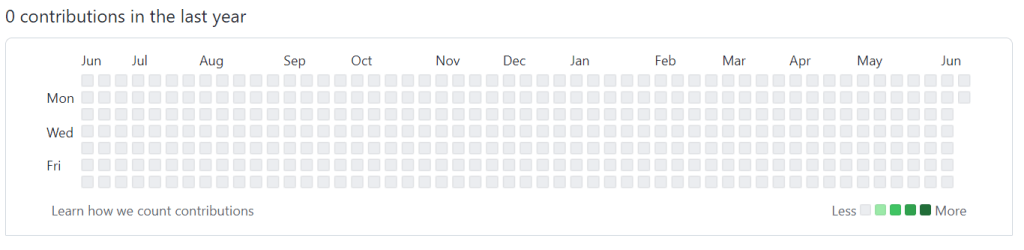
But those are things that require a lot of time an effort. There’s another thing that may only require a couple of minutes. If you’ve been using your GitHub account for work or for university, that account has a lot of activity. You may not be able to show code from work and you may not want to show code from university, but you may show the activity. Go to your Public Profile settings and tick “Include private contributions on my profile”:
This, if you have any private activity, will turn your public GitHub profile from something that looks like a ghost town:
into something like looks more lively:
The latter looks like a developer that wrote some code. It will not send you to the top of the Yes-pile, but if the rest of your application looks good, it might be enough to send you to the Yes-pile and it’s a change that requires only a few seconds.
Now, if you are in the know, you might object that this is completely fakable, and you are right. Yet, I don’t see people faking it. I see lots of empty profiles looking sad and empty, so it’s still a useful signal.
I’m not trying to find a perfect way to evaluate candidates, I’m trying to find a heuristic to help me find which ones to evaluate first
Even if some people fake it, I might still continue using the signal. It’s not like you don’t have to pass all the interviews after this anyway. Remember that I’m not trying to find a perfect way to evaluate candidates, I’m trying to find a heuristic to help me find which ones to evaluate first because it’s impossible to evaluate everyone.
Now, if you decide to fake it, you have two paths. The first one is to just fake, essentially lying about it. That’s a deception. The second is to troll. You can spell out your name or draw something in that part of GitHub. I won’t know if you have real activity or not, your profile won’t look as empty, but at least I know you know enough about coding to pull off that.
You could argue that because some people wrote the code to make that happen and uploaded to GitHub, all you have to do is find it and run it, and it doesn’t prove that you are above script kiddie. And then again, most applications I have don’t even have script kiddie level of a display of ability, so you may still be coming ahead.
I started coding when I was 7 years old and until I was 29 or so, my whole professional life was coding. Then, the startup I co-founded had to hire some people because it was doing well and I became a manager. I discovered I love managing as much as coding, but there was an ongoing issue: at the end of a day coding, I could look back at my code and feel productive, whereas at the end of a day managing, mostly meetings, I felt exhausted and with nothing to show for.
I highly recommend it to all managers: write down notes.
I’ve been managing for 10 years, taking over and building teams from scratch, being hands on and hands off and that feeling of not being productive is rarely there and I think there’s one habit that I have that helps a lot and I highly recommend it to all managers: write down notes.
I go into every meeting with some note taking tool. If the meeting is face to face, I prefer to stick to pen and paper, because a computer can stablish a divide. The other person doesn’t know what I’m typing, I may be chatting with a friend. With pen and paper it’s immediately obvious I’m taking notes and there’s no wall (the screen) between me and the other person.
But now we are all remote, and the notes are digital. This is so much better because it cuts down (but doesn’t completely remove) the need to process notes post-meeting. Depending on the type of meeting, I even share my screen so the other person can look at the notes I’m writing. You have no idea how many misunderstandings were caught this way. They said something, I misunderstood them, wrote it down in front of them and they corrected me. If you are not sharing notes, repeat what you wrote to the other person to have the same effect. This is similar to active listening.
There are a few more things that I do with my notes that I highly recommend.
I try to make all my meetings 50 minutes long, with 10 minutes to review and action notes. If we reach the 50 minute mark, ideally, I want to just book another one to continue. Having meetings overrun and everybody being late to the next meeting is very bad to the morale of a company but being the only person enforcing the strict end of meetings can be hard.
When I review the notes, if the meeting was just the two of us or sensitive, I write them down on an email and I send them to the other people in the meeting. This helps have a shared record of what happened. Otherwise I write them down on a public record in a centralized documentation system, like Confluence or Notion.
Looking at my written notes gives me the same feeling of accomplishment than looking at my written code. I’ve done something.
Once a week I go through my week worth of notes to see if I have missed something. If they are written on paper this is when I digitize them for permanent record. This also informs the report to my boss about what happened that week. Looking at my written notes gives me the same feeling of accomplishment than looking at my written code. I’ve done something.
If the book is amazing and you need to highlight stuff, buy the Kindle version.
If it’s a book that you lend or give away, buy paper versions
Here’s my workflow for choosing:
Use Audible whenever possible, because going through audiobooks is much easier than going through any other format.
If the book has code or diagrams, most likely the audiobook won’t exist, but if you need to chose between Kindle and paper, choose paper. Big pages, diagrams, code, thumbing through pages are things that paper beats Kindle any day.
If the book is amazing and you need to highlight stuff, buy the Kindle version. If it’s amazing, re-reading it is probably a good idea and Kindle is really good at highlighting sections. If you need to write notes, the Kindle device is not that good, but the Kindle app on your phone is and they do synchronize, so you can switch back and forth. If you are a non-linear note-taker, the paper version might be better.
If it’s a book that you lend or give away, buy paper versions. Digital can’t be given away (not easily).
If it’s fiction or something you’ll read very linearly and you won’t listen to the audiobook, buy the Kindle version. This is where Kindle is the best.
If you want it signed by the author, or on your shelf, buy the paper version. A few times I listened to a book and it was amazing and I bought the paper version just because I want it sitting on my shelf. This is more book collecting than book reading and there’s nothing wrong with it.
If you are in front of it at a shop and want it, just buy it. Don’t be dogmatic about using a single format for everything, be a multi-format reader.
And now, the background story…
I’m a book lover, I grew up in a house that didn’t have a library, it was a library. When I was a kid my mom told me “We always have money for books”. I actually found the limit of that statement, but that’s another story. By the time I moved out of my parent’s house, my own collection was about 200 or 300 books. I’m not sure, I didn’t keep it. I gave most of it away to a friend that was setting up a used book store during the 2001 Argentina financial crisis and the only reason it didn’t break my heart was because helping my friend came first. I like paper books, their feel, their smell. I have a small collection of signed books that a prize possessions.
For a while I tried switching to one format to rule them all, but it doesn’t work.
But I also love tech, I’ve been coding since I was 7 years old, and always playing with the latest technologies. Reading from an electronic device where I can access all books and all information gets me excited. I bought some of the earlier ebook readers, made by Sony, before Amazon dominated the industry with the Kindle. And like most of us, I’m very busy, and sitting down to read a book is not something that comes easy. When I started to use Goodreads I realized how little I was actually reading and I didn’t like it. Audiobooks came to the rescue. They allow me to read a book while doing mindless but necessary activities, like chores, working out, commuting (not a lot of that happening lately).
For a while I tried switching to one format to rule them all, but it doesn’t work. Books are not all equal. Some work very well as audiobooks, some work very well in Kindle, and some require paper to be consumed. My method of reading books might seem a bit inefficient in that if I want to write notes, I end up reading a book twice. But if the end result is that I read more books, that lower inefficiency doesn’t matter because I increased my efficacy.
If you are reading this blog post, I expect you are very familiar with paper books but considering Kindle and Audible, so I’ll just talk a bit more about them.
With Kindle, you can have apps on your computer, phone and tablet as well as dedicated Kindle e-readers. They all connect to your Amazon account and they all get the same books and synchronize in which page you are. That means you may do most of your reading on a Kindle device, but open the app in your phone when you find yourself with some time to kill (better than doom-scrolling). You can start to experience Kindle with just your phone or tablet and buy a Kindle e-reader only if it’s working for you, but let me tell you, the screens on those e-readers are so much better for reading than your phone, they are much closer to paper.
Kindle Paperwhite: to me this feels like the Kindle. It has some very important features: waterproofing and warm light. This is the one I recommend to most people.
Kindle: the most basic e-reader. If you want to save money, if you want to try, maybe this is a good starting point.
Kindle Paperwhite: to me this feels like the Kindle. It has some very important features: waterproofing and warm light. This is the one I recommend to most people.
Kindle Paperwhite Signature Edition: ok Amazon, you need to get better at naming things. What happened here? I don’t see why anyone would get this one to be honest. Auto-adjusting light? meh, I will adjust it anyway. Wireless charging? I plug my Kindle every other week. 32GB instead of 8GB makes no difference, books are tiny (unless you are storing audiobooks, which I don’t think you should).
Kindle Oasis: this is the top of the line, the most expensive, the luxury version. This is the one I have and it was a present. What used to be its killer feature, warm light, is not present in the Paperwhite version. It has some nice features, like the auto rotate page, the buttons, the mobile connectivity, but those only add value if you actually use them. Auto-rotate and buttons may be useful depending on how you hold the book. They are useful to me, but it’s hard to predict if they’ll be useful to someone else.
Some extra things to keep in mind when buying a Kindle:
You can store audiobooks in them, but then you need to pair your headphones to your Kindle. I have enough trouble with my headphones being paired to my phone and computer, I don’t need another device. When I’m listening to audiobooks I’m on the go, working out, doing chores. I have my phone on me, but not my Kindle on me. I don’t think this is a very valuable feature.
All Kindles come in two versions, with and without ads. I don’t know if you can upgrade to not have ads, I always bought mine without ads. Make sure you choose what’s appropriate for you. They also tend to have deals with Kindle Unlimited. Kindle Unlimited is like the Netflix of books, where you don’t pay for each individual book. The catalog is hit or miss and I never got it. My partner reads way more books than me and she got it for a while. If you start a free trial, make sure to set a task to stop it to allow paying for a subscription you don’t want.
When purchasing a Kindle, you can choose to have it tied to your account already. It’s a sort of pre-setup that they do. If it’s a present don’t chose this option. If it’s for you, it’s convenient.
Kindles have two ways of connection to the Internet: wi-fi and mobile. Mobile now is only available in the Oasis, the most expensive one. I never got a Kindle with mobile connectivity but I had friends that did. If you are a person that’s on the go a lot, that might be convenient, because it’ll keep your page synchronized even when wi-fi is not present. If I’m on the go and I want to buy a book, what I do is make my phone into a hotspot, connect my Kindle to it, and then buy and download the book. This is very rare.
I can’t comment on the Kindle for Kids since I never tried. Amazon lets you form a family and then everybody in the family can see the books of others. Unfortunately an Amazon family can only have two adults, which I find frustrating.
Understanding Audible
Amazon bought Audible, but it’s not completely integrated into the Amazon ecosystem yet. There’s a separate app from Kindle called Audible that you use to listen to audiobooks although the Kindle e-readers can also play the same audiobooks and I believe the Kindle app can do it as well. I still recommend you just use the Audible app on your phone, because you already have your headphones connected to your phone and your phone on you, what you need to listen to books.
You can buy audio books one by one, but they are quite expensive. Audible offers several memberships that are much cheaper per book. There are four offerings:
Audible Premium Plus: 1 credit per month.
Audible Premium Plus—2 Credits: 2 credits per month.
Audible Premium Plus Annual—12 Credits: 12 credits per year.
Audible Premium Plus Annual—24 Credits: 24 credits per year.
Who named these plans? This names are terrible, but that’s for another blog post.
These plans give you credits. Once upon a time, books could cost 1 or 2 credits, depending on the length. I haven’t seen a book costing more than 1 credit in ages, so when you see “credit” you can read “book”.
The higher you go in plan, the cheaper per credit they become, as you would expect. But the annual ones have an extra benefit. Credits accumulate so if you don’t use them, they’ll just pile up (at some point I think they expire, but that’s not a problem I had). If you find yourself with 0 credits and you are in a monthly plan and you want a book, you’ll have to buy the book, at its cash price, which can be as bad as double or more what a credit costs. If you have an annual plan, you can renew early. For example, I have the 24 credits per year, but if I run out of credits, and this has happened, I just click the renew button and start another year of subscription on that day.
If you have an annual plan, you can renew early. For example, I have the 24 credits per year, but if I run out of credits, and this has happened, I just click the renew button and start another year of subscription on that day.
My recommendation is that you get the 1 credit per month plan to give Audible a try, and if it’s working well for you after 3 to 6 months, switch to the 12 credits per year. If you run out of credits, then consider renewing early or switching to 24 credits per year.
Some books in Amazon have a feature called whispersync. This allows to synchronize the page in Kindle with the position in Audible. You can be listening to a book in the car, get home, pick up your e-reader and continue reading. When a book has whispersync and you own one of the two mediums, generally the other one is much cheaper. I think buying audiobooks on deal through whispersync after you bought the Kindle version is cheaper than a credit (but Kindle + audiobook is way more than a credit). If you only use Audible with whispersync-ed books, a membership might not make sense at all. I can’t comment beyond that because I have never used whispersync.
And that’s all. I hope this post helps you become a multi-format reader and that allows you to read more. It certainly help me:
The term one-on-one evolved to refer to a specific type of meeting and does not mean any general meeting that has two people on it. One-on-ones are the regular meetings between a manager and each of their reportees. One-on-ones are always important but in a distributed team they become critical – mainly because you are not going to be able to run into your reportees on the hallways and have a quick meaningful conversation opportunistically.
A one-on-one has several goals and I recommend the relevant chapters on The Hard Thing About Hard Things (Ben horowitz) and High Output Management (Andrew Grove) in order to understand more about how to conduct them and their importance.
The main and most critical role of the one-on-one is to identify problems, or potential problems, as early as possible. By the time one of your employees tells you they have another job offer, more often than not, it’s way too late to do anything about it. The issues leading to their moving posts will have started long before, perhaps months, and the opportunity to address them will have been when it first arose. If you’re not aware, and not providing the opportunity for your worker to make you aware, a problem can fester beyond the point of salvation. The one-on-one aims to reduce this possibility.
A one-on-one is the time when an employee can bring up small issues:
I’m not happy with our project.
Work is boring.
I feel my ideas are ignored.
This person is being rude to me.
The way we work just sucks.
And from that information it is your job to start fixing it.
However, it is unlikely your employee will feel empowered to say any of this unless they already trust you. For this reason, one-on-ones should not be reserved for only dealing with critical issues, or when you suspect there could be a problem. Routinely meeting is an exercise in building the rapport that will be required for the worker to bring up any real problem.
For those uneventful one-on-ones, it is important that you keep a balance between listening and sharing. If you don’t share anything at all, you’ll end up coming across as an interrogator. It is through sharing that you show them that you are listening and empathizing with what they are saying.
The opposite tends to be a bigger problem. If you as the manager go into long monologues during the one on ones most of your employees will respectfully listen and hate every minute of it. Many of us tend to have a bias that means that if we feel we spoke for 50% of the time, we actually spoke 70% of the time, so you might need to rein it in.
Since you are doing this remotely, you could get a stopwatch and during a couple one-on-ones measure how much you talk or how much they talk. Don’t worry about getting too precise (for example, when switching back and forth quickly during clarifying questions). This is just a rough approximation. Your performance during those one-on-ones will be distracted, so this isn’t something to do regularly, but it can be a useful self-test to show yourself your baseline.
To achieve a good balance, here’s a recipe you can follow:
Start with the pleasantries: How are you? Fine, you? Fine. This is neither sincere nor useless. It’s a protocol to start communicating, it establishes cadence, tone of voice. Don’t ignore it, but also don’t take it at face value.
Ask one or two questions to let the worker become comfortable talking. “How was this week?” or “That was a good release, wasn’t it?”
Re-ask them how they are doing: “Now, really, how are you doing? All good in your life?”. Now is when you need to start practicing silence.
Ask them if they have any questions for you. Continue practicing silence.
Ask them what was the best or worst part of the week. Again… silence.
When I say practice silence, what I mean is that you ask the question and then shut up. Different people take different amounts of time to start talking. Especially if they need to bring up a difficult subject, which can require mustering some courage. Give them time and space. This will feel uncomfortable, but it’s a skill you need to master. There are some stereotypes that introverts are more comfortable with silence than extroverts, but I’m not sure how true it is. If you are a manager, you are probably more comfortable talking than the worker (if they are developers for example), so you might need to put up with more discomfort.
The initial “How are you?” question is part of the protocol of starting a conversation. There are some studies that show that it establishes speed cadence, tone of voice and other aspects of communication. What it’s not is a sincere question of how someone is doing. Don’t expect people to answer it truthfully; if they do, great! But most people need to be asked twice. But… avoid asking twice in a row. When we are asked the same question twice in quick succession, it engenders the feeling of being accused, as though we are lying or are being unreliable – so most of us will dig in our heels and avoid changing our answer. Most of us need to warm up to a conversation before we can answer truthfully. So ask some other benign questions, and then circle back round to it.
If at any point during that recipe your worker takes off on a tangent that is useful, as in it’s providing you with the information you need about their wellbeing, drop the recipe and follow their lead. The recipe is there for the cases where a worker is being more passive, which is likely to be true when you are just starting to work together.
I recommend taking copious notes during the ones-on-ones and following up on things that were happening. These notes should be strictly private.
I tend to run one-on-ones in two different schedules:
Weekly but optional.
Every other week but mandatory.
Every other week but mandatory is the default way I use to schedule one-on-ones. Weekly but optional is a scheme that I use under many special circumstances:
The employee and I don’t know each other well.
The employee is new to the team.
I am new to the team.
There’s an ongoing issue or conflict.
They are a junior employee needing more guidance.
The optionality has limitations: we can skip one, if they are being productive and have no pending issues to discuss in the one-on-one. Once it’s skipped one week, the next week it becomes mandatory.
Normally I book one-on-ones to last 25 minutes with five minutes for me to finalize my notes. If someone reaches the end of the one-on-one and there are pending issues to resolve, book another meeting straight away to continue working on it (this rarely happens).
It’s very easy for one on ones to become status reports. It’s something easy for the worker to say, and it’s something easy for the manager to consume, but the one on ones are not about performance or what got done. To drive that point: imagine the situation in which the line manager and the project manager are different people, the line manager does the one-on-one but the project manager cares about the status reports of what has been done.
Instead, I suggest you just say something along the lines of: “This is not about a progress report, but was there anything you enjoyed or that annoyed you this week?”
That last part of the question allows the worker to do a retrospective and instead of talking about having achieved tasks A, B and C, they can talk about how whilst doing C they had a conflict with another worker; or how they loved doing B and wished they were doing more of that. Those are important signals for you.
The one-on-ones cannot be extremely transactional. It takes time for someone to be comfortable to tell you about a problem they have. This is normal: people literally go to the doctor, where their confidentiality is protected by law, and still procrastinate on sharing something because it’s uncomfortable. So don’t expect that a worker will just show up and tell you there’s a problem because you have an “open door” policy. You need more than that. You really need to prove yourself approachable proactively, and that happens through repeated positive small interactions.
If, like me, you have a terrible memory, write down the names of their spouses, children, pets, birthdays, what’s going on with their lives and ask them about it the next time (“how was your holiday to Mallorca?” or “How was [daughter’s name] school play?”). These are notes that I consider extremely private; not to be shared with employers or other managers. I don’t even write them on a medium they could gain access to (normally I use paper). For me, it’s the same as with any other friend: I have a calendar with their birthdays, because it’s important that I don’t miss them.
In Summary: one-on-ones are often neglected or perceived as only necessary when something is already wrong. In fact they are a vital means of establishing rapport with your team and keeping on top of what’s going on with your employers. This is really the only way you’re going to be able to identify minor issues before they become big problems, and has knock-on effects on employee retention, team morale, and productivity.