Tag: rant

  • Star Trek DiscoveryMy opinion of Star Trek: Discovery is positive, but there’s still something that annoys me and since it’s a bit of a spoiler, you should stop reading here until you watched season 1.

    Star Trek: Discovery shouldn’t have been a prequel. STD (oops, unfortunate acronym) should have been a sequel to all the other Star Treks we had. I don’t understand why they made it a prequel. It’s not trying to explain an origin story; if anything, it’s destroying Star Trek cannon.

    If it was a sequel, in the 25th century:

    • the uniforms wouldn’t be an issue
    • the introduction of new races wouldn’t be an issue
    • the introduction of a human that went through Vulcan academy wouldn’t be an issue (she could be Spock’s protege, instead of Spock’s father’s protege)
    • the Klingons looking different wouldn’t be an issue
    • flat screens and holograms wouldn’t be an issue
    • the use of a sort of holodeck wouldn’t be an issue
    • discovering a way to teleport through the galaxy without needing warp drives wouldn’t be an issue
    • we could have Star Trek: The Next Generation, Voyager and Deep Space 9 cameos.

    The BorgWhy make it a prequel then? There’s no advantage to having it be a prequel. You could still have a war with the Klingons if they wanted to bank on their fame (although a war with the Borg is much more frightening in my opinion, specially since peace with the Borg is impossible).

    They couldn’t have the flip phones, I mean, the communicators, which apparently are iconic enough to put on one of the posters, but aren’t the badge communicators also iconic? And if not, it feels like a small lose.

    I don’t understand this obsession with needles prequels, are people afraid of the future? of moving forward and seeing what happens next?

  • I’ve just seen Avatar. I liked it, except for one thing.

    In Avatar there are two societies, one is technologically advanced and believes in science; the other is religious. Of course they gave some consistency to the religion, but it remains a religion. The technological society, the humans, are warmongers; while the spiritual society is peaceful. They go to war and the religious society wins. I don’t think that’s the right message.

    I’m a geek. I believe in reason. I believe in science. I believe in technology. I believe the human race will only survive if it stops taking myth and legend seriously and start seeking proof, learning, studying, researching, building. Look at medicine, people were dying of very simple deases a hundred years ago. Today we conquered a lot of them!

    The life expentansy is growing at the rate of one year every two years. If today the life expectancy is 80 years old, by the time I’m 80, it’ll be 106 years old. And that’s consider the growth of the life expectancy linear, it’s actually accelerating.

    The previous generation of science fiction authors dreamed of supercomputers in our pockets, being able to pick up a microphone and talk with anyone on the planet. We are living that and it’s great.

    Back to Avatar, for me a story that is much more worthy of being told is the one of Rama. In Rama there’s an alien civilization, extremely advanced and technological, and at the same time very pacific. They inhabit part of a huge ship while the humans inhabit another part. One day the stupid humans decide they want the whole ship. Maybe they were procreating too much and were overpopulated, go figure!

    Stop reading know if you intend to read Rama, spoilers ahead.

    They start invading the technological civilization. A selected group of the technological civilization gathers to save their race, they develop a virus that would kill adult human males; the group that was actually attacking them. In a couple of hours, the war is over, every human adult male is dead and peace returns.

    The individuals of the advanced civilization who participated in the extermination, all commit suicide. It’s part of their law: those that participate in war must kill themselves at the end, even the leaders. Nobody that causes the death of other beings is fit to return to the society.

    How many soldiers would enlist if they knew that after returning from a tour, what awaits them is suicide? Very few. How many wars would we have in the world if those declaring them would have to blow their brains out at the end of it? None.

  • I apparently speak Spain, United States, United Kingdom and Canada.

    I would also like to speak Germany because it might be useful in Switzerland, you see, in Switzerland they speak a version of Germany, something like Swiss Germany.

    As seen on http://easportsactive.com. And by the way, the reason why I was at their site is to try to figure out whether EA Sports Active, here in Switzerland at least, comes multilingual or not. From the box it seems to be only in German (or should I say Germany?), searching on-line I’ve found conflicting results. It seems EA Sports doesn’t dig multilingualism, they should support Esperanto to not have to deal with that problem (of course I’ve had to drop some Esperanto propaganda!).

  • 150 years ago a great man was born. His name was Ludovic Lazarus Zamenhof and he was born to a world divided by language, a world of constant violence between polish, jews, russians, etc. All speaking different languages. He thought the problem of the world was that people could not understand each other and set himself the task of fixing it.

    He invented what latter on became know as Esperanto. You can go to the Wikipedia and check the article on Esperanto and on Zamenhof to get a lot of encyclopedic information. If you want to actually taste or learn the language, my recommendation is to go to Lernu. And with that you can learn your first Esperanto word (if you don’t know any yet): lernu means learn, as in “you learn”. Lerni means to learn.

    In this post I will tell you some things I find interesting about Esperanto.

    Let’s go on with lerni. School is lernejo. See the relationship? lern – ej – o is school. Ej means a “a place for”, so lernejo is literarily a place to learn. There are other places like laborejo, which is the place to work. Laboro means work (think of ‘labor unions’).

    Zamenhof thought about the task of creating the Esperanto dictionary and the task was so big he thought it was the end. Until he came up with the idea of allowing people to build words. My English-Esperanto, Esperanto-English dictionary is 75% for English, 25% for Esperanto. There are less words to learn in Esperanto.


    Did you know the Wikipedia is available in Esperanto? If you go to wikipedia.org, you’ll see it among the languages with more than 100000 articles.

    Esperanto Wikipedia

    And if you go to the English wikipedia homepage, Esperanto is the only constructed language listed on the left column. Do you want to know something amazing? Vikipedio, the Esperanto Wikipedia is actually bigger than the Encyclopedia Britannica.

    The legend goes that Zamenhof released his book about Esperanto, called La Unua Libro (the first book) and six months latter someone nocked at his door speaking Esperanto and asking to practice the language. Esperanto spread like wildfire, unlike any other constructed language.


    Pasporta-servoToday it is estimated that there are 2 million Esperantists in the world. If you consider that 122 years ago there was only one Esperanto speaker, it’s growing quite fast. I would expect its growth is accelerating but it’s very hard to know. No census asks about Esperanto. I know someone that made a informal survey asking for people that spoke Esperanto on the streets of Zürich and then actually asking questions in Esperanto and he got 3% positive response.

    Those 2 million speakers are not concentrated in one location, they are spread through the world so you are very likely to find Esperanto-speakers everywhere if you know where to look.

    There are even an estimate of 1000 native Esperanto speakers. Basically that happens when a family is formed by a man and a woman who only share Esperanto as a common language. Even if they don’t actively teach their children Esperanto, they learn to be able to understand their parents. I know a couple of people that speak it natively.


    When talking about how many people speaks the language, it’s important to mention that Esperanto speakers were hunted by many totalitarian goverments. The Nazi government specially targeted them because Zamenhof was jewish and according to Hitler as expressed in his My Fight, Esperanto was the language to be used by the International Jewish Conspiracy to set a new world order.

    In the Soviet Union Esperanto was embraced at first. Most socialists parties saw the potential for international communication and understanding. Joseph Stalin saw it as a way to spread the ideals of communism until they realized that it was a two way street, new ideas would come from outside, including capitalism, and denounced Esperanto as the language of spies. Imperial Japan didn’t like the language either.

    In all those cases of totalitarism, Esperanto was forbidden and Esperantists hunted, exiled or even executed.


    The first Esperanto congress was held in 1905, bringing 600 people together from across the world. since then it was held every year except during the world wars with an average of 2000 participants. When it was done in China it was the biggest gathering of foreign people ever to happen in China.


    There’s a very practical reason to adopt Esperanto. Currently we waste a lot of resources pretending English is an adequate medium of international communication and in translation. Let me give you one example. In 1975 the World Health Organization denied the following requests:

    • $ 148,200 to improve the health service in Bangladesh
    • $ 83,000 to fight leprosy in Burma
    • 50 cents per patient to cure trachoma, which causes blindness.
    • $ 26,000 to improve hygiene in the Dominican Republic

    All those requests denied. It seems the World Health Organization didn’t have much money. But that same year they approved Arabic and Chinese as working languages requiring lots of translations and increasing the expenses of the WHO by $ 5,000,000 per year. That’s right, 5 million dollars per year spent on translation when they couldn’t give 50 cents to cure trachoma.


    Esperanto is probably the easiest to learn usable language out there. The Institute of Cybernetic Pedagogy at Paderborn compared how long it would take French speaking people to learn different languages to reach the same level:

    • 2000 hours studying German
    • 1500 hours studying English
    • 1000 hours studying Italian
    • 150 hours studying Esperanto

    Yes, a tenth of the time it takes to learn English and less than that when compared to German. And something very interesting happens here. The third language you learn takes less effort than the second one.

    If you want to learn another language, let’s say, German, it’ll take you less time to learn Esperanto and then learn German than to just learn German. Yes, you’ve read right. Less time to learn two languages than one.

    That experiment was done by teaching one year of Esperanto and four of French to some students while five of French to others. The amount of time studying was the same but those that spoke Esperanto first reached a better French level. So even if you never utter a single Esperanto word out there, it makes economical sense to learn it first, before you learn another language.


    Many said that Esperanto will never take off and they proceed to never learn it and accept a divided broken world. If you are among those, I’m sorry about your defeat. I’d rather hope and do my part and learn Esperanto. It’s not that hard.

  • other-doorOf all the bad practices I see on the web this ranks as very bad and I believe it’s not mentioned enough. It’ll easily make it to my personal top 5.

    I go to a web site, like example.com, and I immediately get redirected to an ugly URL beast, like example.com/news/today?date=2009-06-30&GUID=5584839592719193765662.Wha? Why? First, the site broke any chance I had of making a bookmark of it with just one click. I don’t want to bookmark yesterday’s news (look at the URL, it has a date), and what’s that GUID? Oh well, I go and make the bookmark, pointing to example.com, by hand, because I have no other way.

    Even if it only redirected me to example.com/news/today it’d be pretty bad. That URL may not work tomorrow due to changing software. Or what can be even worse: the software and the content get revamped, the URLs changed and everything is cool again, and since the developers are smart people they leave old URLs working. So my bookmark works, but shows obsolete information.

    With my crazy browsing habits (open a trillion tabs, fast, fast, faster) I go to a page, leave it loading, and when I go back and see a weird URL I end up wondering whether I accidentally clicked on something or something weird happened. I have to go back and check.

    It gets even worse when the URL is rather obscure. My e-banking site has this issue. I go to the bank home page where I can find the e-banking link. I click it and it opens the e-banking page, which sells you the service and in a small corner has a link to the real e-banking application where you can log in and see the big red numbers. I’d say they have a deeper problem than redirecting. They see the bank as a company with its useless propaganda home page and e-banking as a product with its useless propaganda home page and then, the actual e-banking site, somewhere else. They should just have the log in on their home page, like any other on-line service. But I digress.

    Back to redirecting. I click log in and it opens, in another window, a web site with a URL that is measured in meters. Long, ugly and scary. I never even thought of bookmarking that because I’m sure it won’t work the second time. So my bookmark is to the previous page. Just today, after a year of using it, I discovered that there’s a nice short well-formed URL for the log in page, something like: bank.com/ebanking/login which immediately redirects to the ugly one. Thanks to the amazing speeds of Switzerland internet connection and today’s browsers I never noticed.

    If the bank had just been serving the content through that URL, they would have saved more time over a year than it took me to write this post. Literally. I can’t understand why they don’t do it properly. If they are passing session information, they should use session state on the server side and a cookie. If they have a modular structure where the app is located elsewhere, instead of redirecting you they should use a reverse proxy. It takes a day to configure Apache for such a thing if you don’t know what you are doing.

    I’ve been using it for ages to serve Plone sites that are in a subdirectory in a Zope web server which runs in an alternate port, yet the front end is Apache and you are never redirected anywhere. You go to example.com which hits my Apache server and inside makes a request to zope.example.com:8080/example.com and serves you the result, you never leave example.com. Even if you go to the secure version, the SSL part is handled by Apache since Zope is not that good (or wasn’t) at it.

    There are cases to redirect someone on a web site. When the content is no longer available or temporarily unavailable. When the user just submitted a form, you redirect if the form was successfully processed to another page that shows the result of the form (the record created or whatever). There are many reasons to do that but that’s for another post.

    There’s no reason to redirect on load. Please, don’t do it.

    Reviewed by Daniel Magliola. Thank you! Use Other Door picture by cobalt123.

  • NetBeans could make the Ruby on Rails experience great for the vast majority of developers who are using Windows, where installing Ruby, Rails, PHP, MySQL, Python, etc is always a pain and the end result is ugly. But it falls short in some important ways which turned my experience with it into a nightmare.

    The reason I say “for developers using Windows” is because I believe that for everybody else, the experience is great already. Or as good as it can be and NetBeans can be an excellent IDE, but not improve the installation and managing experience.

    This is my story, my rant.

    I downloaded the latest NetBeans and installed it. When creating my first Ruby project, I encountered the first problem. Ruby chocked on my username, which was “J. Pablo Fernández”. You could say it was my fault. Windows 7 asked for my name and I typed it. I wasn’t aware it was asking for my username. Even then I would have typed the same, because Windows 7 doesn’t distinguish between usernames and names, and in the 21st century, computers should be able to deal with any character anywhere.

    I know it’s not NetBeans’ fault, it’s Ruby’s. But! Can you imagine a Software Engineer telling Steve Jobs “oh, copying files in a Mac behaves weirdly because it uses rsync and that’s its behavior, you see, it makes sense because…”? Of course Steve would have interrupted: “You’ve failed me for the last time”. The next developer would have patched rsync, trying to get the patch upstream, or creating an alternate rsync or stop using rsync.

    I’ve spent many hours creating another user, migrating to it, which in Windows is like 100 times harder than it should.

    Hours later, as soon as I created a project I got a message saying that I should upgrade gem, Ruby’s package manager, because the current version was incompatible with the current Rails version. By then I had already played with NetBeans’ gem interface telling it to upgrade everything, it should have upgraded gem as well, not just the gems. Every single developer out there running NetBeans must be encountering this error, and indeed there are quite a few threads about it on forums.

    Trying to upgrade gem with NetBeans was impossible. I think what they did to install and upgrade gems in NetBeans is excellent, but failing to upgrade gem itself was a huge drawback. This one was NetBeans’ fault. Neverfear, let’s do it from the command line.

    When doing it from the command line I encountered another error:

    \NetBeans was unexpected at this time.

    Looking around it seems it’s because of the spaces in “Program Files (x86)”. That means that the command line environment for Ruby that NetBeans installs is broken for everybody. I repeat: everybody. The answer: install it somewhere else.

    Well, I have two things to say about it: first, fix the freaking thing, Ruby, gem, whatever. Paths can have spaces and all kind of weirdness. It’s a big world full of people speaking languages that can’t be represented with ASCII and people that believe computers should do our bidding, instead of the other way around. “If I want spaces you better give me spaces, useless lump of metal and silicon”.

    Second, if you know one of your dependencies is broken, try to avoid triggering the broken behavior or at least warn the user about it. “We see you picked C:\Program Files (x86)\ to install NetBeans, which is pretty standard, but you know, Ruby is broken and can’t work in there, not even JRuby, so if you plan to use those at all, please consider installing it somewhere else.”

    I uninstalled NetBeans, or tried to. The uninstaller didn’t work. I deleted it and tried to install it on C:\ProgramFilesx86, which failed because some other directory created by NetBeans somewhere else existed from the previous installation, which halted the installation. I started a dance of run installer, remove dir, run installer, remove dir, run installer… until it worked.

    Once I finished I found out that NetBeans installed in C:\ProgramFilesx86\Netbeans 6.7.1. Yes, that’s a space. Oh my…

    As a bonus, NetBeans can’t automatically find Sun’s JDK in its default directory. I had to point to it by hand. Sun was, as usually, absolutely disrespectful of the platform conventions and installed its crap in C:\Sun. I would have picked another place but I thought “I’m sure some stupid program will want to pick that shit from there”. Silly me.

    12 hours have passed and I still haven’t been able to write a single line of source code. I contemplated installing Ruby by hand, but it’s so ugly that I decided I’m not going to use Windows for this. I’m going to work on another platform where installing Ruby is trivial and where I would probably never touch NetBeans because I have other editors.

    I know there’s a lot not really related to NetBeans here, for example, the fact that working with Python, or Ruby or MySQL in Windows is a pain; but it’s a great opportunity for NetBeans. There are developers wanting to use those languages and environments and if NetBeans makes it easy for them, they will pick NetBeans not because of its editor, but because of everything else (which is what I was hoping to get out of NetBeans).

    Aside from doing some usability tests, the people working on NetBeans should learn from the people working on Ubuntu (not the people working on Evolution) and instead of asking me for debugging traces when I report a simple obvious bug and then tell me it’s not their fault, they should submit those bugs upstream, to Ruby, gem, or whatever. Whenever someone like me submits that bug to NetBeans they should mark it as duplicate of an existing open bug that points to the upstream bug. I would have followed that link and told the Ruby developers “wake up!”. As it is, I didn’t. It’s too much work for me.

    Reviewed by Daniel Magliola. Thank you!

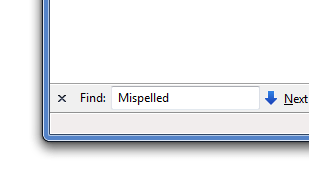
  • searchWeb browsers, like Firefox or Chrome, are no longer document viewers, but application platforms. I’d like to see browsers start to implement search and replace. Of course not modifying the page, just replacing the matching strings in forms.

    I’m really surprised it’s not implemented yet. In the last two weeks I needed this feature about 5 times. It’s time for search and replace in web browsers already.

    Reviewed by Daniel Magliola. Thank you!

  • This has been mentioned thousands of times on the interwebs, but in case there’s at least one person reading this that didn’t know it, I’m explaining it again. Using hyperlinks in a piece of text doesn’t mean it has to stop being proper, readable English (or any other language). For example, imagine the phrase:

    It was a nice movie, click here to read more about it.

    Read it again. Now close your eyes and imagine someone reading it out loud. It doesn’t make any sense, does it?

    Hyperlinks already carry the meaning that there’s more information behind them. No need to repeat it with “to read about it”. And they also carry the information about being clicked, so no need to say “click here”. And in some interfaces you don’t click, and I can think of already two cases:

    • People using the keyboard and only the keyboard to navigate. They are more than you think. I myself would be doing it much more if it wasn’t so hard on so many broken web sites.
    • People using a phone, like the iPhone. You don’t click, nothing clicks. It’s called tapping.

    For computers “click here” doesn’t provide any proper meta-data. There are services that extract a lot of information about links. Google being one example. Let’s analyze what would happen to Google if you do it correctly, like:

    It was a nice movie.

    That was short, wasn’t it? Half the size and no-nonsense, but I digress. Google would index that link as a “nice movie” and that’s good because you are adding information to the web, you are expressing your opinion and when people search for “nice movie” they are more likely to find the movie you pointed to. Maybe you are the only one believing that’s a nice movie, but when lots of people link to it as a “nice movie”, Google will catch that.

    Also, imagine that your page gets turned into plain text, or printed, or spoken, or whatever:

    • It was a nice movie, click here to read more about it.
    • It was a nice movie.

    Which one makes more sense?

    Now, we can take it a step further. Something else you can do to make your text more readable, more robust and nicer overall is to do more or less proper attribution. I’m not talking about academic proper attribution, I’m taking about simple things. I’ve recently found this sentence in the Stack Overflow article Advice for Computer Science College Students:

    I’ve read an article from Joelonsoftware.com a few years agohttp://www.joelonsoftware.com/articles/CollegeAdvice.html

    which I promptly edited, thanks to my karma earnings, to be:

    I’ve read the article Advice for Computer Science College Students from Joel on Software a few years ago.

    Aside from the proper period at the end of a sentence, do you see how and why my version is more readable, contains much more information (while being shorter on text on the screen) and can resist being turned into text, speech or braille? So, next time you write something, please, remember that even if you are using a computer, you are still writing a proper language.

    Sometimes the links are so important that you want them to get to a text or spoken version. In that case, imagine how you would write it if you were speaking or writing with a pen on paper:

    I really like Joel on Software, which you can read on http://joelonsoftware.com.

    which you can then later enhance for the web:

    I really like Joel on Software, which you can read on http://joelonsoftware.com.

    Now there’s extra information in there. The URL is there three times, one in text, two in hyperlinks. But the text is not longer and it’s not harder to read (unless you pick up hyperlink colors badly) and it gives the user more places to link, machines that look for context information more to pick up from. It’s a win-win.

    Reviewed by Daniel Magliola. Thank you!

  • “The car is not starting”, he said, “I have a theory, the tank must be empty.”. That’s not a theory! That’s a hypothesis.

    A hypothesis is the first part of a theory, it’s how a theory begins and it’s what we have when we think we have an explanation for something. When we go and confirm that explanation (check the tank is actually empty), proving the hypothesis, then, we have a theory.

    I’m tired of hearing the word theory when they mean hypothesis. In Start Trek they do it all the time. Captain Picard asks La Forge why the friking thing is not working and after thinking for 1.5 seconds, La Forge says: “I have a theory, maybe the…”. There are no maybes on a theory! That’s a hypothesis. I think I’ve heard the word hypothesis used correctly in Star Trek TNG twice. Somehow, my wife started to use it correctly. I’m surprised. I suppose she got tired of me shouting “that’s a hypothesis!” every time La Forge opens his mouth.

    I leave you with the official definition of hypothesis:

    an idea or explanation for something that is based on known facts but has not yet been proved:

    Several hypotheses for global warming have been suggested.

    And then we reach the conclusion that all that we talk about all the times are not theories or hypothesis, they are not formal; but somehow I’m OK with using those words informally. By the way, I’ve learned this on school. I can’t remember if it was in the last years of elementary school or on the first years of high school.

    This is the first of a probably infinite series of post about my pet-peeves. Muhahaha.

  • Let’s compare how we print the class-path in Clojure and how we do it on Java.

    In Clojure:

    [sourcecode lang=”clojure”]
    (println (seq (.getURLs (java.lang.ClassLoader/getSystemClassLoader))))
    [/sourcecode]

    In Java:

    [sourcecode lang=”clojure”]
    import java.net.URL;
    import java.net.URLClassLoader;

    public class PrintClasspath {
    public static void main(String[] args) {
    //Get the System Classloader
    ClassLoader sysClassLoader = ClassLoader.getSystemClassLoader();

    //Get the URLs
    URL[] urls = ((URLClassLoader)sysClassLoader).getURLs();

    for(int i=0; i< urls.length; i++)
    {
    System.out.println(urls[i].getFile());
    }
    }
    }
    [/sourcecode]

    To be fair, the output is not the same, but the effect is.